They left knowing the risks because the risks had already been named: fever, isolation, death. West Africa was not imagined. It was spoken about plainly, as a place where many did not survive long.
They went anyway.
The women who would become the Sisters of Our Lady of Apostles entered mission with their bodies first. They learned hunger and heat, illness and exhaustion. They learned how little protection faith offered against infection, and how necessary it was all the same. Some barely lived long enough to see the work take shape. Others buried companions before their own bodies had adjusted to the climate.
What sustained them was their calling to mission. Their commitment to remain. It held them in place as they taught, tended, wrote letters, nursed, and sat with women whose lives were already constrained.
The congregation emerged because mission could not continue without women willing to share the cost of it.
Congregation
Fr Augustine Planque, Superior General of the Society of African Missions, understood this early. For more than a decade he appealed to established congregations to send sisters into conditions already known for disease and high mortality. Each request was refused. Eventually he collaborated with the Franciscan Sisters from Couzon, France, who staffed the first schools and dispensaries in Porto-Novo and Lagos beginning in 1868.
The sisters established schools, tended the sick, and learned what it meant to live in West Africa. But the losses were severe, and eventually the Franciscan community could no longer sustain them.
In Rome, he was told plainly: You want Sisters… well then, make them.
When the OLA congregation was formally established on May 1, 1876 in Lyon, the Franciscan Sisters already serving in West Africa were given a choice. Six of the ten sisters in Dahomey and Lagos chose to stay. Srs Claire, Marie-Joseph, Marie-Veronique, Colette, Veronique, and Agathe became the nucleus of the new OLA congregation.
Lessons took place where space could be found. Care depended on whatever was at hand. The work continued only because it was taken up again each morning”
Those already living in Porto-Novo and Lagos had stayed long enough to know what life in West Africa demanded of the body. The OLA congregation drew its life from that reality and was placed under the protection of Mary, Queen of Apostles, with the words Cum Maria Matre Jesu set at its heart.
Formation followed the same logic. The sisters slept on straw mattresses, lived in bare rooms, and supported themselves by sewing for local linen shops. Poverty, rather than virtue, was preparation. Their bodies were trained to endure long days, poor food, and uncertainty.
From the beginning, the work was slow, measured, deliberate. The sisters taught, treated wounds, kept records, carried messages. They worked among women and girls whose days were narrowed by labour and expectation. Lessons took place where space could be found. Care depended on whatever was at hand. The work continued only because it was taken up again each morning.
Ireland
Irish women were part of the congregation from its inception. By 1877, when the first OLA sisters came to Ireland at the invitation of the SMA, Sr Dominique had already planted the “mustard seed” of the OLA Mission in Nigeria, joined a year later by Sr Felicite Kirwan.
In Ireland the OLA sisters were housed on Blackrock Road, Cork, within the SMA seminary. Their days were spent in the kitchens and laundries. Even the local bishop was initially unaware of their presence. Irish women who wished to enter still travelled to Lyon for formation until 1890, when a novitiate opened within the seminary itself. Ireland became a place of preparation and continuity; sisters moved outward and returned again.
Twenty years later the congregation purchased Ardfoyle. It became the centre of the Irish District, formally decreed as a Province in 1933. Under Mother Patricia Loughnane’s leadership, young women prepared for the same work their predecessors had begun. They trained as nurses, midwives, teachers and learned tropical medicine. The formation was practical because their survival depended on it.
Irish sisters left for West Africa in large numbers. Some stayed for decades. Others barely survived their first year. Each loss was felt. The work continued.
They taught catechism under trees, treated wounds in makeshift clinics, walked hours to reach scattered communities”
In 1991, the OLAs moved into East Africa when Srs Mairead Hickey and Deanna Donohue opened a dispensary in Mwamapalala, Tanzania. The conditions were familiar: remote locations, scarce resources, communities needing care that wasn’t available anywhere else. The sisters stayed. Tanzania was officially named a Region under the Irish Province in 2015.
By the late twentieth century, independence across many African nations brought government takeovers. Schools and hospitals the sisters had built passed into state hands. The buildings remained. The sisters moved on.
Many went to remote areas where Church presence was sparse or non-existent. They lived in villages without electricity or running water. They taught catechism under trees, treated wounds in makeshift clinics, walked hours to reach scattered communities.
students at Ho secondary school, Ghana c1970
Change
It was within this context that Nigeria became a Province in 1990, Ghana followed in 1996. The women making decisions now were Nigerian, Ghanaian, and Beninese. They had grown up speaking the languages, living the customs. They knew what worked and what didn’t, they understood their people intimately. They had learned from the inside.
Sisters still teach, but now they also lobby against human trafficking. They still care for the sick, but they also advocate for refugees. They sustain relationships across religious difference, where belief systems define community and separation.
In 2024, structural changes named what the congregation was already living. Ireland and Tanzania became Districts. In Balbriggan, a community established in 2021, brought sisters from Africa and Ireland into shared life and ministry, serving the multicultural needs of contemporary Irish society.
Mission now moves in more than one direction.
OLA sisters had long worked at the edges of institutional Church structures. They built schools where others would not go. They remained in communities that could not sustain clergy. They stood with women and children in settings where formal authority carried little weight. That experience is now being acknowledged at the highest levels.
Sr Mary Barron, an Irish OLA with years of experience in Nigeria and Tanzania, currently serves as Congregational Leader. Her election in 2023 as President of the International Union of Superiors General placed that lived experience at the heart of global Church conversation. She participated prominently in the Synod on Synodality. In 2024, Pope Francis appointed her to the Dicastery for Evangelisation. In January 2026, Pope Leo XIV named her as Consultor to the Dicastery for Interreligious Dialogue.
These appointments are significant, but they also trace decades of work by Irish OLA sisters that has gone largely unnoticed in Ireland.
One hundred and fifty years on, the Sisters of Our Lady of Apostles remain committed”
In May 2025, members of the OLA and SMA family gathered in Ouidah, Benin, to launch the 150th Jubilee year. They gathered at the place where missionaries first came ashore, a site marked by a monument recording those arrivals. Five names are inscribed there: Fathers Borghero and Fernandez, who arrived in 1861, and the first OLA sisters to arrive in 1877 — Srs Monique, Cypren, and Dominique O’Riordan.
One hundred and fifty years on, the Sisters of Our Lady of Apostles remain committed to mission taken up again each day and sustained through presence and proximity. The work looks different from what their predecessors began in 1876. Language and structures have changed. The sisters come from different countries, speak different languages, and carry different histories.
What has not changed is the willingness to remain.
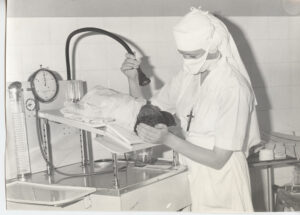
ward at Oke Offa Hospital c1964