A Place Where Ireland is Invisible,
by James Harpur, woodcuts by Paul Ó Colmáin
(The Eblana Press, €35.00 postage included, Ireland / €45.00 post included, worldwide)
The allusion in the title is to the banishment of Columcille to Scotland: he had to go to a place from which the coast of his beloved Ireland could not be seen, which was the island of Iona.
Ireland is invisible in a different sense in this new collection of poems, focussed on the lives of early Irish saints, from much admired poet James Harpur. Invisible because he evokes a very different Ireland to the everyday country of today through the lives of some fifteen saints from Patrick himself to Fintan of Clonenagh.
He remarks that “to immerse oneself in the stories associated with the Irish saints is to enter a sphere in which truth is conveyed by imagination, not fact; by poetic thinking, not prose; and in our age of scientific materialism we need to be reminded of the old stories more than ever…”
Sources
He notes too that “the poems in this book, mostly sonnets, are based on scholarly sources and try to capture something of the wonder of a partly mythic, but wholly spiritual world.”
It is this original Irish feeling for the mystical that fills Harpur’s poems. This book, like others in his output over the years, combines both a feeling for landscape with a sense of the mystical and the strange. These are elements with which the early Irish lives of the saints are filled.
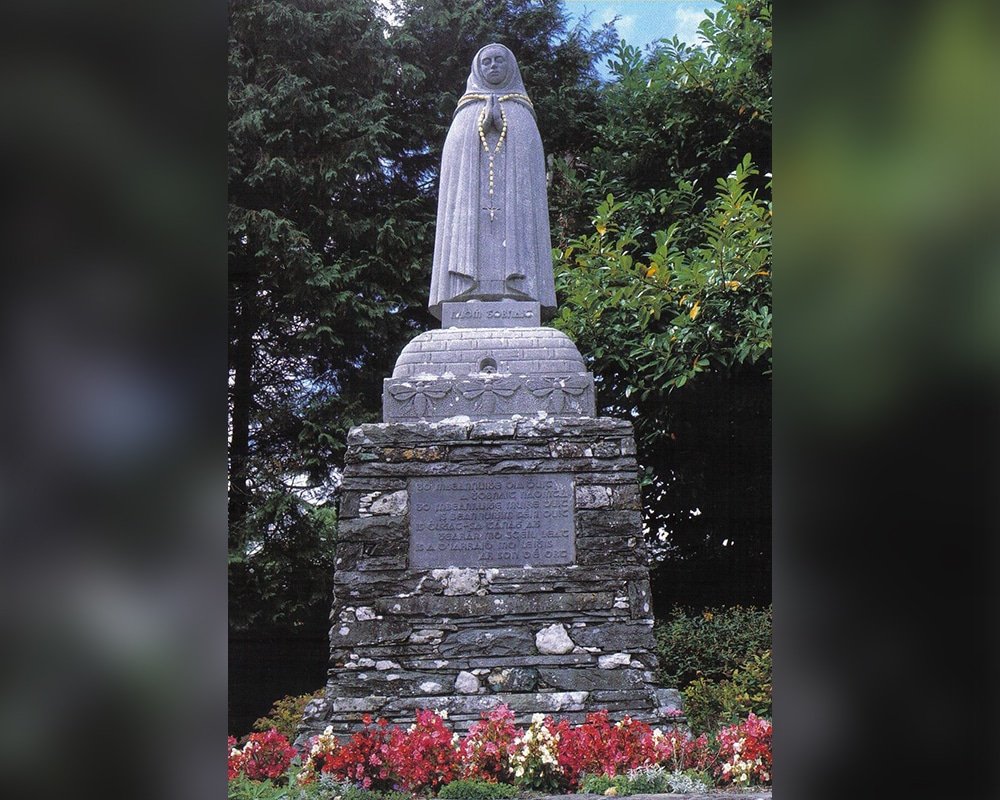
To give a flavour of the poems here is one of a place many will know, for several reasons, Ballyvourney in Co. Cork.
Gobnait’s End
Nine pure white deer would mark my bed of earth,
The angel said, my rising into glory
But not on Inishmore.
Appalled by death –
The closing vision of these spectral deer –
I left to flee the ending of my story,
Those bloodless creatures sucking on my fear.
I tried to slip my fate in woods, strange valleys,
I chanted, prayed to slow my heart,
but still I heard the pulsing of mortality.
Until that snowing day near Ballyvourney.
I almost missed them standing by the hill.
White against white
nine curls of breath.
The journey
Was at an end: I kneeled, shook off the fright,
Then rose up in the glow of falling light.
The art paper is used to evoke in its turn the overlapping nature of the Irish landscape”
But here, too, are evocations of other familiar moment’s incidents of early Christian days in Ireland: St Kevin and the blackbirds, Finbar and the serpent of Gougane Bara, St Brendan at sea, and the Vision of Furze … poems that epitomise a whole tradition of amazed devotion.
The book is illustrated with decorations by Paul Ó Colmáin, whose rugged vigour echoes in some ways the time worn stylised carvings on the high crosses of early Christian Ireland. They contrast certainly with the illustrations in O’Hanlon, who was also deeply engaged with local history and folklore, which are more akin to those in say the contemporary Illustrated London News.
Here, however, the surface of the art paper is used to evoke in its turn the overlapping nature of the Irish landscape of stone and water, fear and hope.
But here, too, as James Harpur’s epigraph from the proverbs of Erasmus suggests, in these places, “Called on, or uncalled on, God is always present”.