Pre-Famine fever epidemics: A case study of the Cork Street Fever Hospital, Dublin,
by Ciarán McCabe
(Maynooth Studies in Local History / Four Courts Press, €12.95 / £10.99)
Molly Malone is a much-disputed Dublin character. Though she may well have been a songwriter’s invention, her death from a “fever” was one which certainly carried away many thousands of Dubliners in the old medieval town that was slowly enlarging over three or four centuries into the modern city, and which was for many a wretched place to live.
Be that as it may, she was a symbol of the dangers to health of Dubliners from “fever” – a cover word for at least three infections, such as typhus, typhoid and cholera.
Epidemics
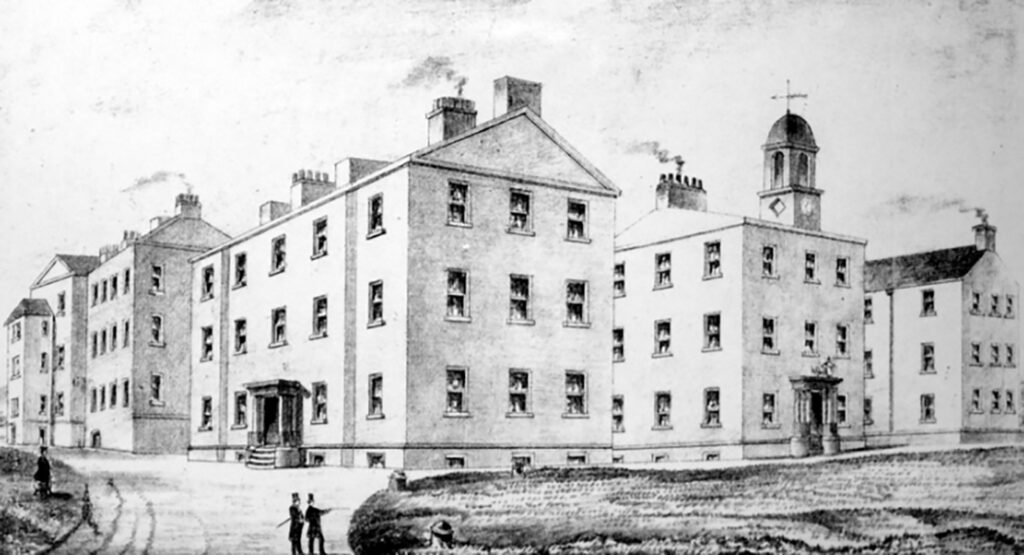
Author Ciarán McCabe is a young historian specialising in social and cultural history. This little book – one of the latest additions to the Maynooth Studies in Local History – deals in detail with how the large fever hospital in Cork Street coped with the complications of two large “fever epidemics”, one in 1817-19 and a second 1826-7. His research for an MA degree was based on the serving records of the hospital, then kept at Cherry Orchard Hospital (a place associated in the memories of many with the TB scourge of the mid 20th century – now thankfully a thing of the past).
These were inspired by a religious sense of charity that originated in Europe rather than in Ireland”
Inevitably, what he says relates to only one institution, though he makes a case for the existence of a “fever hospital movement” involving as well several hospitals in Britain, from which
much was learned by the Dublin institution.
Readers of this paper will probably be most familiar with the Catholic voluntary hospitals of a slightly later period: St Vincent’s founded in 1834, and the Mater, an altogether more impressive place, initiated in 1852, which opened in 1861. These were inspired by a religious sense of charity that originated in Europe rather than in Ireland.
Problems
The Cork Street Fever hospital in contrast was found by wealthy Dublin philanthropists, seeking to alleviate the sufferings of the poor in the city’s slums – and also, he suggests, to prevent the spread of the “fever” into their own homes, in say, Mountjoy and Merrion Squares.
The author however eschews any discussion of the religious and philosophical outlook of the hospital founders, which perhaps does not give a true feeling for the spirited controversies of the time over the feckless undeserving poor of the city.
But by focusing on the difficulties faced by the administrators, he has little room for a more focused treatment of the real problems at the heart of the matter: that hospitals in the 1820s were incapable of dealing with public health issues through the undeveloped nature of medical science and the appalling social problems of the city, well identified two centuries before by Swift (himself in death a hospital benefactor). Indeed. It was only with the introduction of penicillin and other antibiotics in the 1940s that gave modern
medicine the weapons to truly
conquer contagions.
However, in Cork Street, merely getting people out of their squalid, crowded homes which depended on water supplies fouled by the almost total lack for proper waste disposal, affected many seeming cures. But perhaps many patients returned home merely to die a few years later of the same “fevers”.
For those with an overwhelming admiration of the civilisation of Georgian Ireland, the matters disclosed by McCabe’s researches illustrate the fact that there was comfort for the rich, little for the poor, and money for the renter class – which in later days often included many by now wealthy Catholics.