From Crown to Harp: How the Anglo-Irish Treaty was Undone, 1921 – 1949,
by David McCullagh
(Gill Books, €26.99 / £25.99)
This is an account of the three decades in Ireland which followed the War of Independence. Those years featured a number of remarkable Irish persons. Not least among them was Alfred O’Rahilly, an academic at University College, Cork. I have made a particular study myself of Prof. O’Rahilly’s public career at this period. Surprisingly, his important contribution to national life is not even mentioned in this study.
O’Rahilly was regarded by the British government as the most effective and important Sinn Féin propagandist before and during the War of Independence. Thus, he was interned at Bere Island off the south west coast at the end of April 1921.
Earlier, he had been given to understand by President de Valera that he would be appointed the principal secretary to the delegation travelling to London to negotiate a treaty. However, this was not feasible, as he was among the last group of Sinn Féiners released by the British. But on release, he hurried to London, where he assisted Erskine Childers, the principal secretary.
The Articles of Agreement for a Treaty was signed on December 5-6, 1921. From the outset O’Rahilly favoured acceptance of the treaty. Requested to write an article on the treaty by the editor of the Irish Independent, he readily agreed to do so.
He was alarmed by de Valera’s proclamation, effectively objecting to the terms. Such a stand he regarded as indefensibly irresponsible. He was convinced that the British government would not renegotiate the treaty and considered that a return to arms by a hopelessly divided Sinn Féin / IRA movement would be but a futile and disastrous gesture which would almost certainly lead to well-nigh total anarchy.
O’Rahilly became alarmed that the treaty might not be approved by a majority in Dáil Éireann. Despite receiving death threats from the Anti-Treaty IRA, who controlled Cork City, he published a twenty-three-page pamphlet entitled The Case for the Treaty at the end of December 1921. It was extensively used by Pro-Treaty apologists, many of whom stressed the ‘stepping-stone’ potential of the treaty, which he highlighted.
O’Rahilly received a formal invitation from Michael Collins, chairman of the Provisional Government, to join the committee charged with producing a constitution for the Irish Free State. The committee produced three drafts. Three members produced Version A, another three Version B and O’Rahilly produced Version C.
The Provisional Government selected a revised Version B. By a curious irony, however, fifteen years later, the 1922 constitution was superseded, and the subsequent constitutional history of the country was influenced significantly by O’Rahilly’s draft constitution.
The Civil War began on June 28,1922, when the Irish Free State forces shelled the Anti-Treatyites who had occupied the Four Courts in Dublin. As the fighting became more vicious, O’Rahilly made several attempts to broker a truce between the opposing sides.
He held consultations with the Anti-Treaty IRA in Cork city and county and with Mary MacSwiney, TD, generally regarded as the leader on the Anti-Treaty side in Cork. On July 28, 1922, he travelled to the military barracks in Fermoy to meet Liam Lynch, the leader of the Anti-Treaty IRA, in an unsuccessful attempt to persuade him to become involved in the efforts to establish a truce. As a Cumann Na nGaedheal, TD, for Cork City, he voted for the Treaty in Dáil Éireann and supported the new Irish Free State government.
Delegate
Subsequently, as David McCullagh records, members of the first Irish Free State Governments, by their attendance at conferences of the British Dominions and skilful participation in their debates, successfully developed the constitutional independence of the Irish Free State in a number of ways.
While applauding this, O’Rahilly was also active in that regard. He was appointed the government delegate to the International Labour Conferences of 1924, 1925 and 1932.
From the time of his arrival in Geneva he became aware of the use which could be made of the Irish Free State’s membership of the League of Nations and its participation in the work of the International Labour Organisation (I.L.O.) to advance the Irish Free State’s international status and independence from Britain and he availed of every opportunity to achieve this. In this vein he personally delivered the Treaty to the League of Nations on July 11, 1924.
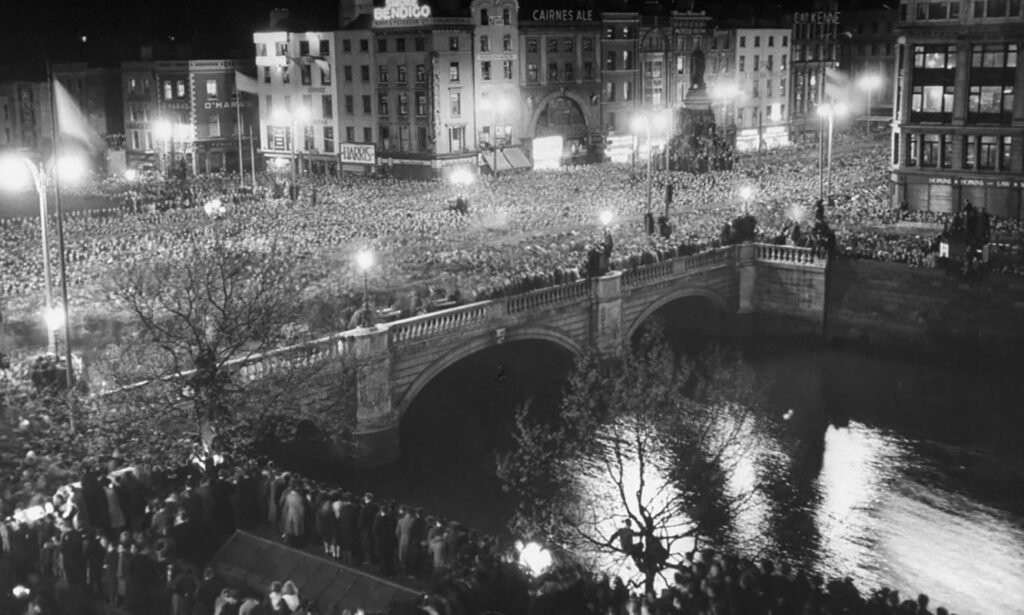
The peaceful developments, orchestrated by a series of governments from various parties and some remarkable persons, not least O’Rahilly, ensured that Ireland eventually became a Republic, formally exiting the British Commonwealth in 1949.