Leo XIV: An Augustinian Life in Context,
by Brian Heffernan
(Messenger Publications, €12.95 / £10.95)
This book is the second short biography of the new Pope to arrive in the last three months. Others are doubtless on the way. And we can be sure that those 500-page volumes so typical of American journalism today will begin to appear in the autumn.
However, this book, from a familiar Irish publisher, is far better than the recent, more publicised one from a British press.
Originally written in Dutch, it has been quickly translated and is well worth reading. The particular value of Brian Heffernan’s book is its deep familiarity with the Augustinian Order and with the particular charism that motivates Pope Leo XIV.
The election of Robert Prevost took many by surprise, but author Heffernan, a good while before there was any possibility of a conclave, had already identified Prevost as “a person of interest” and had begun to assemble a large file on him from whatever sources he could find, in Europe and North America.
Prevost
This foresight now stands him well to the good, for his book, aside from its special insights into the religious order that the Pope belongs to, means that he had ready to hand a great deal of information about the background and earlier life of the new pope. This is the most interesting publication about Pope Leo so far, and it will, for a good while to come, be hard to beat as a concise account of his development as man and priest.
Across some six chapters Heffernan follows the course of Prevost’s life and the development of his particular spirituality, emphasising in turn the Chicago background of his birth – his family had already connected with the Augustinians, his long years as a missionary in Peru and all the difficulties that entailed, in the era of liberation theology, emerging finally as a leading figure in the order. But this was later followed by a return to Peru as a bishop, from where he was removed by the Pope to a position in Rome as a Cardinal, concluding with his eventual elevation to the Papacy. In the course of this, he does not avoid some contentious moments, such as seem these days to affect the presentation of every important figure. His experience in the Vatican as a Cardinal will have greatly expanded his view of affairs.
This is all recounted in a concise but well-resourced manner, and will prove very enlightening, I think, for general readers who have little time to devote to magazines and journals.
There is also a need for prophecy, of bearing witness in the ancient Old Testament mode, in so many passages of the gospels”
On the general tendency of Pope Leo’s mentality, Heffernan notes what he sees as Pope Leo’s general position, as a conciliator, anxious to maintain the church as “a big tent”. The author does not shy away from controversial matters, in relation to his time in his Peruvian diocese of Chiclayo or in Rome, such as local matters of abuse.
But he notes, too, that one cannot be both a conciliator and a prophet. There is always a need for conciliation, especially in these increasingly divided times, both universally and among Catholics and Christians as a whole. But there is also a need for prophecy, of bearing witness in the ancient Old Testament mode, in so many passages of the gospels. How will Pope Leo balance these two roles?
The overall impression is of a man who owes less to his American experience than many in the United States would like to think. (There is an interesting allusion here to the Creole element in his ancestry, of that element of Black culture which so many North Americans have, but often deny in favour of a “white” identity; see page 9.)
Conciliator
But in the end, we are left with thoughts about what is not discussed in a global sense.
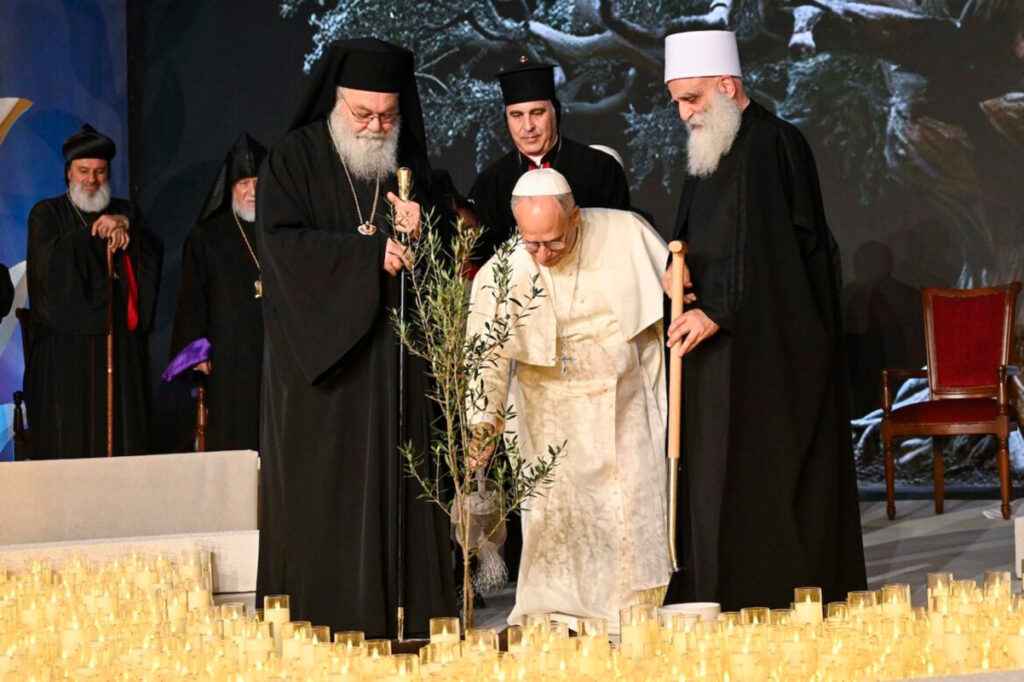
Pope Leo is represented as a man with little contact or experience of the Middle East, with Africa, or with greater Asia. Though Pope Leo has indeed shown his solidarity with the besieged Christians of the Middle East by his recent visit to the Lebanon, the stresses that Christians face in parts of Africa, not only against violence from some Muslim quarters, but also from the penetration of evangelical and other Christian movements such as the Seventh Day Adventists to the Latter Day Saints and local personal ministries, sects with a significant appeal to many in search of a jubilant religious way, suggests a context which Pope Leo may find challenging.
Then there is the long continuing problem of the Catholic presence in China, where the underground Catholic Church has to find its way beside the state-authorised Patriotic Catholic Church. This, in one of the world’s most populous nations, is a severe challenge.
Excellent as this book is in its delineation of the Augustinian nature of the new papacy, readers will look for a more detailed examination of the wider global problems in those books due in the autumn, which will have to look towards the Pope’s position in an unsettled post-Trumpian world – which is quickly advancing towards us, whether the President likes it or not. In that era, the calm, conciliatory nature of Pope Leo will be an invaluable reassurance to all peoples.