Author Diarmuid Johnson reflects on how the legacy of Ireland’s ancient monks continues to shape modern Europe, despite being forgotten at home
“Much of the knowledge the old people once had about the local saints, the holy wells, the pilgrimages and the feast days was lost – and another version of faith has come to dominate since the time of the Famine.”
Author, academic and all-round polymath Diarmuid Johnson reflects on how much of the heritage associated with early Christian Ireland has declined over the centuries.
Originally from Wales, but of Irish extraction, the former lecturer in Celtic studies is fluent in seven languages and has published several novels inspired by ancient Irish history.
Mr Johnson’s book Ceallach – based on the voyages of the 6th century Irish monk St Gall – has recently been translated into German and he is looking forward to being joined by the Swiss ambassador for the book’s launch in the University of Limerick on November 13.
Legacy
However, Mr Johnson is keenly aware that the legacy of the early Irish monks often receives more recognition in mainland Europe than in Ireland, where it is frequently banished to the realms of academia.
“In German-speaking countries, it is a living tradition – part of their own story and part of their folklore”, he says.
“In Ireland, we are blind to many aspects of history – particularly the history relating to many aspects of Christianity.”
“The culture that exists in Ireland now, of course, is not what it once was. There was a language shift in the 19th Century, and when English replaced Irish, much folklore was lost – particularly in relation to placenames and storytelling.”
“It wasn’t my intention to correct that through the writing of the book, but that was the result – that people now have a chance to learn about a hidden aspect of their history.”
Indeed, in Ireland, we often remain unaware of our local saints, with some exceptions such as Patrick, Bridget or Colm Cille.
But many of those local saints – whose names remain associated with the placenames of Ireland – have also etched their names into placenames further afield.”
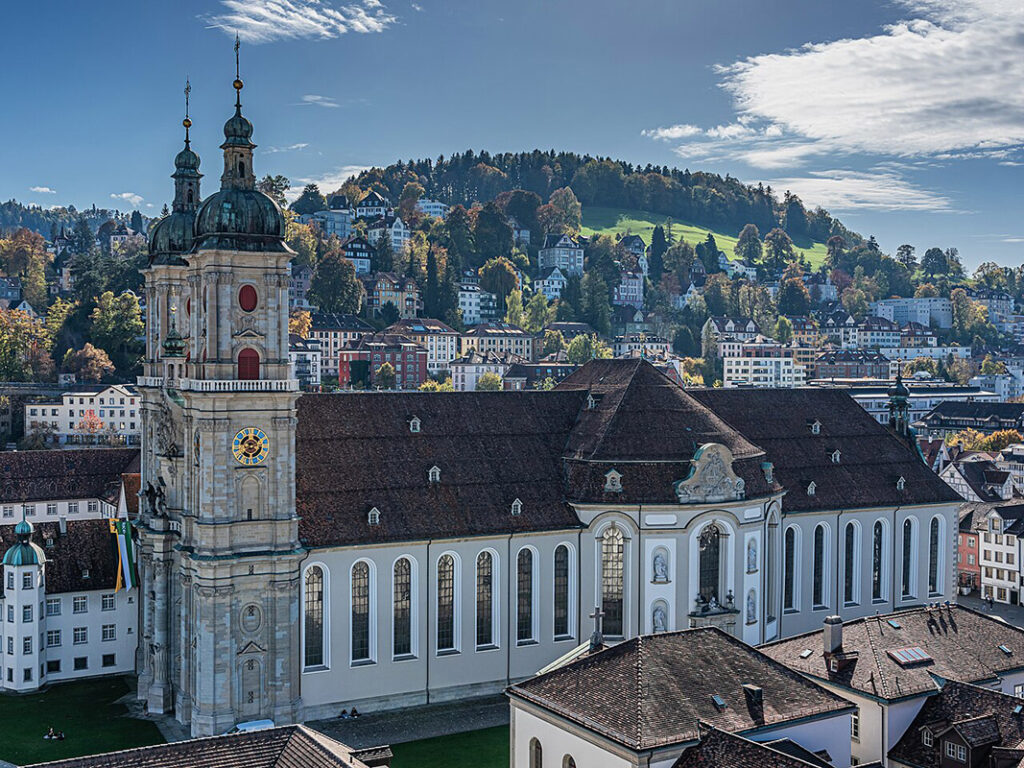
The Swiss city of St Gallen is named in honour of the Irish monk that Mr Johnson wrote about, where the Abbey of St Gall – which is now recognised as a UNESCO World Heritage Site – continues to stand.
In fact, Mr Johnson was inspired to write his novel Ceallach after coming across a schoolbook in German that noted the epic voyages made by Irish monks to mainland Europe.
The voyages of early Irish monks such as St Gall and St Columbanus to the continent continue to have enduring relevance to modern Europe”
“I found a book of maps, an atlas, in German. It described a journey made by a group of monks from Ireland around the year 590, from Bangor, Co. Down, all the way to the continent – and then on foot across France and down toward Lake Constance”, he says.
“I was amazed by that map, which was inspired by Germanic culture, and then I began to investigate the story.”
Indeed, Mr Johnson is eager to stress that the voyages of early Irish monks such as St Gall and St Columbanus to the continent continue to have enduring relevance to modern Europe.
He cites the former French foreign minister Robert Schuman – who was instrumental in establishing institutions such as the Council of Europe and the EU’s predecessor organisation the European Communities – as a major figure who was deeply inspired by these Irish monks.
“The route that St Columbanus, St Gall, and some of their companions took led them eastwards along the River Moselle toward Lorraine”, Mr Johnson says.
“That’s the area where Schuman was raised, and he took great interest in the teachings and life of Columbanus.”
“What they shared was the Christian faith – the fundamental thing that has often been cited as the culture of Europe over the centuries.”
“When the founding of the [European] Union was being planned, it happened that a book was published in French; The Life of Columbanus and Schuman would have read that book in the early 50s.”
“Schuman was a devout Catholic. What he wanted to do at that time was to establish peace throughout Europe on an economic basis, with Christianity as the bond between people.”
However, Mr Johnson believes it is important to not simply view these early Irish monks as mere relics of ancient history.
Reflect
He stresses that they were real human beings who were skilled boatsmen and farmers, who often demonstrated extraordinary bravery to complete their mission of spreading the Gospels to mainland Europe.
“They were devout, but they were also young men of great courage and skill”, Johnson says.
“They crossed the sea without any map, perhaps guided by the stars, in a small boat facing rough weather.”
“And they were farmers. They could make a living from the land – even land in desolate areas that was infertile.”
The academic also believes that by reading about these monks, we can learn not just about the differences in how Christianity was practised centuries ago – but can also reflect on how we practice the faith today.
There were no standardised calendars – the only thing they had really was a strong faith in the Creator and the Saviour”
“Of course, Christianity at that time was something quite new. The Church was only coming into its own that time as an institution.”
“Then, there wasn’t really a book of rules either. There were no standardised calendars – the only thing they had really was a strong faith in the Creator and the Saviour.”
In Mr Johnson’s view, the most important aspect of the faith practised by St Gall, St Columbanus and their contemporaries is the inherent importance placed on what the German theologian Rudolf Otto described as the “mysterium tremendum” – or “tremendous mystery”.
“There was a greater emphasis on creation and the wonders of the universe – there was an understanding that there was a nobility, and a beauty in all that God had created. That was an intrinsic part of the outlook that was widespread at the time”, Mr Johnson says.
“In our day, we often have a rather different outlook.”