Today the Three Kings are an essential part of the story of Christmas time as we tell to ourselves and our children. They have a part as the first givers of Yuletide gifts. They appear in parish and school plays and presentations across Christendom, and even at times in countries not usually thought of as Christian, like those of the Far East.
They came from a far off country in the East themselves, but their legendary journey through history has been a long and complicated one.
Indeed, they were not originally Kings at all, as the author of the Gospel of Matthew relates; he being the only one of the evangelists to tell their story, bound up as it is with the brutality of King Herod, the original model of the powerful Middle-Eastern tyrant. The passage is in Matthew II: 1-12:
When Jesus therefore was born in Bethlehem of Juda, in the days of king Herod, behold, there came wise men from the East to Jerusalem, Saying: Where is he that is born king of the Jews? For we have seen his star in the East, and are come to adore him.
And king Herod hearing this, was troubled, and all Jerusalem with him.
And assembling together all the chief priests and the scribes of the people, he inquired of them where Christ should be born. But they said to him: In Bethlehem of Juda. For so it is written by the prophet:
And thou Bethlehem the land of Juda art not the least among the princes of Juda: for out of thee shall come forth the captain that shall rule my people Israel.
Then Herod, privately calling the wise men learned diligently of them the time of the star which appeared to them; And sending them into Bethlehem, said: Go and diligently inquire after the child, and when you have found him, bring me word again, that I also may come and adore him.
Who having heard the king, went their way; and behold the star which they had seen in the East, went before them, until it came and stood over where the child was. And seeing the star they rejoiced with exceeding great joy. And entering into the house, they found the child with Mary his mother, and falling down they adored him: and opening their treasures, they offered him gifts; gold, frankincense, and myrrh.
And having received an answer in sleep that they should not return to Herod, they went back another way into their country.”
Today, what are said traditionally to be their mortal remains are enshrined in the great medieval cathedral in Cologne in the heart of Europe”
That is all we know from the gospels about these mysterious visitors; but in time Christian traditions filled out their identity in remarkable ways. Today, what are said traditionally to be their mortal remains are enshrined in the great medieval cathedral in Cologne in the heart of Europe. In recent translations of the scriptures they are often called “astrologers” which is misleading; they would in fact have been natural philosophers by a later century, as proto-scientists, seeking through a knowledge of the stars to understand the world.
Marco Polo
The medieval view of them is related in the travels of Marco Polo, the Venetian traveller who with his father and uncle had set off on a journey to the farthest reaches of Asia in 1271. In the eleventh chapter of his book he describes the province of Persia, and refers to the local legends about the Magi.
In Persia there is a city which is called Saba, from whence were the three magi who came to adore Christ in Bethlehem; and the three are buried in that city in a fair sepulchre, and they are all three entire with their beards and hair. One was called Baldasar, the second Gaspar, and the third Melchior.
Marco inquired often in that city concerning the three magi, and nobody could tell him anything about them, except that the three magi were buried there in ancient times.
After three days’ journey you come to a castle which is called Palasata, which means the castle of the fire-worshippers; and it is true that the inhabitants of that castle worship fire, and this is given as the reason.
Three kings
The men of that castle say, that anciently three kings of that country went to adore a certain king who was newly born, and carried with them three offerings, namely, gold, frankincense, and myrrh: gold, that they might know if he were an earthly king; frankincense, that they might know if he were God; and myrrh, that they might know if he were a mortal man.
When these magi were presented to Christ, the youngest of the three adored him first, and it appeared to him that Christ was of his stature and age. The middle one came next, and then the eldest, and to each he seemed to be of their own stature and age.
Having compared their observations together, they agreed to go all to worship at once, and then he appeared to them all of his true age.
When they went away, the infant gave them a closed box, which they carried with them for several days, and then becoming curious to see what he had given them, they opened the box and found in it a stone, which was intended for a sign that they should remain as firm as a stone in the faith they had received from him.
When, however, they saw the stone, they marvelled, and thinking themselves deluded, they threw the stone into a certain pit, and instantly fire burst forth in the pit. When they saw this, they repented bitterly of what they had done, and taking some of the fire with them they carried it home.
And having placed it in one of their churches, they keep it continually burning, and adore that fire as a god, and make all their sacrifices with it; and if it happen to be extinguished, they go for more to the original fire in the pit where they threw the stone, which is never extinguished, and they take of none other fire. And therefore the people of that country worship fire.
Marco was told all this by the people of the country; and it is true that one of those kings was of Saba, and the second was of Dyava, and the third was of the castle. (Quoted from the Yule / Cordier text of Marco Polo.)
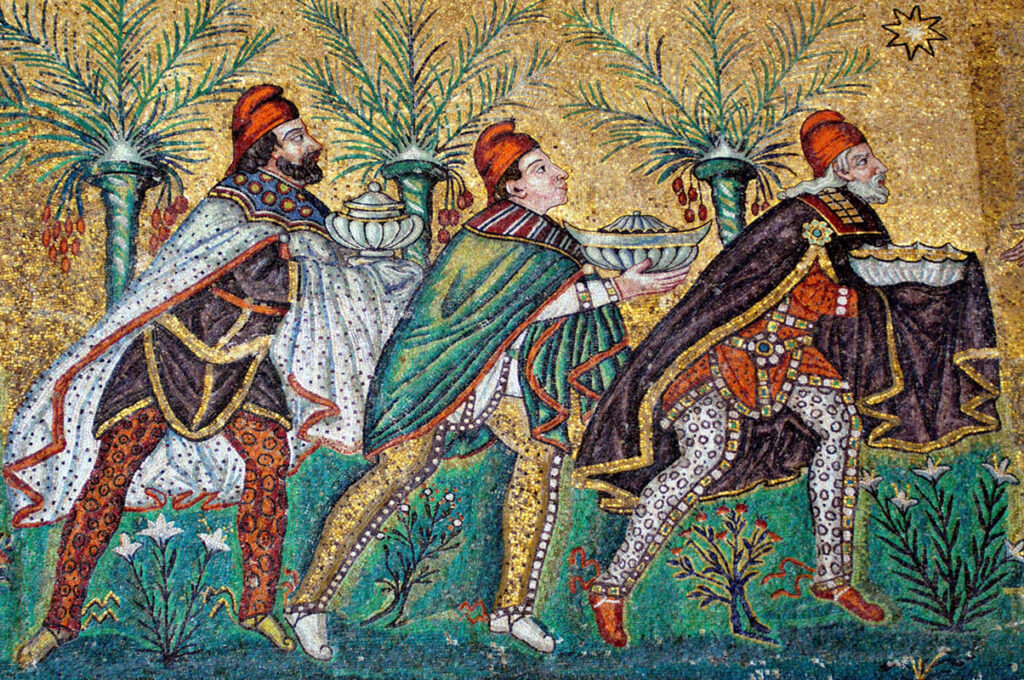
The three kings came to represent Asia, Africa and Europe paying homage to the birth of the Saviour, imaging the wise men as white, brown and black”
Here, Marco Polo (or perhaps his amanuensis, the romance writer Rusticello) confused the record by associating the three visitors with the Parsis or Zoroastrians, who still pay their devotions to the mystical purity of fire.)
Christian tradition took another direction. In the Vulgate Psalm 68:32-, it was noted that “Venient legati ex Aegypto; Aethiopia praeveniet manus ejus Deo. Regna terrae, cantate Deo… “; that is to say: “Ambassadors shall come out of Egypt: Ethiopia shall soon stretch out her hands to God. Sing to God, ye kingdoms of the earth…”
This provided tradition with the idea of royal ambassadors, easily turned into rulers of the kingdoms of the earth. The reference to Ethiopia (then a general term for what we would call Africa today) allowed one of these legates to be presented as Black, though the Ethiopians are not actually Bantu, but Hamitic. But in tradition the three kings came to represent Asia, Africa and Europe paying homage to the birth of the Saviour, imaging the wise men as white, brown and black.
Bede, the Anglo-Saxon historian in his history of the Church, written about 731, records the notion that Melchior was a white-haired old man, Balthasar was a man in his prime, with a full beard, and Gaspar was a beardless youth.
And again from scripture: “The kings of Thesis and the islands shall offer presents: the kings of the Arabians and of Saab shall bring gifts…” Reges Tharsis et insulæ munera offerent; reges Arabum et Saba dona adducent… Saba is the Kingdom of Sheba, in southern Arabia, in legend connected with King Solomon.
And again, in Isaiah 60:6: The multitude of camels shall cover thee, the dromedaries of Midian and Ephah; all they from Sheba shall come: they shall bring gold and incense; and they shall shew forth the praises of the Lord.
Persia
Though Marco Polo reports that they three were buried in Persia, this was not the only tradition current in the Middle Ages. Another was that they were interred in the Hadhramaut in southern Arabia (now part of Yemen). As Yemen was the main source of both Frankincense and myrrh, which the three brought as gifts, this notion is understandable.
They were said to have been slain in Arabia by another tradition in A.D. 70, by another legend. Later in the 4th century, bones were recovered for the Empress Helena and carried north to Constantinople, her son’s great new city on the Bosphorus in Asia Minor, where they were enshrined.
Later still, they were brought to Milan in northern Italy at the early part of the reign of the Emperor Manuel Comnenus (1143-1180). There they were enshrined in the Church of Sant’ Eustorgio.
When the Emperor Frederick Barbarossa captured and destroyed Milan in 1162, he presented the relics of the Three Kings to Bishop Rainald of Dassell (1159-67), who brought them to Cologne on July 23, 1164. That was where they were when Marco Polo was hearing about them in Persia a century later; and there they remain to this day, in the city’s great cathedral.
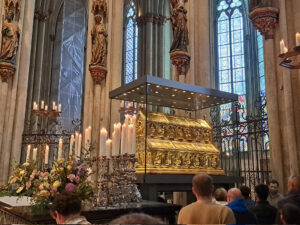
They are now contained in a golden shrine made about the turn of the 12th century by Nicolas of Verdun, a celebrated metal worker of the day: this creation is one of the most astonishing examples of medieval metal work in existence; truly a thing worth travelling to see.
***
The story of the Magi as related by Christian tradition has always had a great appeal to young and old, rich and poor, a legend that delights families celebrating Christmas.
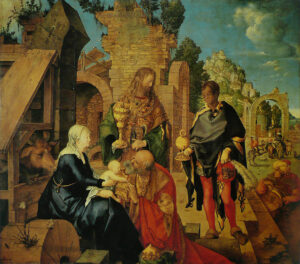
In the painting note the ruins in the background: these were an integral part of the iconography, for they represent the breakdown of the old dispensation”
As a theme in art, it has also attracted artists from the earliest times, but especially in the Renaissance and since, as it gives them so many factors to illustrate. The theme has appealed to most Christian traditions, except for those of the Puritan tendency that opposes the celebration of Christmas (as in England under the Cromwellian Republic).
There are many images to select from, but perhaps Durer’s Adoration of the Magi from 1404, which hung in the great church at Wittenberg to the door of which Martin Luther, tacked his 95 theses, thirteen years later, an event seen as the effective begging of the Reformation.
But in the painting note the ruins in the background: these were an integral part of the iconography, for they represent the breakdown of the old dispensation, whether Jewish or Pagan, at the moment of the arrival of the birth of a new dispensation, with the promulgation, not of ancient myths, but of the “Good News” of the Gospel of Saviour’s coming.
The Reformation was another moment of cultural change, as indeed is our period in history. But for Chrstians, despite the challenges of the past, the message has remained good.
Fragile
When Christians today feel they may be living through another moment of despair, they should take heart, for something new is in the making, the meaning of which will prevails despite the doubts of many, especially those clinging to fragile relics of the past.
For us “the gifts of the Magi” so to speak remain to be unpacked and to be presented in respectful regard. But we should not forget that this represents a lovingly developed tale. At this time of year we should try to keep in mind the image from Matthew verses of “three Wise Men”, so that by eschewing the pomps of the world we can rather take possession of the wisdom of the ages.
Last Christmas our granddaughter insisted on re-arranging the figures around the crib in our front hall that we set up every year – it one of those handmade by a craftsman here in Ireland – decked with the figures bought in France of little santons.
She wanted all the figures to crowd around the crib itself, angels, shepherds, wise men and villagers, as she said “Everyone would want to see the little baby”. Out of the mouths of babes and sucklings, as the scriptures say (Psalm 8: 2).