Isaiah 42:1-4, 6-7; Psalm 29 (28); Acts 10:34-38; Matthew 3:13-17
=====
“This is my Son, the Beloved, with whom I am well pleased”
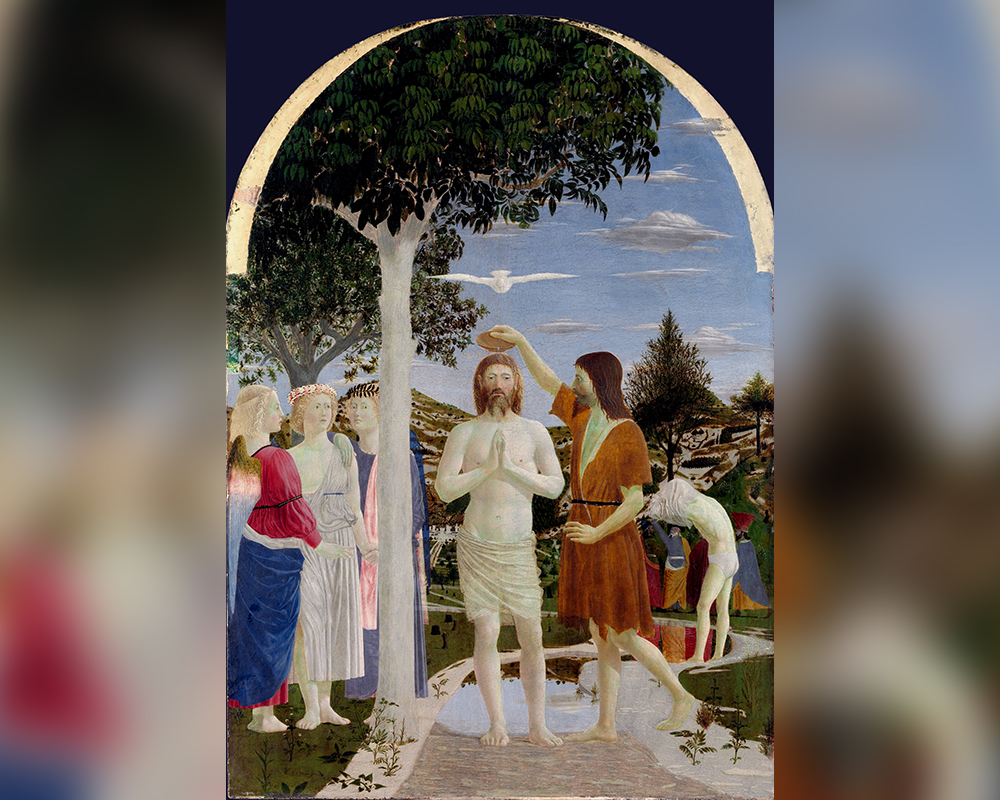
Matt 3:13 Then Jesus came from Galilee to John at the Jordan, to be baptised by him.
Matt3:14 John would have prevented him, saying, “I need to be baptised by you, and do you come to me?”
Matt3:15 But Jesus answered him, “Let it be so now; for it is proper for us in this way to fulfil all righteousness.” Then he consented.
Matt3:16 And when Jesus had been baptised, just as he came up from the water, suddenly the heavens were opened to him and he saw the Spirit of God descending like a dove and alighting on him.
Matt3:17 And a voice from heaven said, “This is my Son, the Beloved, with whom I am well pleased.”
Initial observations
The baptism of Jesus by John is referred to in all four Gospels. “Referred to” rather than recounted because while Mark tells the story more or less straightforwardly, the other accounts show varying degrees of unease. The origin of the unease is probably two-fold. First of all, the baptism shows Jesus “submitting” to John and receiving from him. One could conclude that the one who gave was greater than the one who received. In the second place, at the time the Gospels were actually written there were still followers of John the Baptist around. Perhaps part of their identity over against the Christian movement was that John was the mentor and Jesus a pupil. One of the side-effects of this unease with John’s Baptism of Jesus is that the baptism is one of the most historically certain events in the Gospels, because the early Christians would not have “developed” an account which gave them so much trouble.
The trouble it did give them becomes apparent in today’s excerpt—the conversation shows John realising that something was not quite right in his baptising Jesus. This is unlikely to be historical—it is not found in Mark, the vocabulary is Matthean (see below), and it is in tension with the question of the Baptist regarding the identity of Jesus in Matt 11:2-6. The unease is more marked in Luke, where, from a narrative point of view, John seems to be in prison when the baptism takes place (see Lk 3:18-22)! Again, in John’s Gospel, the Baptism is avoided and not recounted (although the associated phenomena are—see Jn 1:29-34).
Kind of writing
The first scene, with a basis in history, is an anecdote (a chreia), telling of a key turning point in the career of Jesus. The Transfiguration will be similarly significant. The second scene, resonant with symbolism, expresses the transcendent meaning of the baptism for Jesus (awareness of Sonship and the gift of the Spirit) and also for the first Christians.
Old Testament background
(i) Ritual washing is known in the Old Testament and was widely used in Qumran by the community of the Dead Sea Scrolls. John’s baptism seems to be different—marking acceptance of his programme rather than ritual purification.
(ii) The “voice over the water” is an echo of Ps 29, today’s responsorial psalm. The Spirit over the water is an echo of Gen 1:1-2; “like a dove” perhaps echoes the story of Noah’s flood, with the dove signalling the beginning of the end of the disaster.
(iii) “This is my Son” may echo the enthronement Psalm 2, used in the NT as a messianic text (Acts 4:25-26; 13:33; Heb 1:5; Rev 2:27).
New Testament foreground
(i) There is an immediate foreground in the Transfiguration accounts:
While he was still speaking, suddenly a bright cloud overshadowed them, and from the cloud a voice said, “This is my Son, the Beloved; with him I am well pleased; listen to him!” (Matt 17:5 ; Mk 9:7; Lk 9:35) For he received honour and glory from God the Father when that voice was conveyed to him by the Majestic Glory, saying, “This is my Son, my Beloved, with whom I am well pleased.” (2Pet 1:17 )
(ii) Matthew, with a strong Jewish identity, has a special interest in “righteousness”, as can be seen from the Gospel occurrences: 7-0-1-2. In our particular setting, righteousness retains its Old Testament meaning of “to act correctly within a relationship”. In this instance, the right thing for John to do is to baptise Jesus. “Proper” and “prevent” are hapax in the Gospels. In the Synoptics, “to fulfil” is a strong Matthew word: 16-2-9-15.
(iii) That Jesus is God’s Son is made plain in Matthew’s Gospel:
But just when he had resolved to do this, an angel of the Lord appeared to him in a dream and said, “Joseph, son of David, do not be afraid to take Mary as your wife, for the child conceived in her is from the Holy Spirit. She will bear a son, and you are to name him Jesus, for he will save his people from their sins.” (Matt 1:20-21) “Look, the virgin shall conceive and bear a son, and they shall name him Emmanuel,” which means, “God is with us.” (Matt 1:23) “The tempter came and said to him, “If you are the Son of God, command these stones to become loaves of bread.”” (Matt 4:3) …saying to him, “If you are the Son of God, throw yourself down; for it is written, ‘He will command his angels concerning you,’ and ‘On their hands they will bear you up, so that you will not dash your foot against a stone.’” (Matt 4:6) At that time Jesus said, “I thank you, Father, Lord of heaven and earth, because you have hidden these things from the wise and the intelligent and have revealed them to infants; yes, Father, for such was your gracious will. All things have been handed over to me by my Father; and no one knows the Son except the Father, and no one knows the Father except the Son and anyone to whom the Son chooses to reveal him. (Matt 11:25-27) “Simon Peter answered, “You are the Messiah, the Son of the living God.”” (Matt 16:16) Now when the centurion and those with him, who were keeping watch over Jesus, saw the earthquake and what took place, they were terrified and said, “Truly this man was God’s Son!” (Matt 27:54)
St Paul
As many of you as were baptised into Christ have clothed yourselves with Christ. There is no longer Jew or Greek, there is no longer slave or free, there is no longer male and female; for all of you are one in Christ Jesus. And if you belong to Christ, then you are Abraham’s offspring, heirs according to the promise. (Gal 3:27–29)
Brief commentary
Verse 13 Jesus came to John from Nazareth, in Galilee. John was a prophet, proclaiming the last days, offering a baptism which symbolised the conversion to God’s word as revealed to John himself. Jesus was definitely a follower, as is shown by the baptism and also by the timing of the start of Jesus’ ministry. Implied in the withdrawal to the desert from Jerusalem is a critique of the Temple cult (as can also be seen in Jesus’ ministry). Baptise here means to “immerse”.
Verse 14 This Matthean addition has been accounted for above. This extra Matthean verse communicates the unease of the writer and perhaps his community (in Antioch on the Orontes).
Verse 15 Each has a role within a relationship, which includes relationship with God. Righteousness is a kind of code word here meaning the right fulfilment of the Scriptures. Thus, John acts “righteously.”
Verse 16 Notice that the actual baptism is not recounted but presumed (a kind of ellipsis). The symbolism indicates an experience of the numinous—heavens opened, God’s Spirit descends. Alighting on him makes the symbolism very physical. This was probably not Mark’s intention when he spoke of “like a dove.” However, for Matthew the real meaning is not physically but really and truly.
Verse 17 A profound affirmation of identity. It has often been noted that the descent of the Holy Spirit marks the end of the relative absence of the Holy Spirit. In rabbinic tradition, it was considered that at this time all one could expect was an echo of the voice of God (a bat qol, literally a daughter of the voice). Mark has “you are my Son”, a real echo of Ps 2. Because Matt has made clear the Sonship of Jesus already (in Matthew 1-2), it makes less sense to use “you”, so Matt changes the wording to “this is”. The scene becomes, in Matthew’s hands, not only a realisation of Sonship, but a revelation of the Son to the world. This incipiently “Trinitarian” moment anticipates Mt 28:19.
Pointers for prayer
- The Baptism of Jesus marks a turning point in his life, and the start of his public ministry. Recall moments when your life changed and you moved into a new phase.
- The experience was one in which Jesus had a new sense of his own identity. What have been the experiences which have helped shaped your sense of who you are?
- How have you come to an awareness of being a child of God, beloved by God, and one on whom rests the grace of God?
- It is surprising that Jesus, the Saviour of the world, asks to be baptised by John. The request symbolises his desire to identify with us. At the same time he is filled with the Holy Spirit. That step of identifying with us is an important element in his being able to help us. Have you ever found that when someone identifies with you, it is easier for him/her to help you? Has your ability to identify with others had any impact on your effectiveness in helping others?
Prayer
God of the covenant, you anointed your beloved Son with the power of the Holy Spirit, to be the light of the nations and release for captives.
Grant that we who are born again of water and the Spirit may proclaim with our lips the good news of his peace and show forth in our lives the victory of his justice.
We make our prayer through Jesus Christ, your Word made flesh, who lives and reigns with you in the unity of the Holy Spirit, in the splendour of eternal light, God for ever and ever. Amen.
Thought for the day
Begin by recalling some special moment between yourself and your parents. Did you ever hear from them the equivalent of “This is my son, my daughter, the beloved: my favour rests on you”? In Jesus’ ministry, on several occasions, he felt such a word from his Abba, his Father. His baptism by John was one such moment, as was the Transfiguration later on. Such deep love and affirmation grounded him as a human being and as God’s prophet to the people of Israel. Our sense of calling grows out of our relationship with the Father, whose beloved we are, whose favour we too enjoy.
Prayer
Let us hear again, Abba, Father, your words of favour to each one of us. Direct us on the Way of discipleship, that we may be bearers of the Good News by simply being who we truly are before you, your children.
====

God anointed Jesus of Nazareth with the Holy Spirit and with power
Acts 10:34 Then Peter began to speak to them: “I truly understand that God shows no partiality,
Acts 10:35 but in every nation anyone who fears him and does what is right is acceptable to him. Acts 10:36 You know the message he sent to the people of Israel, preaching peace by Jesus Christ—he is Lord of all.
Acts 10:37 That message spread throughout Judea, beginning in Galilee after the baptism that John announced:
Acts 10:38 how God anointed Jesus of Nazareth with the Holy Spirit and with power; how he went about doing good and healing all who were oppressed by the devil, for God was with him.
Acts 10:39 We are witnesses to all that he did both in Judea and in Jerusalem. They put him to death by hanging him on a tree;
Acts 10:40 but God raised him on the third day and allowed him to appear,
Acts 10:41 not to all the people but to us who were chosen by God as witnesses, and who ate and drank with him after he rose from the dead.
Acts 10:42 He commanded us to preach to the people and to testify that he is the one ordained by God as judge of the living and the dead.
Acts 10:43 All the prophets testify about him that everyone who believes in him receives forgiveness of sins through his name.”
Initial observations
The Acts of the Apostles is offered as history. However, it is not quite history as we would imagine it today. The writer does indeed use sources and tells a story in sequence. However, the overall purpose is persuasion, that is, to bring people to a new understanding of the Gospel. In particular, there are three dimensions which influence the telling: the role of the Holy Spirit, the ideals of the community and the career of Paul. Within that, the writer offers speeches at significant moments. How much of these go back to the events is a moot point. They seem to reflect a mature biblical appropriation of the Jesus tradition and reflect more or less entirely the language and outlook of the writer. Such “history”, with words put on the lips of characters, was completely normal at the time. The long story of Cornelius and his household occupies a pivotal position in the overall narrative and project of Luke-Acts.
Kind of writing
This is a highly dramatic telling, unfolding in the context in a number of scenes and interlude:
(9.43): Peter a guest at home of Simon
Scene 1 (10:1-8): Cornelius (revelation)
Scene 2 (10:9-16): Peter (revelation)
Scene 3 (10:17-23a): Peter meets the envoys of Cornelius
Interlude (10:23b-27) Journey of Peter and entourage; meeting of Peter and Cornelius
Scene 4 (10:28-48) Peter and Cornelius in the latter’s home in Caesarea
Scene 5 (11:1-18) Peter explains his actions to the community at Jerusalem.
By means of this layout, Luke narrates the story of Cornelius no fewer than three times, without boring the hearers / readers.
Our selection—vv. 34-43—make up a distinct unit as follows:
Scene 4b (10:34-43)
- vv. 34b-35 Universalism
- vv. 26-38: Jesus—what he did
- vv. 39a: Witnesses
B* vv. 39b-40: Jesus—what has done to him
C* vv. 41-42: Witnesses
A* v. 43 Universalism
Context in the community
Acts 9:32-11:18: a unit of teaching. There are three stories about Peter: (1) 9.32-35; (2) 9:36-43; (3) 10:1-11:18 = (a) 10:1-19 the events and (b) 11:1-18 the justification of the events.
All three stories take place in Judea (incl. the administrative capital, Caesarea Maritima.
Related passages
While they were talking about this, Jesus himself stood among them and said to them, “Peace be with you.” They were startled and terrified, and thought that they were seeing a ghost. He said to them, “Why are you frightened, and why do doubts arise in your hearts? Look at my hands and my feet; see that it is I myself. Touch me and see; for a ghost does not have flesh and bones as you see that I have.” And when he had said this, he showed them his hands and his feet. While in their joy they were disbelieving and still wondering, he said to them, “Have you anything here to eat?” They gave him a piece of broiled fish, and he took it and ate in their presence. (Luke 24:36–43)
Brief commentary
Verses 34b-35 The theme of universalism is a key: cf. Testament of Job 4:8; Rom 2:11; Gal 2:6; Col 3:25; Eph 6:9; 1 Pet 1:17; James 2:1, 9; 1 Clement 1:3; Barnabas 4:12; Polycarp, To the Philippians 6:1.
Verses 36-38 Jesus’ activity as prophet, closely following Luke’s Gospel.
Verse 39a The witnesses to the ministry of Jesus. Being witnesses is central to the mission in Acts.
Verse 39b-40 Jesus is rejected (using the language of Galatians, interesting); the resurrection (i.e. vindication) is the deed of God.
Verse 41-42 These are the witnesses to the resurrection of Jesus. Cf. Lk 24:36-43 (above); Acts 1:4.
Verse 43 Universalism once more, as already implied in the Pentecost speech. Cf. Peter said to them, “Repent, and each one of you be baptised in the name of Jesus Christ for the forgiveness of your sins, and you will receive the gift of the Holy Spirit. For the promise is for you and your children, and for all who are far away, as many as the Lord our God will call to himself.” (Acts 2:38–39) Cf. Lk 2:29-32; 3:6; 4:25-27; 24:47; Acts 1:8.
Pointers for prayer
- Witnesses: who has been to me an authentic witness and bearer of the Good News? To whom have been been a witness?
- Showing partiality is a very human trait and it takes conscious choice to act differently. How have I learned to accept people without prejudice?
- The need for forgiveness is also a regular human phenomenon, sometimes from myself or from others; from time to time we need forgiveness also from God.
Prayer
God, creator of everything and everyone, lover of all humanity without partiality or distinction, help us to live according to the good news of Jesus.
Help us to break down barriers just as he did. Show us how to reach out to the excluded, in imitation of Christ who was himself excluded in death, your Son, our Lord Jesus Christ, who lives and reigns with you in the unity of the Holy Spirit.
=====

Here is my servant, my chosen, in whom my soul delights
Is. 42:1 Here is my servant, whom I uphold,
my chosen, in whom my soul delights;
I have put my spirit upon him;
he will bring forth justice to the nations.
2 He will not cry or lift up his voice,
or make it heard in the street;
3 a bruised reed he will not break,
and a dimly burning wick he will not quench;
he will faithfully bring forth justice.
4 He will not grow faint or be crushed
until he has established justice in the earth;
and the coastlands wait for his teaching.
5 Thus says God, the Lord,
who created the heavens and stretched them out,
who spread out the earth and what comes from it,
who gives breath to the people upon it
and spirit to those who walk in it:
6 I am the Lord, I have called you in righteousness,
I have taken you by the hand and kept you;
I have given you as a covenant to the people,
a light to the nations,
7 to open the eyes that are blind,
to bring out the prisoners from the dungeon,
from the prison those who sit in darkness.
Initial
Observations
The present text is a kind of calling or appointment oracle. As such, it suits very well because the baptism was for Jesus a moment when his identity and future role became apparent to him.
Kind of writing
As indicated above, today we read one of the four poems in Second Isaiah, known as the Suffering Servant Songs (Isa 42:1-4; 49:1-6; 50:4-9; 52:13–53:12). It is not entirely clear what these songs may have meant at the time of writing. The somewhat mysterious servant can be singular or plural, it can be in the second person or third person, it can also have a collective or corporate meaning. Ultimately, this polyvalent imagery seems to point to the prophet as an individual called to live the suffering of exile in an exemplary manner to that the people too may know how to live this bitter experience in grace. When the Servant is said to suffer “for” the people, this is not substitutionary (“in place of”) but exemplary (“for the benefit of”). In vv. 1-4, the servant is present to the court. In vv. 6-7, the servant himself is addressed directly, following the identification of God as the creator of all in v.5.
Origins of the reading
The context is Second Isaiah, the unnamed prophet whose teachings are gathered in Isaiah 40-55. He was active, it would seem, towards the end of Babylonian exile and, when all seemed lost, he raised the spirits of the exiles to place their hope once more in God. Within Second Isaiah, 42:1-7 are found in the longer context 41:21-42:12, in which the Lord (YHWH) is show defending his choice of Cyrus, his chosen instrument.
Related readings
The Lord God has given me the tongue of a teacher, that I may know how to sustain the weary with a word. Morning by morning he wakens— wakens my ear to listen as those who are taught. The Lord God has opened my ear, and I was not rebellious, I did not turn backward. I gave my back to those who struck me, and my cheeks to those who pulled out the beard; I did not hide my face from insult and spitting. The Lord God helps me; therefore I have not been disgraced; therefore I have set my face like flint, and I know that I shall not be put to shame; he who vindicates me is near. Who will contend with me? Let us stand up together. Who are my adversaries? Let them confront me. It is the Lord God who helps me; who will declare me guilty? All of them will wear out like a garment; the moth will eat them up. (Isaiah 50:4–9)
Brief commentary
Verse 1 The “policy” of the heavenly court is presented: God will commission a new servant—Cyrus—to carry out his will. The word. The word judgment, which occurs three times here, needs to be translated as verdict or judgment arrived at.
Verses 2-3 The meaning seems to be that he will not proceed by force or violence. The bruised read and the dimly burning wick must refer to the weakened state of the exiles.
Verse 4 This new servant will not be discouraged by anything. It is a surprise to find “his teaching” (lit. torah) at the end. Of course, the “his” is ambiguous but really refers to the torah of YHWH. At this point, the term had not yet become a technical expression for the Pentateuch. Torah or teaching is important in Isaiah 1-55 (Is 1:10; 2:3; 5:24; 8:16, 20; 24:5; 30:9; 42:4, 21, 24; 51:4, 7).
Verse 5 Here the Lord is presented as the creator of the world. The Hebrew reads, “the El, YHWH.” God’s universal control of history is evoked. There is surely an echo of Genesis 1.
Verses 6 Cyrus is directly addressed and his role described in very high terms. 6a describes how God will protect Cyrus, having taken him by the hand. 6b describes his double role, as a covenant to Israel and a light to all other nations. The writer does not hesitate to use traditional terms of tremendous religious import to speak of the Persian leader.
Verse 7 The calling of Cyrus is made very concrete in relation to the exiles. 7a: restoring sight. 7b: setting free. 7c both terms together, setting free those in darkness.
Pointers for prayer
- When have you experienced in your own life that gentleness and non-violence achieve more than force and dominance?
- The sense of being held by God and kept by him is very powerful in this reading. Can you name such experiences in your own life?
Prayer
God, you know us all by name and hold us all by the hand. Grant we pray the gift of faith—absolute trust in you—that we too may know that in you we live and move and have our being. Amen.