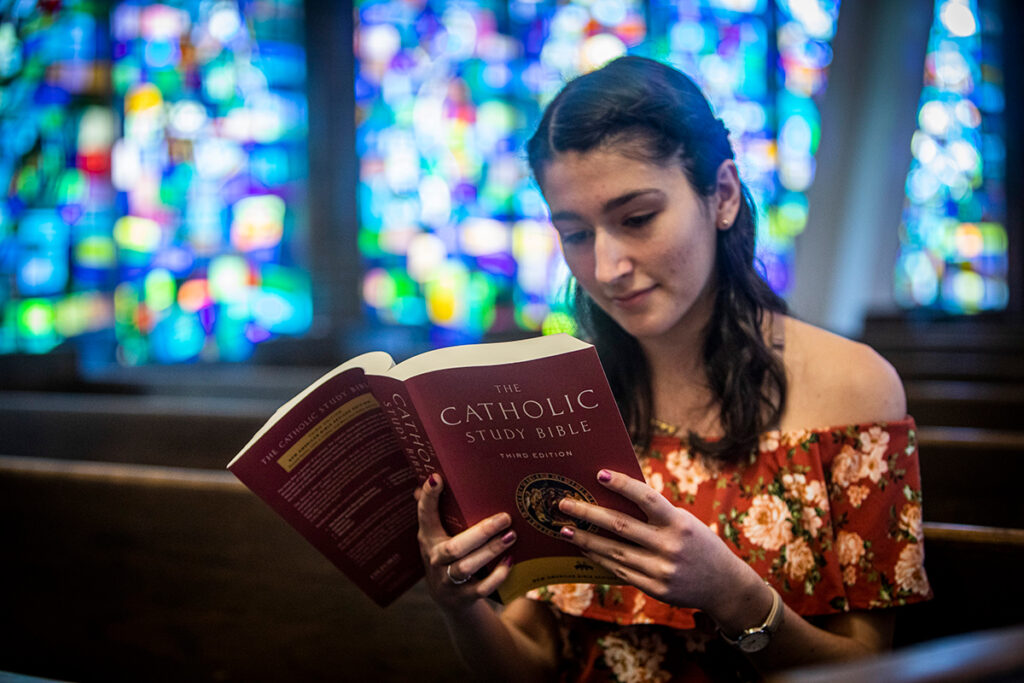
How can Scripture draw us more deeply to God? One ancient Christian practice offers a path: lectio divina, Latin for ‘sacred reading.’ It is one of the earliest forms of Christian prayer, long recommended by the Church as a way to let the Bible come alive in our hearts.
From the beginning, Christians followed the Jewish practice of praying with the Scriptures. Once the New Testament was written, they approached these texts the same way, convinced that God was personally present in the words. They learned to read not only with the mind, but with the heart.
The Fathers of the Church — including St Jerome, St Augustine, St Basil and St Benedict — all practiced this form of prayer. Over time it became a hallmark of monastic life, and while it is still central to religious communities, many lay Christians today have rediscovered its value.
The essence of lectio divina is simple: reading Scripture with the heart, guided by the Holy Spirit. It is not a rigid technique, but a flexible way of praying. Still, Christians often describe it in four traditional stages. Nearly a thousand years ago, the monk Guigo II outlined them in a letter that remains the classic explanation.
The passage for lectio divina is usually brief — a verse from Jesus’ words or a short scene from the Gospels.
Having pondered the text, we respond to God. Perhaps with gratitude, repentance, or petition. We ask: What do I say to God in response?”
The Steps
The first step is lectio — reading. We read the passage slowly for understanding. What is its context? What did the sacred author intend to say? The question here is: What does the text say?
The second step is meditatio — meditation. We linger with the words, repeating them slowly. We let them interact with our thoughts and memories. The question becomes: What does the text say to me?
The third step is oratio — prayer. Having pondered the text, we respond to God. Perhaps with gratitude, repentance, or petition. We ask: What do I say to God in response?
The final stage is contemplatio — contemplation. Prayer moves beyond words. We rest in God’s presence and allow his love to transform us. The question here is: What is God saying to me?
Lectio divina rarely unfolds in a neat sequence. We may move back and forth between reading, meditating and praying. Yet the overall movement is toward simplicity: it begins with careful attention to the text and ends in a quiet resting in God.
If we practice lectio divina, we must develop certain habits. First, we must slow down. Sacred reading takes time. Many recommend setting aside at least an hour when possible. This is not a method for a hurried commute; it requires stillness.
Second, we must learn to read differently. We are used to reading for information. But in lectio divina, the goal is not information, it is encounter. We read to seek God. It is an exercise of the heart, led by the Holy Spirit. As one writer noted, “The full process of ‘reading’ could take 15 minutes or 15 years.”
Interest in lectio divina has grown in recent decades. Both Pope Benedict XVI and Pope Francis have encouraged Catholics to adopt it as a way of hearing the voice of God. Pope Benedict called it a means of responding to God “with openness of heart,” adding, “If we learn to pray this way … this practice will bring to the Church, I am convinced of it, a new spiritual springtime.”
Lectio divina is ancient, but its invitation is always fresh: to approach the Word of God slowly, prayerfully, and with a heart ready to listen.
Jim Manney is a writer and editor living in Ann Arbor, Michigan.