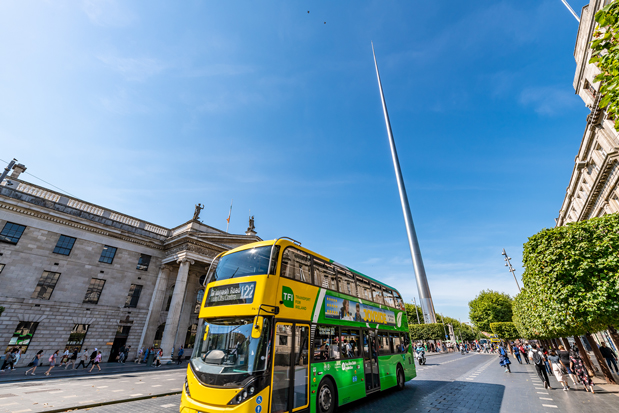
Names of streets and parks are the least of Dublin’s worries
Dear Editor, on a recent trip to Dublin, I was mulling over the obsession some politicians nowadays have over changing the names of roads and parks, which, according to them, do not reflect the Irish Republic.
We discuss changing the names of roads, etc., to reflect our Republican history and neglect to look after the statues, streets, etc., which are named after heroes of the past. Just walk down Parnell St, Cathal Brugha St, Dublin and tell me seriously that these streets reflect a prosperous Capital City.
Dublin needs a massive cleanup, especially in the streets off O’Connell St. When that is done, Dublin City Council should start seriously dealing with water leaks, drainage, etc. Names of streets and parks are the least of Dublin’s worries, or any of our prominent cities like Galway, Cork or Limerick.
Yours etc,
Nuala Nolan
Bowling Green, Galway
Synodality is not the only option
Dear Editor, one mode of change existing in the Catholic Church has consisted for decades of many small pockets of renewal showing definite positive growth. They involve efforts at faithfulness, seeking the grace of God in terms of personal conversion and repentance while attending to salvation, all energised by joyful hope through the centrality of sacramental practice (Mass and Confession) together with traditional prayer at home and elsewhere, obedience, good works, and awareness of sin.
Another mode, synodality, is not the only show in town. It has been rehearsing for some time. Does synodality’s associated literature bear much reference to the above orientations? In some cases, yes. Bishop Brendan Leahy speaks of inner purification leading to changes in choices, behaviour, and lifestyles. He espouses Pope Leo’s view that synodality should not diminish episcopal/priestly authority, but foster bonds among all the faithful. Despite the repetitive prolix nature of its literature, most of synodality is not new. Inexorably, it is mainly a new iteration of the virtuous faith-life practices promoted by the Church and practised by the saints for yonks albeit in a different articulation.
Adherence to synodality’s notion of ‘the Spirit,’ requires a necessary sacred space and avoiding self-constructed modes of the Church. As Cardinal Ouellet suggests, synodality must start from God and from his manifestation in history, instead of starting from personal aspirations and human representations. As the Cardinal also states and as Bishop Leahy perhaps implies, a perspective rooted in the communion of The Three Persons never abandons the concrete life of human persons who are loved for their own sake, whereas a perspective from below, starting from ideas that are generous but human, runs the risk of regenerating partial solutions without giving true life.
Yours etc,
Neil Bray
Cappamore, Co. Limerick
The F-word is being used too frequently
Dear Editor, all I want is that people refrain from using F-words and the words ‘I am obsessed with’ and ‘absolutely’. Swearing is becoming more widely acceptable. Swearwords are increasingly used for emphasis and to build social bonds, rather than to insult, say academics.
Swearing has become more widely acceptable over the past two decades because it is increasingly used for purposes other than to insult people. ‘F**k’ and ‘sh*t’, are the two most commonly used swearwords in Ireland, frequently used to emphasise a point in conversation or to build social bonds, rather than with the specific intent to cause harm.
On hearing Ivan Yates advising Fine Gael to ‘smear the bejasus’ out of Catherine Connolly, I felt insulted and consider it to be reprehensible and indicative of low life and very unprofessional for a seasoned broadcaster. How dare he speak like that? Who does he think he is? The F-word seems to be part and parcel of every sentence, and its frequent use means it has lost all meaning and sense.
I find it disconcerting when someone approaches me, uttering the F-word to me and immediately says, “Oh, sorry for the bad language.”
Yours etc,
Gerry Coughlan
Kilnamanagh, Dublin 24
Gender equality doesn’t mean everyone has the same role
Dear Editor, While I know some parishioners will be disappointed with the Vatican Commission’s decision not to recommend the ordination of women deacons, I do not think they will agree that it will lead to the institutional Church’s self-inflicted oblivion, as reported in our media.
Whether one accepts the theological arguments or not, the reality is that the role of a deacon (from the Greek diakonos, meaning servant) is one of service, not leadership. As a permanent deacon, I am an equal member of the Parish Pastoral Council. I celebrate the funeral rites at graveyards and crematoriums as do lay parishioners, and while I celebrate the baptism ceremony, other lay members of the baptism team prepare the families.
Gender equality does not necessarily mean everyone has the same role, but that each person’s contributions are valued. Pope Francis and now Pope Leo XIV are working to increase the involvement of women at every level of Church decision-making.
Yours etc,
Deacon Frank Browne
Rathfarnham, Dublin 14
The king’s and the president’s Christmas speeches
Dear Editor, firstly, full disclosure. I come from an old-school Irish Catholic republican background.
In this context, it’s quite extraordinary that of the two ‘Christmas addresses’ by the Irish President and the Protestant English King, I found the latter much more resonant and respectful.
If you are going to give a Christmas speech, it helps if you acknowledge its raison d’être. The clue is in the word, Christmas, meaning literally, the Mass of Christ. King Charles’ speech, quite correctly, focused centrally on the teachings of Christ, while respecting other perspectives.
In sharp contrast, the Irish President’s effort was appalling. Full of the usual waffle about tolerance and inclusivity, it excluded the very person whose birthday we are honouring. She seems more enamoured of the pre-Christian solstice. Perhaps conveniently forgetting that the pre-Christian Celts practised human sacrifice.
Welcome to ‘modern/liberal’ Ireland. Every tradition is respected, apart from our own.
Yours etc,
Eric Conway
Navan, Co. Meath
Is it our job to save the world? Did Christ not do that?
Dear Editor, please allow a discussion about this question in your paper (IC December 4, 2025).
This question, posed by an Irish priest, illustrates a line of thought that has been used to advance what is often called the ‘modernist’ agenda. That agenda tends to reduce religion to social work, devotion to superstition, and faith to a tool for psychological manipulation —sometimes even exploited for financial gain at the expense of the trusting flock.
To clarify: as the laity know, Christ, who has revealed Himself to us, is not merely one man, but a Divine Person. He has incorporated us into His life and invited us to participate in His work of salvation and redemption. We are not passive bystanders, but active instruments, called to serve both enemies and neighbours throughout time.
Death is defeated, but eternal life requires our response: to will our place in heaven rather than hell. This is precisely what modernist interpretations often miss, which explains their resistance to Our Lady of Fatima and her reminder that, in union with Christ, God can accomplish great things through us.
God, who has no need of us mere creatures, nevertheless chooses to cover us in His own glory by inviting us to active participation in His plan for salvation.
It is important for clergy to remember that their flock — those who support their ministry and livelihood — deserve guidance rooted in fidelity to the Word of God. For example, the choice of ‘all’ in place of ‘many’ at the consecration of the chalice is not a neutral adjustment but a theological statement, one warned against in Gestis Verbisque 2.2.24.
The responsibility of priests is to shepherd their people faithfully, ensuring that the ewes and lambs entrusted to them are nourished by truth rather than ideology.
Yours etc,
Jane Campbell
Ballina, Co. Mayo
My hope for the Spring Meeting 2026
Dear Editor, the Bishop of Meath, Thomas Deenihan has rightly said that “more than ever the world needs hope.” (The Irish Catholic, December 18, 2025) He referred to the conflict in Gaza, the war in Ukraine, the Bondi Beach killings and the murders, road deaths and the appalling attacks on people in Ireland. I agree with Bishop Deenihan when he said that we should hope in God and in His salvation.
What he did not highlight is the ever-growing number of abortions in Ireland, which has risen to about 55,000 since the Termination of Pregnancy Act was introduced in 2018. How could he be more concerned about the slaughter of people worldwide and not concerned about the slaughter of innocent babies here in Ireland? Many people (33.1%) voted ‘No’ in the referendum to repeal the 8th Amendment of the Constitution, and this should have encouraged the Catholic Church in Ireland to look at the consequences of the referendum. It is my hope that the hierarchy, at its spring meeting in 2026, will discuss whether the repeal of the Termination of Pregnancy Act 2018 should be brought into the public arena. Will this hope be in vain?
Yours etc,
Herbert F. Eyre
North Strand, Dublin