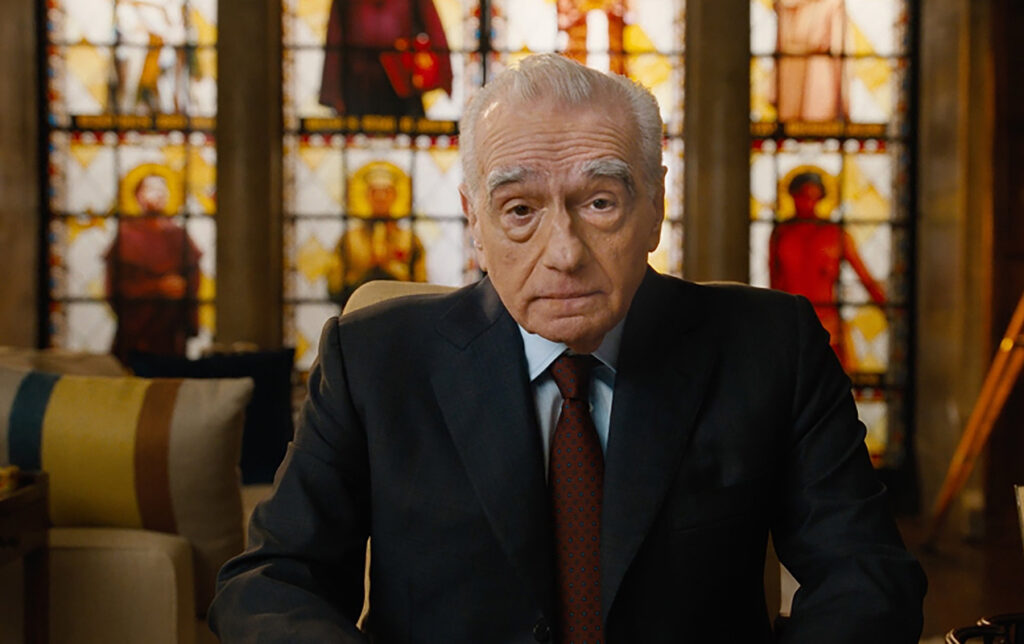
The director of Mean Streets and Silence sees his life as a journey through fear, failure, and the surprising grace found in ordinary moments
There is a moment early in Scorsese on Filmmaking and Faith when Martin Scorsese recalls what he asked Pope Francis back in 2018: “Holy Father, How can a human being live a good and just life in a society where greed and vanity drive action? How can I live well when I experience evil?”
It is a question which has haunted him since childhood as he makes clear in a series of dialogues with Italian Jesuit pries Fr Antonio Spadaro, undersecretary of the Dicastery for Culture and Education. Throughout their ongoing discussions we get the sense of Scorsese as someone who sees cinema not just as a craft but as a means for spiritual inquiry and ultimately, we see, throughout his own insights, someone who sees life as a pilgrimage. For Scorsese, faith is a way of answering his question above but it is also lived daily.
Little Italy
Scorsese’s story begins in a small apartment in ‘Little Italy’, New York City, a strange collision of old world values and new world desperation. “Because of the asthma,” he tells Fr Spadaro, “I lived a life apart. I felt separate from everyone else.” Yet it was this enforced observation which he says gave him an unusual sensitivity to the rhythms of the adult world around him. It was his asthma which, in a sense, became his first teacher.
His other refuge was Old St Patrick’s, now a basilica, a place that insulated him from the neighbourhood’s constant pressures: organised crime, violence, addiction, homelessness, and the pervasive culture of fear they bred. It was there he encountered his second great teacher, a young parish priest whose tone and outlook stood in striking contrast to the old-world Italian clergy.
In a neighbourhood where retribution and suspicion were taught like family customs, the young priest represented another way of being”
“Fr Francis Principe,” he says, “brought us a whole new way of looking at life… He represented a way of thinking that was very, very different from the harsh and judgemental world around me.”
“He opened the world to us,” says Scorsese, describing how this priest began to expose him and his friends to music, to cinema, and to various works of literature such as Graham Greene and James Joyce whose morally complex and grace haunted characters would become the undercurrents for Scorsese’s own works.
“He would say to us: ‘you don’t have to live like this.’ in a neighbourhood where retribution and suspicion were taught like family customs, the young priest represented another way of being. He made sense morally. We were being taught these street lessons which came from the old world and he counterbalanced all of that.”
Root
One story from Scorsese’s youth shows just how deeply those words took root. As a teenager, he and a friend accepted a ride from an off-duty policeman — the kind who flashed his badge and gun while cruising through after-hours clubs. At a certain point Scorsese felt something shift inside him: “Forget it. I’m out of here.” The boys stepped out. Five minutes later, the car was shot up.
The moment became, for Scorsese, a kind of revelation: “I realised I was on borrowed time. And I realised Fr Principe was right – I didn’t belong there.”
‘I received the grace of being rejected,’ he says. ‘The grace of being despised. And the gift of saying: ‘Okay, now we start over again’”
And that insight, he tells Spadaro, became a pattern. Time and again he came to see that moments of rupture, setback, or humiliation were not simply failures but forms of grace. “I received the grace of being rejected,” he says. “The grace of being despised. And the gift of saying: ‘Okay, now we start over again.’”
It was Fr Principe’s example which led Scorsese to consider the path to priesthood, entering the seminary and very quickly exiting it with the realisation – he wasn’t cut out for the life.
“I started to realise wanting to be like someone isn’t enough. You have to have a vocation. And a vocation is a serious thing. I realised I was trying to hide by becoming a priest. I was trying to hide form life and from fear – fear of being hurt and hurting other. And I thought, I could create the vocation myself, but that’s not the way it happens. Its about giving up control and opening yourself up to the mystery of God’s love.”
Presence
When Fr Spadaro asks whether people today can still sense the presence of God, Scorsese responds not with theory but with a line from Mean Streets. Harvey Keitel’s voice echoes his own conviction: “You don’t make up for your sins in church… You do it in the streets and you do it at home.” Scorsese calls this something like a personal mission statement. For him, the Incarnation and Resurrection are the moral heart of reality; the sacraments open the door, but conversion is lived out in the rough, unglamorous details of everyday life.
“Transubstantiation can’t only happen in a building. It has to resonate throughout the rest of the world… We have to take Jesus and God out of the church and into the streets and into our homes most of all.”
Which he immediately qualifies with a note of humility asking, “Have I succeeded? I don’t know. I don’t think so. But maybe ‘success’ is the wrong way of framing it. You just try, and when you fail, you keep trying.”
The most explicit ‘pilgrimage’ in his life has been his relationship with Shusaku Endo’s Silence, which he finally made into a film in 2016 after 22 years of writing, rewriting, and wrestling with the it. He says that the novel’s central moment when Christ whispers “Step on me” to save innocent lives, overwhelmed him. “I didn’t know if I could ever approach it,” he admits. But he knew he had to try.
Jesus embraces all of humanity… He shows us how to deal with anger and vengeance and love and forgiveness and redemption”
And it was this journey to bring the film to life which he says became like a spiritual discipline. “I look back and see it coming together as a kind of pilgrimage,” he tells Spadaro. “The story became a spur to thinking about faith… and about how grace is received.” Realising through the process that culture might complicate discipleship but it never negates it.
Near the end of the book, Scorsese offers a line that could serve as the thesis of his entire life: “Jesus embraces all of humanity… He shows us how to deal with anger and vengeance and love and forgiveness and redemption. Jesus contains multitudes.”
It is a deeply Catholic vision of the Incarnation: the God who enters all of human experience — not to excuse it, but to redeem it from within. An idea he hopes he might get across in his films, in their violence and acknowledgements of the darker possibilities within the human being. “People think: ‘How can I be put in the same category as a murderer?’ But you can’t dismiss a whole swath of humanity like that. They are us.” To deny this is to deny our need for redemption.
For Scorsese, the pilgrimage of faith is nothing other than learning to see this presence in the everyday and to surrender, again and again, to the mystery of grace.