Get up, take the child and his mother, and flee to Egypt, and remain there until I tell you
Matt 2:13 Now after they had left, an angel of the Lord appeared to Joseph in a dream and said, “Get up, take the child and his mother, and flee to Egypt, and remain there until I tell you; for Herod is about to search for the child, to destroy him.”
Matt 2:14 Then Joseph got up, took the child and his mother by night, and went to Egypt,
Matt 2:15 and remained there until the death of Herod. This was to fulfil what had been spoken by the Lord through the prophet, “Out of Egypt I have called my son.”
Matt 2:16 When Herod saw that he had been tricked by the wise men, he was infuriated, and he sent and killed all the children in and around Bethlehem who were two years old or under, according to the time that he had learned from the wise men.
Matt 2:17 Then was fulfilled what had been spoken through the prophet Jeremiah:
Matt 2:18 “A voice was heard in Ramah, wailing and loud lamentation, Rachel weeping for her children; she refused to be consoled, because they are no more.”
Matt 2:19 When Herod died, an angel of the Lord suddenly appeared in a dream to Joseph in Egypt and said,
Matt 2:20 “Get up, take the child and his mother, and go to the land of Israel, for those who were seeking the child’s life are dead.”
Matt 2:21 Then Joseph got up, took the child and his mother, and went to the land of Israel.
Matt 2:22 But when he heard that Archaelaus was ruling over Judea in place of his father Herod, he was afraid to go there. And after being warned in a dream, he went away to the district of Galilee.
Matt 2:23 There he made his home in a town called Nazareth, so that what had been spoken through the prophets might be fulfilled, “He will be called a Nazorean.”
Initial observations
Our Gospel for today is a combination of real history, typology and theology. To understand the text, it is important to have a clear idea of Matthew’s purpose here and his intentions at this point in his Infancy Gospel. The lectionary excerpt omits, for obvious reasons, vv. 16-18, although these are vital to discerning Matthew’s purpose.
Kind of writing
In Matthew 1-2, the evangelist offers the listeners/readership a deep, virtually complete grasp of the identity of Jesus. To achieve this goal, Matthew makes use of several typologies and a series of fulfilment citations.
The typologies are both innovative and traditional. For instance, the David typology is already traditional (see Romans 1:1-7). To move the story on, there is a Joseph typology from Genesis 37-50. There we find a Joseph, who dreams, who is exiled, who becomes a source of salvation for his people in Egypt, whose bones are eventually to be brought back. It is not accidental that the New Testament Joseph is named as a descendant of (a later!) Jacob. See below.
The Exile typology—emphasised in the genealogy and found also in our Gospel—brings with it a deep note of tragedy, an anticipation of the tragic death of Jesus on the cross.
Furthermore and perhaps most importantly, the Moses typology—richly present throughout this Gospel—is firmly established here as key to the identity and role of Jesus.
The sense of continuity with God’s earlier disclosure to the Jewish people is sustained in the series of fulfilment citations from the Hebrew Bible. These citations function as “static” theological markers, acting as a counterpoint the narrative drive of the typologies.
Finally, in Matthew 2:1-12, a concentric pattern is clear: magi/Herod/magi. Matthew 2:13-23 exhibits the same triple scheme: Joseph/Herod/Joseph.
Old Testament background
Apart from the typologies noted above, each citation is significant for Matthew’s purpose. A brief comment is attached to each citation.
When Israel was a young man, I loved him like a son, and I summoned my son out of Egypt. (Hosea 11:1)
This text was never read in a messianic way in Judaism. It evokes the Exodus, just as the Baptism will evoke the Red Sea and the temptations will evoke the testing in the wilderness.
The Lord says, “A sound is heard in Ramah, a sound of crying in bitter grief. It is the sound of Rachel weeping for her children and refusing to be comforted, because her children are gone.” (Jeremiah 31:15)
In the New Testament, only Matthew explicitly cites Jeremiah: here (2:18), at the Caesarea Philippi scene (16:14) and in the Passion Narrative (27:9). One Jewish tradition located the tomb of Rachel—matriarch of the tribes of Benjamin and Ephraim—at Bethlehem.
The final citation, as is well known, does not exist in the Hebrew Bible or in the Greek Old Testament. Matthew’s carefully vague introduction indicates his awareness of this. In a quite modern way, Matthew’s “citation” resonates with a number of significant messianic passages in the following way:
A shoot will grow out of Jesse’s root stock (nezer), a bud will sprout from his roots. (Isaiah 11:1). …for you shall conceive and bear a son. No razor is to come on his head, for the boy shall be a nazirite to God from birth. It is he who shall begin to deliver Israel from the hand of the Philistines.” (Judges 13:5; cf. 13:7 and 16:17). The blessings of your father are greater than the blessings of the eternal mountains or the desirable things of the age-old hills. They will be on the head of Joseph and on the brow of the prince (nazir) of his brothers. (Genesis 49:26)
New Testament foreground
Matthan the father of Jacob, and Jacob the father of Joseph the husband of Mary, of whom Jesus was born, who is called the Messiah. (Matthew 1:15–16)
St Paul
Therefore, since we have such a hope, we behave with great boldness, and not like Moses who used to put a veil over his face to keep the Israelites from staring at the result of the glory that was made ineffective. But their minds were closed. For to this very day, the same veil remains when they hear the old covenant read. It has not been removed because only in Christ is it taken away. But until this very day whenever Moses is read, a veil lies over their minds, but when one turns to the Lord, the veil is removed. (2 Corinthians 3:12–16)
Brief commentary
Verse 13 Fleeing to Egypt in times of crisis or famine was quite usual. The family’s sojourn there shows Jesus recapitulating the saving history of the chosen people. Cf. When Pharaoh heard about this event, he sought to kill Moses. So Moses fled from Pharaoh and settled in the land of Midian, and he settled by a certain well. (Exodus 2:15)
Verse 14 As always, the obedience of Joseph is silent and absolute, the mirror image of the divine command.
Verse 15 Herod the Great died in 4 bc. Both Matthew and Luke (1:5) time the birth of Jesus to the reign of Herod. The Anno Domini calendar was championed by Dionysius Exiguus (c.470—c.544). The Polish historian Laurentius Suslyga was the first to suggest that Jesus was actually born around or before 4 bc., the year of Herod’s death. This seems to be right.
Verse 16 Although this action is complete in character for the paranoid Herod, who killed his own sons, there is no historical record nor even any hint of this event elsewhere in the New Testament. Instead, the purpose of the story is, again, a recapitulation, this time of the story of Moses. Cf. Then Pharaoh commanded all his people, “All sons that are born you must throw into the river, but all daughters you may let live.” (Exodus 1:22)
Verse 17 Matthew is careful not to say that the massacre happened in order that Scripture might be fulfilled.
Verse 18 This is the third formula citation in Matthew’s Infancy Gospel. It reminds us that Jesus—whose name means “YHWH saves” —came precisely to save humanity from the tragedy of death by means of his own tragic death on the cross.
Verses 19-21 The Moses typology continues to be quite evident. Cf. During that long period of time the king of Egypt died. (Exodus 2:23) The Lord said to Moses in Midian, “Go back to Egypt, because all the men who were seeking your life are dead.” Then Moses took his wife and sons and put them on a donkey and headed back… (Exodus 4:19–20)
Verse 22 Archaelaus took after this father, Herod the Great, but unlike him did not reign long. First of all, Augustus reduced him from being a “king” to an ethnarch. A successful petition to Caesar against him led to his removal in ad 6. Joseph is warned in a dream to take the family to Galilee of the Gentiles (Mt 4:15). It may be that the holy family pictured as displaced persons mirrored the experience of the Matthean community after the Jewish War.
Verse 23 The challenge of this citation was noted above. What is Matthew’s purpose here? Jesus was not known as Jesus of Bethlehem but as Jesus of Nazareth. Even more, his followers were called Nazarenes (Acts 24:5). Matthew wants to show that the fact that Jesus came from Nazareth was not an accident but part of the divine plan.
Pointers for prayer
- The threat to the child Jesus put Joseph in a situation where he had to make a quick and yet wise decision. Perhaps you have also had to make a speedy response to an unexpected crisis. Who were the ‘angels’ who guided you to wise decisions? Remember them and give thanks.
- The whole narrative is designed to bring out the guidance of God’s providence for the child Jesus. Have there been times when you have been grateful that things worked out well for you despite adverse circumstances or experiences?
- External forces forced migration on Joseph and his family, until he came to establish a home in Nazareth. Where have you lived before coming to the place you now call home? How has this journey helped to fashion the person you are now? Perhaps you have a mixture of gratitude and regrets as you look back. Give thanks for the good memories. What helps you to deal with the disappointments and hurts in the past? Bring them to God with a prayer for further healing.
- The story and today’s feast remind us of the importance of the family in nourishing and fostering new life. Recall and give thanks for those in your own childhood who helped you to find your way in life.
Prayer
Loving God, guardian of our homes, when you entrusted your Son to the care of Mary and Joseph, you did not spare them the pains that touch the life of every family.
Teach us to rely on your word, that in our trials as in our joys we may be clothed in gentleness and patience and united in love.
Make us ever thankful for the blessings you give us through Jesus Christ, your Word made flesh, who lives and reigns with you in the unity of the Holy Spirit, in the splendour of eternal light, God for ever and ever. Amen
.
Thought for the day
Our Gospel today omits—understandably?— the brutal massacre of the innocents. While the story is indeed brutal, it is unfortunately not unrealistic. Its omission is a pity because the tragic side of life is underscored, in different ways, by both Matthew and Luke, in anticipation of the passion. They were not composing sweet scenes for Christmas cards! On the contrary, they were addressing the full human condition, in its mystery, its joys and its tragedies. It is precisely within the family that we encounter death, life, happiness and the sheer wonder of being at all. Today’s feast invites us to look unflinchingly at the whole picture, in all its complexity.
Prayer
God, bless us all as members of our different families. As we thank you for the gift we are to each other, we ask your guidance and grace in all we do. Through Christ our Lord. Amen.
Let the peace of Christ rule in your hearts
Col 3:12 As God’s chosen ones, holy and beloved, clothe yourselves with compassion, kindness, humility, meekness, and patience.
Col 3:13 Bear with one another and, if anyone has a complaint against another, forgive each other; just as the Lord has forgiven you, so you also must forgive.
Col 3:14 Above all, clothe yourselves with love, which binds everything together in perfect harmony.
Col 3:15 And let the peace of Christ rule in your hearts, to which indeed you were called in the one body. And be thankful.
Col 3:16 Let the word of Christ dwell in you richly; teach and admonish one another in all wisdom; and with gratitude in your hearts sing psalms, hymns, and spiritual songs to God.
Col 3:17 And whatever you do, in word or deed, do everything in the name of the Lord Jesus, giving thanks to God the Father through him.
Col 3:18 Wives, be subject to your husbands, as is fitting in the Lord.
Col 3:19 Husbands, love your wives and never treat them harshly.
Col 3:20 Children, obey your parents in everything, for this is your acceptable duty in the Lord. 21 Fathers, do not provoke your children, or they may lose heart.
Initial observations
In the Liturgical Calendar, it is recommended to use the shorter version, vv. 12-17. You can see why once you read vv. 18-19, 20-21, even though these last few lines are the real reason the passage was chosen for the feast. Without mentioning family specifically, the message of harmony and forgiveness would still be of relevance today to any community or family.
Kind of writing
After an introduction (1:10-14) and a conclusion (4:7-18), the body of the letter has two parts:
Origin of the reading
The clue for the occasion of Colossians is provided by 2:8 and its amplification in vv. 9-23 (too long to cite):
See to it that no one takes you captive through philosophy and empty deceit, according to human tradition, according to the elemental spirits of the universe, and not according to Christ. (Colossians 2:8)
From the subsequent verses, it is apparent that this “heresy” offered a spiritual path to perfection combining in some unclear way visions, angels, feasts, rituals, dietary laws and some kind of asceticism. The writer’s assessment is both clear and negative:
All these regulations refer to things that perish with use; they are simply human commands and teachings. These have indeed an appearance of wisdom in promoting self-imposed piety, humility, and severe treatment of the body, but they are of no value in checking self-indulgence. (Colossians 2:22–23)
Scholars dispute the authorship, date and location of Colossians. The reasons for the puzzle is that the letter is so close to Ephesian and contains much Pauline vocabulary. At the same time, significant teachings are absent (e.g. justification) and other teachings are taken to a new level (e.g. the cosmic Christ). There is also a puzzling link with Ephesians, which reads almost as a commentary on Colossians. Archaeologically, near-by Laodicea was destroyed by an earthquake in 60/61 and immediately rebuilt (at the citizens’ own expense, they proudly recalled). Colossae, as far as is known, was also destroyed but was never rebuilt. Bearing in mind differences in vocabulary and unconscious differences in grammatical style (especially conjunctions sand connectives, so frequent in Paul), it seems sensible to affirm the this much:
The letter is a product of a post-Pauline school, written after Philemon but before Ephesians. An approximate date would be the 70s or 80s, after both the death of Paul and destruction of Colossae. All would have recognised this document as an updating of the apostle for a later time in the form of a general letter to the churches in Asia Minor. It is, therefore, the first of the Deutero-paulines.
Related passages
Do not get drunk with wine, for that is debauchery; but be filled with the Spirit, as you sing psalms and hymns and spiritual songs among yourselves, singing and making melody to the Lord in your hearts, giving thanks to God the Father at all times and for everything in the name of our Lord Jesus Christ. (Ephesians 5:18–20)
Brief commentary
Verse 12 The address is familiar (cf. Rom 8:33; 1 Pet 2:9). Notice the five virtues—great for reflection.
Verse 13 Reality is recognised: there are tensions and there is need for forgiveness. The motive is clear and comes from the teaching of Jesus (Mt 6:14-15).
Verse 14 Here the writer is close both to Jesus (Mark 12:28-34) and to Paul (Rom 13:8, 10; Gal 5:14; 1 Cor 13).
Verse 15 This prayer reminds Christians of the calling in Christ. Thankful in Greek is eucharistoi, “grateful people.” There is a liturgical feel to the letter: 1:3; 1:12, 2:7.
Verse 16 The first instruction is especially relevant today: the word of Christ, that is the Good News. Mutual teaching and common prayer bring it all together. Thus, taking the Word seriously is very much part of being eucharistoi.
Verse 17 This is a general summary of the widest possible application: whatever you do. It echoes a definition of spirituality: what I do to make the Good News come alive in my life (Nivard Kinsella). Practical considerations of family life (not included in the short form) follow.
Pointers for prayer
- Do the virtues listed speak to me in my life? It may help to be quite concrete.
- Where in my life do I need to practice forgiveness and love?
- How would I describe the place of the Word in my life right now?
Prayer
I pray that, according to the riches of his glory, he may grant that you may be strengthened in your inner being with power through his Spirit, and that Christ may dwell in your hearts through faith, as you are being rooted and grounded in love. I pray that you may have the power to comprehend, with all the saints, what is the breadth and length and height and depth, and to know the love of Christ that surpasses knowledge, so that you may be filled with all the fullness of God. (Ephesians 3:16–19)
For kindness to a parent will not be forgotten
Col 3:12 As God’s chosen ones, holy and beloved, clothe yourselves with compassion, kindness, humility, meekness, and patience.
Col 3:13 Bear with one another and, if anyone has a complaint against another, forgive each other; just as the Lord has forgiven you, so you also must forgive.
Col 3:14 Above all, clothe yourselves with love, which binds everything together in perfect harmony.
Col 3:15 And let the peace of Christ rule in your hearts, to which indeed you were called in the one body. And be thankful.
Col 3:16 Let the word of Christ dwell in you richly; teach and admonish one another in all wisdom; and with gratitude in your hearts sing psalms, hymns, and spiritual songs to God.
Col 3:17 And whatever you do, in word or deed, do everything in the name of the Lord Jesus, giving thanks to God the Father through him.
Col 3:18 Wives, be subject to your husbands, as is fitting in the Lord.
Col 3:19 Husbands, love your wives and never treat them harshly.
Col 3:20 Children, obey your parents in everything, for this is your acceptable duty in the Lord. 21 Fathers, do not provoke your children, or they may lose heart.
Initial observations
In the Liturgical Calendar, it is recommended to use the shorter version, vv. 12-17. You can see why once you read vv. 18-19, 20-21, even though these last few lines are the real reason the passage was chosen for the feast. Without mentioning family specifically, the message of harmony and forgiveness would still be of relevance today to any community or family.
Kind of writing
After an introduction (1:10-14) and a conclusion (4:7-18), the body of the letter has two parts:
Origin of the reading
The clue for the occasion of Colossians is provided by 2:8 and its amplification in vv. 9-23 (too long to cite):
See to it that no one takes you captive through philosophy and empty deceit, according to human tradition, according to the elemental spirits of the universe, and not according to Christ. (Colossians 2:8)
From the subsequent verses, it is apparent that this “heresy” offered a spiritual path to perfection combining in some unclear way visions, angels, feasts, rituals, dietary laws and some kind of asceticism. The writer’s assessment is both clear and negative:
All these regulations refer to things that perish with use; they are simply human commands and teachings. These have indeed an appearance of wisdom in promoting self-imposed piety, humility, and severe treatment of the body, but they are of no value in checking self-indulgence. (Colossians 2:22–23)
Scholars dispute the authorship, date and location of Colossians. The reasons for the puzzle is that the letter is so close to Ephesian and contains much Pauline vocabulary. At the same time, significant teachings are absent (e.g. justification) and other teachings are taken to a new level (e.g. the cosmic Christ). There is also a puzzling link with Ephesians, which reads almost as a commentary on Colossians. Archaeologically, near-by Laodicea was destroyed by an earthquake in 60/61 and immediately rebuilt (at the citizens’ own expense, they proudly recalled). Colossae, as far as is known, was also destroyed but was never rebuilt. Bearing in mind differences in vocabulary and unconscious differences in grammatical style (especially conjunctions sand connectives, so frequent in Paul), it seems sensible to affirm the this much:
The letter is a product of a post-Pauline school, written after Philemon but before Ephesians. An approximate date would be the 70s or 80s, after both the death of Paul and destruction of Colossae. All would have recognised this document as an updating of the apostle for a later time in the form of a general letter to the churches in Asia Minor. It is, therefore, the first of the Deutero-paulines.
Related passages
Do not get drunk with wine, for that is debauchery; but be filled with the Spirit, as you sing psalms and hymns and spiritual songs among yourselves, singing and making melody to the Lord in your hearts, giving thanks to God the Father at all times and for everything in the name of our Lord Jesus Christ. (Ephesians 5:18–20)
Brief commentary
Verse 12 The address is familiar (cf. Rom 8:33; 1 Pet 2:9). Notice the five virtues—great for reflection.
Verse 13 Reality is recognised: there are tensions and there is need for forgiveness. The motive is clear and comes from the teaching of Jesus (Mt 6:14-15).
Verse 14 Here the writer is close both to Jesus (Mark 12:28-34) and to Paul (Rom 13:8, 10; Gal 5:14; 1 Cor 13).
Verse 15 This prayer reminds Christians of the calling in Christ. Thankful in Greek is eucharistoi, “grateful people.” There is a liturgical feel to the letter: 1:3; 1:12, 2:7.
Verse 16 The first instruction is especially relevant today: the word of Christ, that is the Good News. Mutual teaching and common prayer bring it all together. Thus, taking the Word seriously is very much part of being eucharistoi.
Verse 17 This is a general summary of the widest possible application: whatever you do. It echoes a definition of spirituality: what I do to make the Good News come alive in my life (Nivard Kinsella). Practical considerations of family life (not included in the short form) follow.
Pointers for prayer
- Do the virtues listed speak to me in my life? It may help to be quite concrete.
- Where in my life do I need to practice forgiveness and love?
- How would I describe the place of the Word in my life right now?
Prayer
I pray that, according to the riches of his glory, he may grant that you may be strengthened in your inner being with power through his Spirit, and that Christ may dwell in your hearts through faith, as you are being rooted and grounded in love. I pray that you may have the power to comprehend, with all the saints, what is the breadth and length and height and depth, and to know the love of Christ that surpasses knowledge, so that you may be filled with all the fullness of God. (Ephesians 3:16–19)
For kindness to a parent will not be forgotten
Sir 3:3 Those who honour their father atone for sins,
Sir 3:4 and those who respect their mother are like those who lay up treasure.
Sir 3:5 Those who honour their father will have joy in their own children, and when they pray they will be heard.
Sir 3:6 Those who respect their father will have long life, and those who honour their mother obey the Lord;
Sir 3:7 they will serve their parents as their masters.
Sir 3:14 For kindness to a father will not be forgotten, and will be credited to you against your sins;
Sir 3:15 in the day of your distress it will be remembered in your favour; like frost in fair weather, your sins will melt away.
Sir 3:16 Whoever forsakes a father is like a blasphemer, and whoever angers a mother is cursed by the Lord.
Sir 3:17 My child, perform your tasks with humility; then you will be loved by those whom God accepts.
Initial observations
This is a very fitting reading for the feast. In the lectionary, the shortened version is quite coherent and makes sense. However, the omitted verses, while somewhat negative, may reflect reality!
Kind of writing
Sirach is wisdom instruction, in the form of poetry with plenty of parallelism. In our reading, there isn’t much by way of metaphor but there are lots of synonyms for honour and for the marks of old age. V.15—not in the lectionary—contains a striking image of frost melting. The full poem runs to sixteen verses, sensibly abbreviated given the quantity of repetition. There seem to be three stanzas: vv.1-7, 8-11 and 12-16.
Origin of the reading
Sirach was written originally in Hebrew and then translated into Greek for the benefit of Jews living in Egypt. The book itself tells us about its production and formation. There is a prologue by Ben Sira’s grandson, which introduces the whole book. He goes on to say:
When I came to Egypt in the thirty-eighth year of the reign of Euergetes and stayed for some time, I found opportunity for no little instruction. It seemed highly necessary that I should myself devote some diligence and labor to the translation of this book. During that time I have applied my skill day and night to complete and publish the book for those living abroad who wished to gain learning and are disposed to live according to the law.
At the end of the book, there is an autobiographical poem, in which we read:
Instruction in understanding and knowledge I have written in this book, Jesus son of Eleazar son of Sirach of Jerusalem, whose mind poured forth wisdom. (Sir 50:27)
The book itself—a late example of biblical Wisdom—may seem conservative. For example, regarding the problem of evil, it knows nothing of the radical perspective of Job and, frankly, it can be misogynist. On the other hand, it does contain a quite remarkable theology of creation and Wisdom. Some of the very best biblical resources for a theology of creation can be found in this book. See for instance Sir 42:22-43:33. The author’s astonishment before creation and the creator is well captured in these words: “We could say more but could never say enough; let the final word be: ‘He is the all.’” (Sir 43:27) This is risky writing and could sound pantheist but he gets away with it because elsewhere the transcendence of God is clearly affirmed.
Related passages
Honour your father and your mother, so that your days may be long in the land that the Lord your God is giving you. (Exod 20:12)
Honour your father and your mother, as the Lord your God commanded you, so that your days may be long and that it may go well with you in the land that the Lord your God is giving you. (Deut 5:16)
Whoever curses father or mother shall be put to death. (Exod 21:17)
Then Tobit called his son Tobias, and when he came to him he said, “My son, when I die, give me a proper burial. Honour your mother and do not abandon her all the days of her life. Do whatever pleases her, and do not grieve her in anything. Remember her, my son, because she faced many dangers for you while you were in her womb. And when she dies, bury her beside me in the same grave. (Tob 4:3-4)
Hear, my child, your father’s instruction, and do not reject your mother’s teaching; for they are a fair garland for your head, and pendants for your neck.” (Prov 1:8-9)
Brief commentary
Verses 3-4 The parallelism is apparent. Cf. Lay up your treasure according to the commandments of the Most High, and it will profit you more than gold. Store up almsgiving in your treasury, and it will rescue you from every disaster. (Sir 29:11-12)
Verse 5 The first part reflects experience: children learn from their parents how to respect parents.
Verse 6 This echoes the reward attached to honouring parents: Honour your father and your mother, so that your days may be long in the land that the Lord your God is giving you. (Ex 20:12; cf. Deut 5:16.) There is a related commandment with a not dissimilar reward (an irony not lost on the rabbis): If you come on a bird’s nest, in any tree or on the ground, with fledglings or eggs, with the mother sitting on the fledglings or on the eggs, you shall not take the mother with the young. Let the mother go, taking only the young for yourself, in order that it may go well with you and you may live long. (Deut 22:6-7)
Verse 14 The same sentiment is found in v. 3 above.
Verse 15 V. 15b repeats v. 15a, but with a delightful recollection of the warmth of spring causing frost to melt away.
Verse 16 This blunt verse echoes an even more blunt text in Exodus: Whoever curses father or mother shall be put to death. (Ex 21:17)
Pointers for prayer
- Is it true that if people “honour” a parent, they have joy in their own children. What do you think the link is? What has your own experience been?
- The verse about the mind failing is, alas, true in the experience of many. It is a challenge to continue to be loving and sensitive, to stay honouring and showing respect. What has your experience been and what did you learn about yourself?
Prayer
Great and loving God, you are to us a father and a mother. Help us to continue to love and respect our parents, for in honouring them we honour you, from whom all parenthood takes its name. Through Christ, our Lord. Amen.
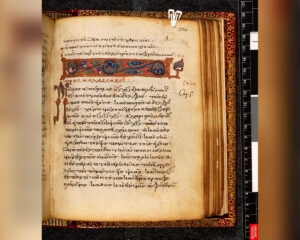
Harleianus 5557, dated to the 12th century. Photo: Public domain
Hearers of the Word: The Liturgy
The readings
At this time of year, we find ourselves with family a good deal more than usual. This brings its joys, of course, as well as the various stresses and tensions. As a result, the readings from Sirach and Colossians will speak to us more directly than usual…and we are invited to listen more closely than usual.
The responsorial Psalm
Psalm 128 (127) is really well chosen and it portrays the family around the table, happy and fruitful.
Sunday introductions
First reading
Sirach 3:3-7, 14-17
Although this reading comes from a very long time ago and a quite different culture, it still speaks across the centuries. In many ways, human nature does not change!
Second reading
Colossians 3:12-21
As we listen, we may find ourselves drawn into the values and attitudes described. Life would be wonderful if we were all a bit like this.
Gospel
Matthew 2:13-23
The attentive reader will notice echoes of the story of Moses — the threat at birth, the escape into Egypt and so on. Jesus is our “new” Moses.
Weekday introductions
Monday 29 December
Saint Thomas Becket, bishop and martyr
1 John 2:3-11
The Letter reflects on the Great Commandment. We are to “mind the gap” between what we say we believe and how we actually live. The standard set is high: we are to live the same kind of life as Christ lived. How can the commandment be both old and new? It is new because in the light of Jesus’ death and resurrection, we are enabled by the Spirit put it all into practice — a challenging idea.
Luke 2:22-35
The reading jumps forward to the presentation/purification. The calendrical inconsistency is worthwhile because (1) the imagery of light is sustained within the birth narratives and (2) the delightful picture of the very old Simeon holding the just-born child Jesus.
Tuesday 30 December
1 John 2:12-17
The reading addresses the hearers directly but needs careful handling. The “world” does not mean creation as such but whoever in creation is opposed to God.
Luke 2:36-40
Matching the story of Simeon, we hear the story of Anna, daughter of Phanuel. She too is old and at the same time a model of Jewish piety and trust in God. As a prophetess, she proclaims Jesus to all longing for deliverance.
Wednesday 31 December
St Silvester, bishop of Rome
1 John 2:18-21
As in all communities, it was not all light and joy in the community of John: some had departed and these are identified harshly with the Antichrist. Nevertheless, those who remain “have been anointed by the Holy One and have all received the knowledge.” In a word, the challenges are an invitation to a deeper sense of our identity in Christ.
John 1:1-18
We have heard this Gospel already over Christmas and it is good to have the chance to hear it again in tranquility, especially at the close of the year. The very last line has the ring of truth: No one has ever seen God; it is the only Son, who is nearest to the Father’s heart, who has made him known.
Thursday 1 January
Mary, the Holy Mother of God
Numbers 6:22-27
Today we have a blessing, a prayer for God’s help and presence as we start the new year. The psalm going with the reading continues the theme of blessing.
Galatians 4:4-7
Paul reminds us today that Jesus was born like one of us, a member of the Jewish people. Christianity is, in some way, the continuation of the Jewish faith, but for all humanity without distinction.
Luke 2:16-21
Today is the eighth day after the birth of Jesus and, according to Jewish tradition, the day for circumcising a newborn son. We are reminded that Jesus was Jew and that the roots of Christianity lie in God’s first chosen people.
Friday 2 January
Saints Basil the Great and Gregory Nazianzen, bishops and doctors
1 John 2:22-28
The reading reflects profound conflict in the community of the Fourth Gospel over Jesus’ identity. The tone is more confrontational than usual.
John 1:19-28
John the Baptist was a challenge to early Christians, precisely because John baptised Jesus. In this reading, the evangelist puts on the lips of John himself the word from Isaiah first used by Mark’s Gospel.
Saturday 3 January
The Most Holy Name of Jesus
1 John 2:29-3:6
Today we hear a justly famous passage, which goes simply and directly to the heart of the matter. The proclamation of the love of God is completed by presenting the consequences for us as believers.
John 1:29-34
What John says of Jesus reflects the understanding of the Fourth Gospel, an understanding which is deep and challenging. Most likely, we are not really hearing the opinion of the historical John the Baptist but the theology of the evangelist.