Christmas is a sacred time marking the birth of Christ and the dawn of Christianity. In Ireland, preparations begin weeks, and for some, months in advance. After Halloween, children write to Santa, and families make travel plans from faraway places to reunite for the festivities. Traditional celebrations include a four-course meal of chicken soup, roast turkey and ham, Christmas pudding with custard, and finally Christmas cake with coffee. Homes are decorated with lighted trees and friendly open fires that warm hearth, mind, and spirit.
I clearly remember as a child rising several times through the night to check if Santa had arrived. Yet few Christmases could contrast more sharply with our familiar Irish traditions than those spent by Kildare-born explorer Ernest Shackleton and his crew of twenty-seven men and seventy huskies on the bitter ice of Antarctica in December 1914 and again in December 1915. Trapped in the frozen Weddell Sea aboard the Endurance in 1914 and later stranded on drifting ice after the ship’s earlier sinking in 1915, they marked Christmas not with comfort but with courage, camaraderie, hope and faith in one another.
The birth of a leader
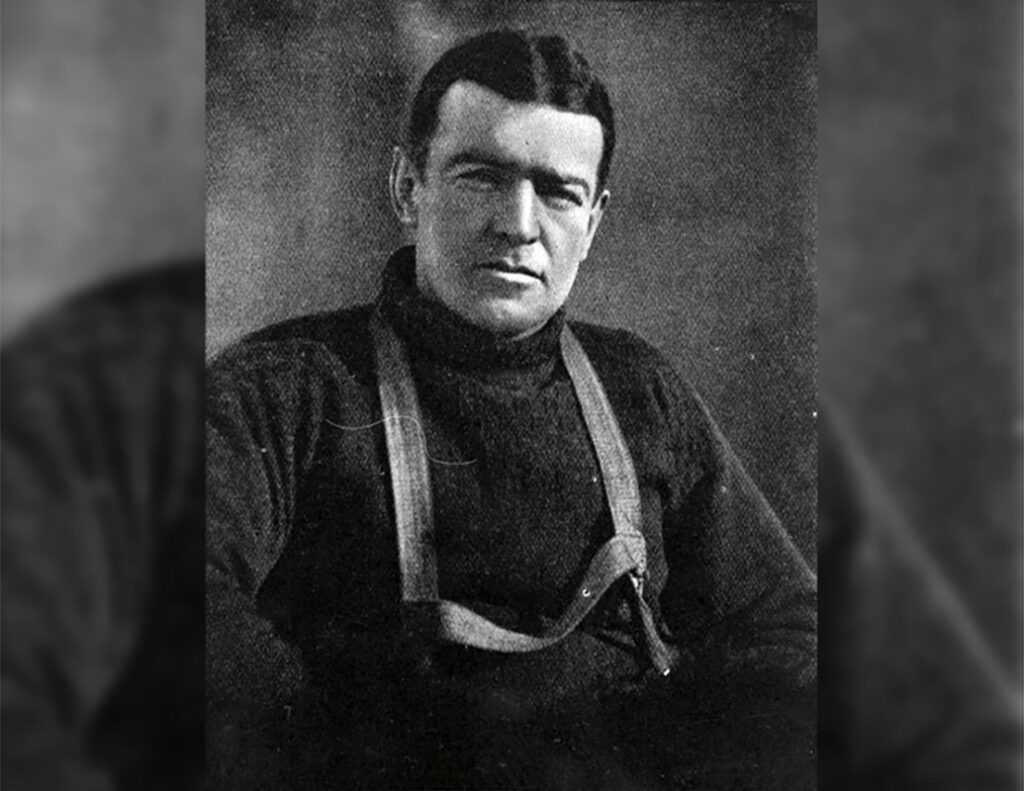
Ernest Shackleton was born in Kilkea, Co. Kildare, in 1874, and raised nearby in Athy before his family moved to London in 1884. From an early age he was drawn to exploration. He joined Captain Robert Scott’s Discovery Expedition to Antarctica between 1901–1904. Though they failed to reach the Pole, the experience deepened Shackleton’s determination to lead his own expedition.
In 1914, he launched the Imperial Trans-Antarctic Expedition, aiming to make the first land crossing of the Antarctic continent. To recruit his team, he placed a stark newspaper advertisement describing a “hazardous journey, bitter cold, long months of complete darkness and safe return doubtful.” Thousands applied from which Shackleton selected twenty-seven men, demonstrating the decisive leadership quality of recruitment and selection that later saved them all.
Years later, during my MSc research in International Business, I interviewed the CEO of Prizio Construction Ltd. in California. He remarked that if a leader fails to master recruitment and selection, no later initiatives including training will compensate. Shackleton’s success confirmed that truth: he hand-picked men whose character, attitude, skill, and spirit turned catastrophe into endurance and eventual survival.
Voyage into the frozen unknown
In August 1914, as Europe descended into war, Shackleton and his crew of twenty-seven carefully selected men and seventy sled dogs set sail aboard the Endurance from London, bound for the South Pole. They reached South Georgia Island on November 5, 1914, where Norwegian whalers warned them not to proceed, reporting the heaviest pack ice in memory. Shackleton faced a stark choice of abandoning the expedition and return to fight in the First World War or continue south into the unknown. He chose to proceed.
On December 5, 1914, the Endurance left South Georgia. Within weeks, she encountered the solid pack ice that the whalers had warned them about and the ship became trapped.
Christmas day on board the trapped ship, 1914
In any event, Shackleton and his men had expected to celebrate Christmas at the South Pole but not aboard an immobilised tightly trapped ship. Yet he made sure the day was honoured.
Cook Charles Green transformed the ship’s stores into a feast and served, penguin and seal stew, plum pudding, and mince pies, with rum and stout to toast the season. Shackleton allowed a rare relaxation of rations, and the on-board dining room became the heart of Christmas cheer.
Shackleton’s determined optimism set the tone. He moved among the men with contagious warmth, insisting they celebrate properly despite their predicament. He believed morale and courage were as vital as food, perhaps more so, and his extraordinary leadership turned potential despair into defiant joy. Christmas positivity shone through in his every word and gesture. Despite the underlying despair, Christmas Day brought the spiritual promise of hope and new life, and the men drew strength from that sacred meaning.
Twenty-seven men and seventy huskies became more than a crew; they became a united family bound by faith, courage, and the shared warmth of humanity”
The crew responded in kind. Music was played on the ship’s gramophone and improvised instruments. Men exchanged jokes, sang carols like Silent Night and O Come All Ye Faithful, and decorated the common areas with whatever they could fashion from ship supplies. Their laughter echoed through the frozen vessel, a deliberate act of hope against the ice. The men’s positivity mirrored Shackleton’s, keeping the Christmas spirit alive with songs, toasts, and shared faith in brighter days ahead.
Outside, the temperature remained around minus ten degrees, the sun reflecting on a frozen, silent sea. Inside, the Christmas spirit prevailed, toasts were raised to loved ones back home, friends, and to their eventual rescue and survival. It was a testament to Shackleton’s innate leadership skills to kindle light in darkness, and to the crew’s refusal to let the ice crush their survival instincts.
For that one frozen Christmas Day, the twenty-seven men and seventy huskies became more than a crew; they became a united family bound by faith, courage, and the shared warmth of humanity in the coldest place on earth.
Survival on the ice
After Christmas 1914, Shackleton formulated and implemented structure on life on the ice. He understood that discipline and morale were as vital as food and shelter. He created a daily programme of work, exercise, and recreation to keep minds and bodies active. Although outwardly confident, his private diary later revealed moments of doubt and anxiety.
To sustain morale, he organised football and hockey matches on the ice, husky races, card games, and communal meals. Sundays were reserved for rest and brief services of prayer. Each man had important duties: caring for the dogs, maintaining stores, or hunting seals and penguins for food.
By June 1915, the ice pressure had crushed the Endurance’s hull. On October 27, 1915, Shackleton ordered the crew to abandon ship. His focus shifted entirely to survival, planning to reach Elephant Island, a solid immovable rocky outcrop at the edge of the Antarctic Peninsula.
The trek across the disintegrating pack ice was brutal. They dragged three lifeboats, the James Caird, Dudley Docker, and Stancomb Wills, surmounting pressure ridges, covering barely a few kilometres a day. Carpenter Harry McNish protested that Shackleton’s orders no longer applied because the ship was gone.
Shackleton immediately confronted him, warning that insubordination would endanger them all. McNish backed down and later played a crucial role in reinforcing the James Caird in preparation for the rescue trip to South Georgia.
A second Christmas in the ice
Before they realised it, another Christmas had arrived, unplanned but nevertheless celebrated.
By December 1915, the men were no longer aboard the Endurance. Instead, they lived on Ocean Camp, a makeshift settlement on drifting ice floes, surrounded by salvaged supplies, three lifeboats, and tents exposed to the relentless cutting Antarctic winds.
Cook Charles Green again worked miracles with dwindling supplies, preparing a modest Christmas feast from seal meat, hoosh, biscuits, and cocoa.
The Christmas spirit took on deeper meaning that year. Faith, hope and fellowship replaced comfort. The men spoke of families gathered around fires back home, of warm churches lit with candles. Shackleton encouraged them to see beyond the present, to believe that just as the Christ Child brought light to a dark world, light would return to them.

Ocean Camp, Weddell Sea,
1915. Photo: Public Domain
They shared stories of home and prayed together. Despite hunger, cold, and uncertainty, they refused to surrender hope”
Shackleton’s Christmas positivity lit brighter than ever. He knew this was the crew’s darkest hour, stranded on ice, no ship, no certainty of rescue, and yet he refused to let despair take root. He moved from tent to tent with gifts he’d saved including, cigarettes, sweets, small tokens that spoke “You Matter”. He raised a toast to their families and to survival.
The men’s response matched his optimism. They sang carols under the midnight sun, joked about ‘ice hotels,’ and performed skits. Photographer Frank Hurley captured images of smiling faces. Meteorologist Leonard Hussey played his five-string banjo, the one luxury Shackleton allowed him to keep. That night, they gathered for a short prayer of thanksgiving. Shackleton reminded them that Christmas had always symbolised endurance, renewal, hope and divine promise.
The Christmas spirit lived in their unity. They shared stories of home and prayed together. Despite hunger, cold, and uncertainty, they refused to surrender hope. This Christmas was about brotherhood, faith, and the sacred belief that light would return.
On that second Christmas, the ice held no warmth, yet the men found it in each other, a brotherhood bound by faith and shared endurance.
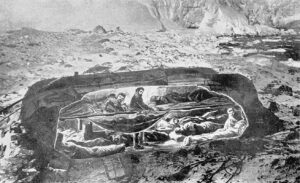
Photo: Public Domain
Fulfilling the promise of ‘bringing you all home safely’
Once the men safely reached Elephant Island, Shackleton then knew that he had to reach South Georgia for rescue. He chose carpenter Harry McNish, whose skill would strengthen a lifeboat for the journey. He selected Captain Frank Worsley for his navigational precision, Tom Crean from Co. Kerry for his positivity and endurance, John Vincent for his physical strength, and Timothy McCarthy, an upbeat steadfast Cork sailor.
On April 24, 1916, they began the 800-kilometre voyage from Elephant Island to South Georgia, now regarded as the greatest small-boat sea crossing in history. For sixteen days they faced freezing spray, gales, and seventy-foot-high waves. Shackleton remained at the tiller for long hours, refusing rest.
When land appeared on May 10, 1916, they had reached the uninhabited south coast. Shackleton, Worsley, and Crean set out across the mountains, forty kilometres of uncharted glaciers never before crossed. Without ropes or maps, they marched for thirty-six hours until they heard the whaling station’s steam whistle.
His word was his bond, his faith unbroken, his extraordinary leadership absolute”
Shackleton immediately secured a ship and launched repeated rescue attempts. Finally, on August 30, 1916, he reached Elephant Island aboard the Chilean vessel Yelcho.
Not one life had been lost. Shackleton’s promise, “I will bring you all home safely” was fulfilled. His word was his bond, his faith unbroken, his extraordinary leadership absolute.
Shackleton’s steadfast faith, compassion, and unyielding moral courage revealed a leader whose strength was not only of body and mind but of spirit, guiding his men through darkness as surely as faith guides humanity through despair.
Just as Christ came into a dark broken world to bring salvation and light, Shackleton, through faith and selfless resolve, became a saviour to his men, proving that salvation can also be found in human courage, compassion, and unbreakable promise.