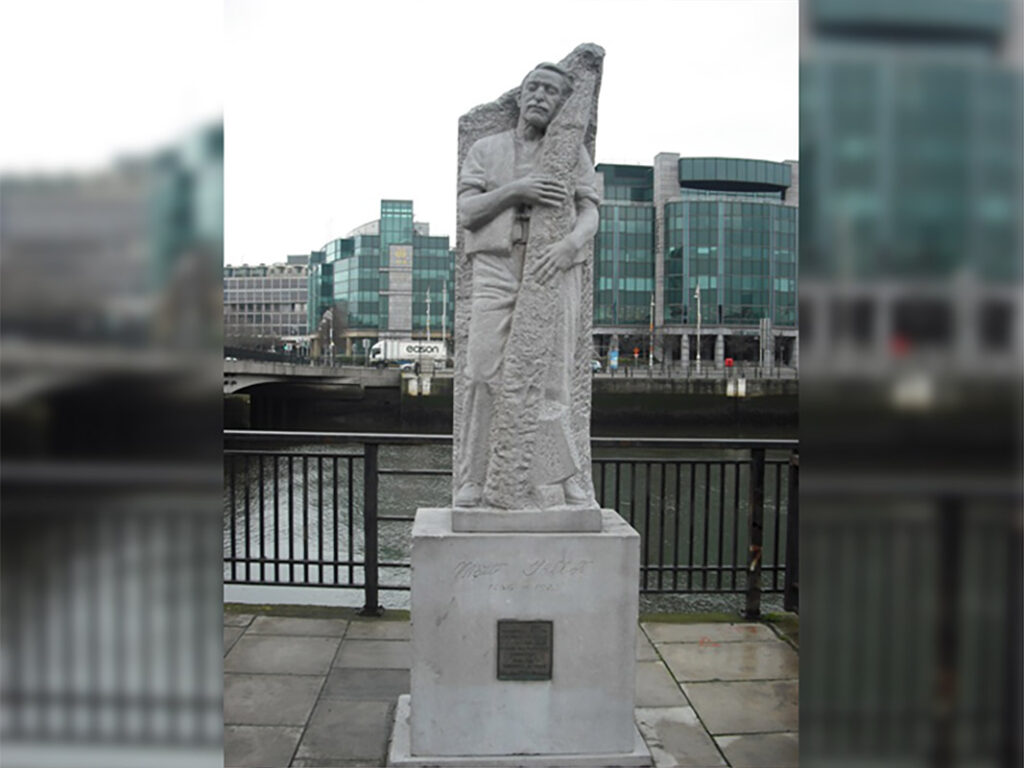
Matt Talbot lived in stirring times; the Lockout of 1913, the First World War, The 1916 Rising, The War of Independence, The Civil War. Some believe mistakenly that these events didn’t impact on him. Although it’s true that no checkpoint would keep him from daily Mass, he was well aware of the intense suffering that industrial strife, deprivation and war inflicted on the poor.
Qualities
Now at the end of his centenary year, there are many qualities about him that come to mind. His personal discipline, his fearless, independent-minded nature, his constancy to prayer and fasting, (his spiritual adventure steeped in an older Celtic tradition); his dislike of gossip and his way of finding something positive to say about anyone being criticised; his legendary respect for the Lord’s name where a raising of his hat became enough to register his disapproval.
His ascetical life of penance and vigil left him tender-hearted rather than harsh”
But his sensitivity to the suffering of others stands out. Early in recovery, when he realised he could not trust himself near a pub with money in his pocket, he decided never to carry any. In time perhaps he saw a deeper meaning to this practice and like St Francis felt that to be a follower of Jesus was to be a poor man, putting whatever money he had at the disposal of those in need.
At times this meant giving a fellow workman the price of a pair of boots. Or making sure the old woman who would sit in doorways and smoke a pipe would have a weekly fill of tobacco. Or giving money for rent to a mother whose family were threatened with eviction. Or during the Lockout of 1913, passing on any surplus to parents struggling to feed their children. Or supporting the Poor Clares in Newry or the famous orphanage of Fr Drumgoole in New York or donating to the young Columban society in their mission to China. And so on.
This neighbourly sensitivity also extended to animals. The story of the rat that was nibbling his piece of bread is enlightening. Young Paddy Laird recalls it like this: “One lunchtime when I called in to see Matt, I spotted a rat on the table nibbling Matt’s crust of bread. I was about to throw a stone at it when Matt intervened and ‘spoke gently’ to the rat who scampered off. He then explained to me that the rat had important work to do in the sewers and was one of God’s creatures. Noticeably, his ascetical life of penance and vigil left him tender-hearted rather than harsh.”
Depth
On another front, his well-thumbed copy of the Catholic Bulletin of November 1916, shows how he had marked the article carrying the names and photographs of four men who had died in the rising. Gerard Keogh, aged twenty, shot dead outside Trinity College; Fred Ryan, aged seventeen, killed while covering the retreat of his comrades; Peter Wilson, aged forty, killed along the quays, his mother still looking for his body. Jack O’Reilly, aged thirty four, released from prison in ruined health who died a few weeks later from pernicious anaemia. This quadruple memory card, reflects his biographer, Mary Purcell, must have affected Matt deeply as she attributes to him the pain of the Mother in Padraig Pearse’s poem, and imagines him, “speaking their names to (his) own heart in the long nights”.
Matt went deep. He knew how to be quiet, and when to speak; from whom to source his direction and who were the great ones worth following. These were his true heroines; many of them women like St Teresa of Avila, St Catherine of Siena, St Thérèse (the Little Flower). It’s interesting how many of them have been recently declared Doctors of the Church including St John Henry Newman, a favourite of his.
I said to her one day, ‘poor Mam’, to which she replied immediately, ‘poor everyone’”
Above all, he was in love with God. Nothing else can explain this total absorption in the life of the Spirit. Reading sustained him. Daily work as an unskilled worker, grounded him. His Union membership kept him close to the men on small wages. His life as a tenement dweller meant he was never out of touch with the grinding poverty of neighbours and his neighbourhood. In his unique way, he embodied a life of contemplation and action in being neighbour to others
And a story to finish. When my mother was doing her final sojourn in hospital following a stroke, I said to her one day, ‘poor Mam’, to which she replied immediately, ‘poor everyone’. I have never forgotten that. We are one body. ‘Poor everyone’ indeed. Something Matt believed and could have said.