Congrats on Herzog, now reinstate Villa Spada
Dear Editor, this is a letter to An Taoiseach Micheal Martin, Tánaiste Simon Harris and Minister for Foreign Affairs and Trade and Minister for Defence Helen McEntee. We wish to commend you on your opposition to the proposal to rename Herzog Park.
As Irish citizens who place great value on our historical and cultural identity we do not agree with the proposal. We remember how Msgr Hugh O’Flaherty risked his life to save thousands of allied prisoners of war and Jews, and Mary Elmes, a Cork woman who did likewise.
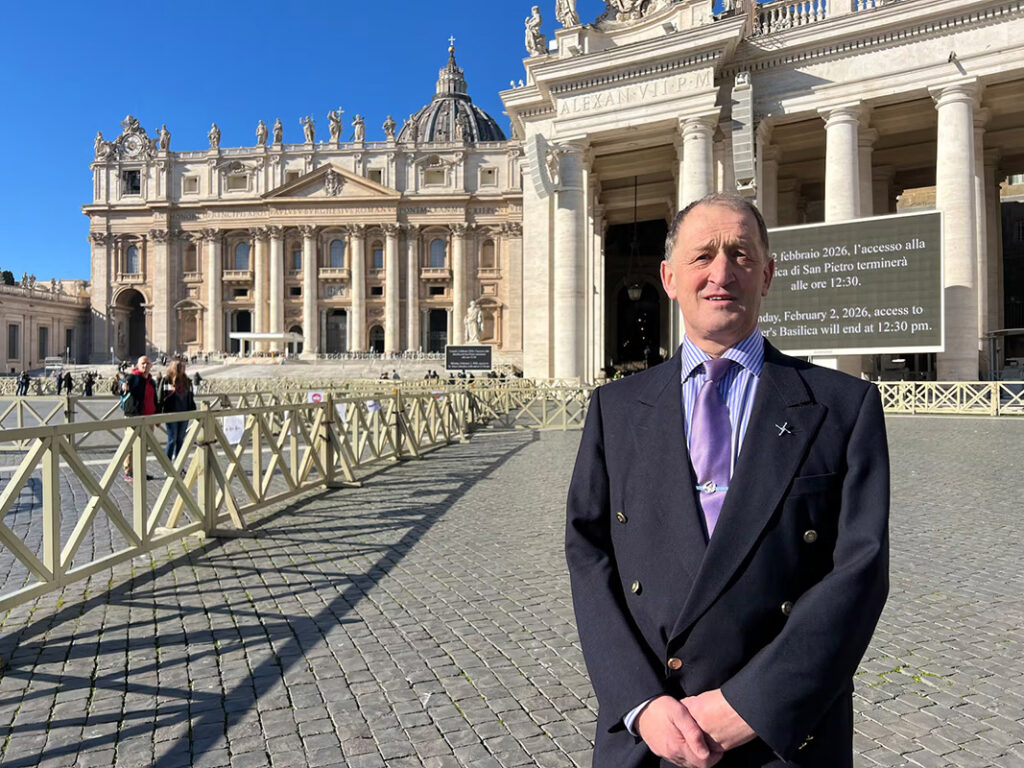
However, we would ask you to reflect on how, for the past 14 years, we have campaigned to see Villa Spada reinstated to serve again as Ireland’s Embassy to the Holy See. Our links with the Holy See are part of the rich tapestry of our Christian heritage. Villa Spada was purchased in 1946, on behalf of the Irish people, to house our Embassy. In 2026, it will be eighty years since Ireland acquired Villa Spada after Roosevelt’s envoy Myron C. Taylor did the bidding. He was good friends with Joseph Walshe, our ambassador and said:
“Ireland has a very special position in the Catholic World and in Rome should have an Embassy worthy of Ireland.”
We are asking for a commitment from you that by 2029, the 100th anniversary of diplomatic relations between the Holy See and Ireland and the bicentenary of Catholic emancipation that it be reinstated and, like Herzog Park, not be a denial of our history.
We look forward to a response, and we are more than happy to send a delegation to meet with you.
Yours etc,
Mary E. Fitzgibbon
Spokesperson for Ireland Stand Up
Drogheda deserves more credit for the ‘Mass of the Bells’ logistics
Dear Editor, I read with interest the TV/Radio review of Brendan O’Regan (The Irish Catholic, November 27). Your correspondent makes mention of the “Mass of the Bells” which was recently broadcast on RTÉ television. While Mr O’Regan found the music to be “impressive”, he expresses some concern at the fact that the choir and orchestra were positioned between the celebrant and the congregation. As someone who was privileged to be present on this great occasion, I feel your correspondent’s comments were somewhat petty and mean-spirited.
This was the premiere celebration of a Mass composed by Michael Holohan honouring the fourth centenary of the birth of St Oliver Plunkett. It presented great logistical challenges. The choirs and orchestra consisted of more than two hundred members. Accommodating them in any church would be difficult, and great credit is due to the Drogheda community, who “played a blinder”. I feel Mr O’Regan might have given a little more credit to the folks concerned.
Yours etc,
Fr Iggy O’Donovan OSA
Thomas Street, Dublin 8
‘General absolution’ is an abuse of the sacrament
Dear Editor, coming up to Christmas there will be penitential services in many churches. In some places, sadly, this will take the form of general absolution, which is an abuse of the sacrament of penance when there is no emergency; and, even if there were an emergency, survivors would still be bound to confess individually.
Another abuse is that of the priest standing at the sanctuary steps, similar to the position he takes when giving out Communion, with the penitents coming up in single file. This is not conducive to people making a good confession who have serious matter to confess or who might need to discuss moral problems.
On the contrary, it is most conducive to people making bad confessions by having them keep back things that most need to be aired. To add to this abuse, some priests will even tell people that there is no need to make a full confession, even of mortal sins, that they need only tell one or two ‘representative’ sins and that all will be well. This flatly goes against the old rule of confessing all of one’s mortal sins in number and kind for an integral confession, and the advisability of confessing venial sins also.
These abuses of the sacrament of penance were introduced by some missionaries about forty years ago and then taken up by some diocesan priests. When the number of penitents is high, encouraged as they are by these abusive practices, these priests then congratulate themselves on having done a good job when in fact they have trivialised this sacrament and left people in their sins. Then on Christmas morning, when such people go up to receive Communion, they add sacrilege to sin. What a way to welcome the Lord who came to free us from sin!
Yours etc,
Fr Richard O Connor
Kerry and Rome
The Blessed Virgin does not make false promises
Dear Editor, the emerging ‘co-redemptrix’ dispute in the Vatican has not only dismayed the Catholic faithful but has rocked the Catholic Church to its core. The Church hierarchy should call into question the centuries held belief that the Blessed Virgin Mary is the Mediatrix of God’s graces. Moreover, the pronouncement by the Vatican that the Mother of God should no longer be regarded as co-redeemer on the grounds that it causes “confusion” is anathema.
Confusion for whom one may ask? Certainly not the laity, who for hundreds of years have invoked Our Lady under this title for a myriad of graces, not least of which is the grace of a happy death. Indeed, it is under this grace that the Blessed Virgin promised salvation for souls for those who recite the Holy Rosary daily. The Blessed Virgin does not make false promises and, by God’s Holy Grace, her Immaculate Heart will triumph.
Vatican, take note.
Yours etc,
Ernest McCarthy
Mornington, Co. Meath
A confusing experience
Dear Editor, recently I attended the Golden Jubilee Mass at a parish church. It was a lovely celebration. I was amazed to find the local Church of Ireland minister in the sanctuary with the priest. He read the Gospel, preached the sermon and was dressed in a white garment with the other priests. He took part in the Eucharist just like all the others. Is this now allowed, or am I and other ‘pew Catholics’ not au fait with current teachings?
Yours etc,
Joseph Hogan
Portumna, Co. Galway
This week last year
Don’t burn out this Christmas bishops urge very busy priests
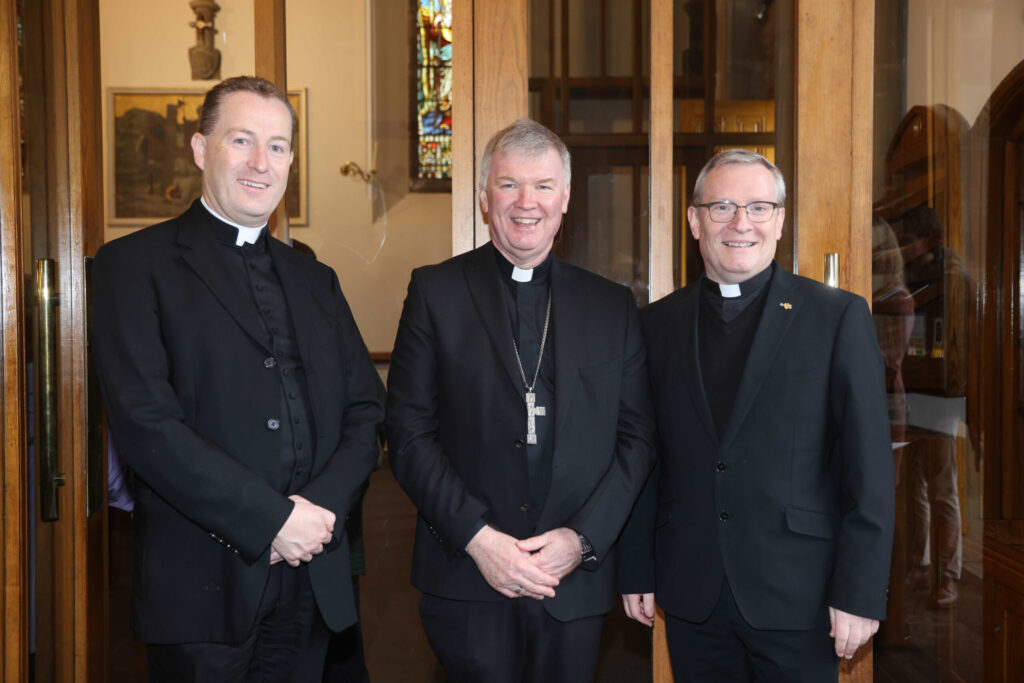
Auxiliary Bishops Donal Roche (Dublin) and Michael Router (Armagh) urged priests to seek support as Christmas brings added pressure to an already demanding year. They encouraged sharing workloads, involving lay people, and considering simpler Christmas services—especially child-friendly celebrations of the Word without Communion—to ease strain. Both highlighted burnout caused by accumulated responsibilities. Priests Fr David Vard and Fr Joe Deegan noted reduced volunteer numbers, declining Mass attendance, and fewer clergy, prompting parishes to cut back Christmas Masses and ask parishioners to adjust expectations. All emphasised understanding, collaboration, and planning to ensure sustainable ministry during the busy season.
Archbishop Martin attends Notre Dame reopening
Notre Dame Cathedral in Paris reopened on December 7, five years after a devastating fire destroyed its roof and iconic spire. Archbishop Eamon Martin of Armagh attended the reopening Mass, representing the bishops and people of Ireland at the invitation of Archbishop Laurent Ulrich of Paris. He praised God for the restoration and for all who helped save and rebuild the 850-year-old cathedral. Paying tribute to artists and craftspeople, he celebrated the cathedral’s renewal as a symbol of faith. Archbishop Martin also prayed for the Church worldwide, asking for renewed faith in Ireland, France, and across the globe.
Priests welcome push for 10-minute homilies
Pope Francis has urged priests to keep homilies under ten minutes, saying anything longer becomes unclear. Three Irish priests welcomed this guidance. Fr Benedict McGlinchey OP supports concise preaching, noting limited attention spans and the need to focus on one practical theological point. Fr Eoghan Ó Cadhla said social media has shaped expectations for brief, direct communication and believes congregations prefer shorter homilies. Fr Paddy Byrne praised the Pope’s practical advice, warning that long, unprepared sermons lose impact and audience engagement. All three agreed that well-prepared, concise preaching is essential for effective evangelisation in today’s Church.