Trendy cafés and plush boutiques line the streets of Achrafieh, an upmarket neighbourhood where colourful Ottoman, French colonial, and art deco homes sit side by side near Beirut’s downtown district. The breeze carries the rattle of reconstruction from the damaged port area, while far overhead a surveillance drone sent from Lebanon’s southern neighbour buzzes relentlessly throughout the day.
Only when one looks upwards, above the shiny shopfronts and pretty verandas, is one spirited away from an idyllic Mediterranean present into the days of Lebanon’s difficult past. More than three decades after its civil war ended, many buildings remain bullet-scarred and shell-pocked.
Beirut’s wounded façades, barely noticed by those passing beneath them, point to a reality often overlooked yet still lingering: the war’s wounds endure – not only in stone, but also in the heart of a nation wrestling with its history, weathering a difficult present, and searching for a future it can build together.
Reconciliation
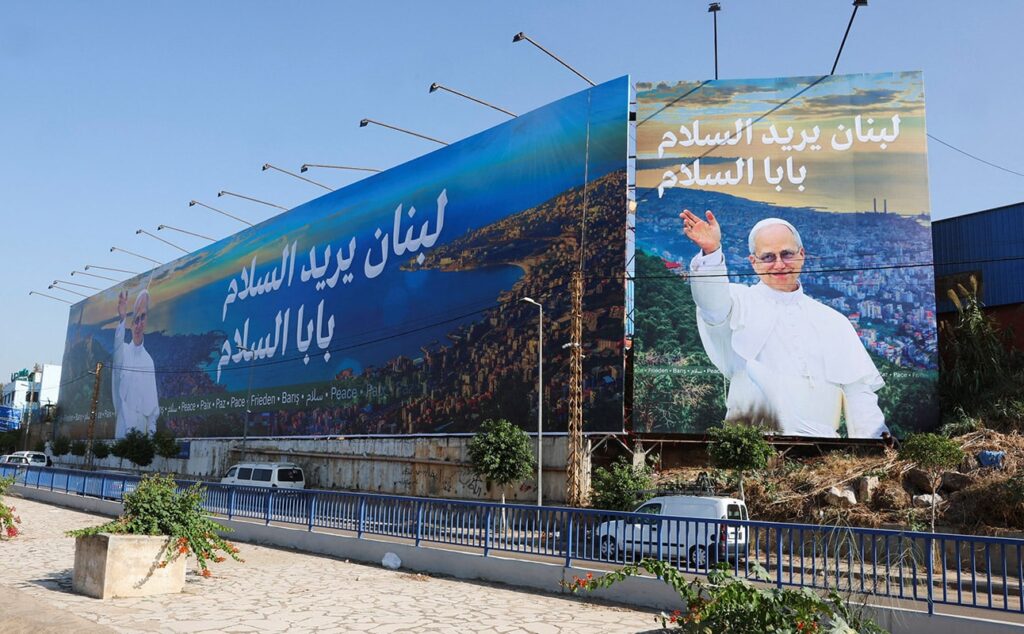
Pope Leo’s visit is therefore timely, a balm to strengthen Lebanon’s Christian community and to promote reconciliation and peaceful co-existence among the country’s patchwork of religious confessions. Down at Martyrs’ Square – once the demarcation line dividing the city’s communities – a gathering of interfaith leaders will stand as a daring symbol of peace and unity for the nation.
Preparations are well underway for the Pope’s arrival, with a large marquee taking shape for the meeting. Designed in the form of a house, it evokes the home Lebanon provides for its diverse confessions living under one roof, with a circular stage representing the unity of the human family and olive-tree motifs symbolising peace.
The Pope reminds us that the Nicene profession of faith in Jesus Christ as true God and true man is ‘the common heritage of Christians’”
Denise Taouk is organising the Pope’s meeting with the leaders of Lebanon’s diverse religious communities, and I distract her from supervising the marquee’s construction for a few moments to chat. “This visit is very meaningful for us, especially as it’s one of the Pope’s first foreign trips,” Denise tells me. “It is important to Lebanese Christians at a time when our numbers are dwindling and we want peace in the region. He comes to us in the name of peace,” she adds.
Pope Leo’s message of peace and unity will first be carried to Türkiye, where the pontiff is due to commemorate the 1700th anniversary of the First Council of Nicaea before travelling on to Lebanon. Writing in his Apostolic Letter In unitate fidei ahead of his journey, the Pope reminds us that the Nicene profession of faith in Jesus Christ as true God and true man is “the common heritage of Christians.”
Creed
It is the Nicene Creed – recited each Sunday by Christians around the globe – that stands as an expression of shared belief and a bridge between communities otherwise divided. Pope Leo recognises the hope such a common sign of unity can bring to a world suffering “so many concerns and fears, threats of war and violence, natural disasters, grave injustices and imbalances, and the hunger and misery suffered by millions of our brothers and sisters.”
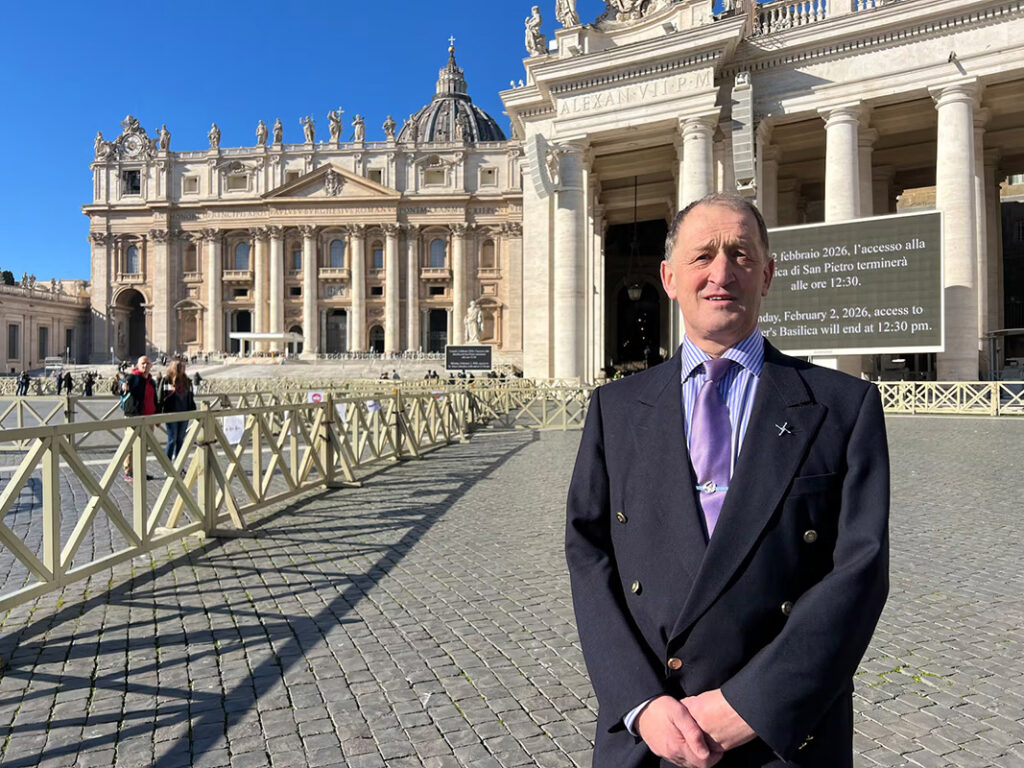
Speaking by phone from Jerusalem, Frans Bouwen M.Afr reflects on the significance of the Pope’s journey to Türkiye and his common prayer with Orthodox Patriarch Bartholomew. The White Father missionary has spent more than six decades working in the ecumenical field in the Holy Land and is a long-standing participant in the International Catholic–Orthodox Dialogue.
There will undoubtedly be a strong call to mutual reconciliation and unity between the Churches, strengthening our common faith”
“These papal visits were always intense moments of communion and common commitment to the search for full and visible unity,” he explains. “Whilst we should not expect any special announcement, we can expect both the Pope and the Patriarch to reaffirm their shared commitment to pursuing full communion and to continuing the Theological Dialogue between their Churches.”
“There will undoubtedly be a strong call to mutual reconciliation and unity between the Churches, strengthening our common faith in Christ and our shared witness to the Gospel in today’s world,” Frans adds. “Our world today is deeply in need of this message, as almost everywhere the powers of evil and death seem to prevail, respect for the life and dignity of all human beings created in the image of God is disregarded, and new barriers are erected between peoples, cultures, and religions.”
Need
Pope Leo’s pilgrimage to Türkiye strikes a prophetic note and offers a wise lesson ahead of his later arrival in Lebanon. By underlining the shared bonds between Catholic and Orthodox Christians, the Pope not only calls for deeper unity among them but also seems to recognise this as a prerequisite for a common witness and contribution to a world in need.
The people of this region hope that Pope Leo’s visits to Türkiye and Lebanon will inspire the building of this future here”
Wandering around Achrafieh, I become convinced that by lifting our gaze beyond the scarred walls above, we might dream of the God-given possibilities for reconciliation and unity. The people of this region hope that Pope Leo’s visits to Türkiye and Lebanon will inspire the building of this future here and now, fostering closer bonds between the followers of Christ and with their brothers and sisters of the Abrahamic faiths.
Justin Robinson OSB is a monk of Glenstal Abbey in County Limerick currently residing in Cairo.