Question: Rebuilding the Gaza Strip – given the images, that sounds like an almost impossible task. What is needed first?
Answer: Humanitarian organisations need unrestricted access to the Gaza Strip. Even before the war – as I was able to see for myself during regular visits to the coastal area until 2019 – the overwhelming majority were dependent on external aid. This need has now increased dramatically at all levels. During a conversation with the Deputy Commissioner General of UNRWA, whose headquarters are located in Amman, I was presented with the latest figures.
Question: What do these figures tell us?
Answer: Almost the entire population has become internally displaced in phases in the small area and 80 per cent of the infrastructure has been destroyed. So far, we have not seen any simplified access policy for humanitarian aid. In addition to immediate aid, there needs to be a reliable timetable for the actual reconstruction, a perspective for an open Gaza Strip and a concrete vision for a democratic Palestinian state. Everyone in the region and in the West must face up to this task, because too many actors share responsibility for the political and historical failures that have led to today’s catastrophic situation.
Question: A Gordian knot.
Answer: I also want to mention the human dimension: over 65,000 people – perhaps many more – have been killed in Gaza. Individual and collective trauma therapy is needed so that Palestinian society in Gaza can come to terms with this terrible experience.
Question: What will become of Hamas?
Answer: Israel has not achieved its war goal of destroying Hamas. Two points are important to me here from an analytical perspective: Hamas not only has a militant wing that is violently rebelling against Israel in the form of the Qassam Brigades. The political and social wings, with which the movement reaches far into Palestinian society, also continue to exist. Secondly, we see that Hamas is also acting self-confidently in these hours: after the first withdrawal of the Israeli army, 50 per cent of the Gaza Strip is no longer under Israeli control. Hamas is now claiming to continue to ensure order here. In recent days, it has already used armed force against members of the opposition and collaborators.
Question: What does that mean in practice?
Answer: If Hamas succeeds in generating new or old support via its regional Islamist network, it will continue to be an actor in the conflict because it is the dominant force in the spectrum of political Islam in Palestine. It is therefore all the more important to think about reforms for political renewal in all occupied territories: the containment of Hamas must also be advanced domestically through reforms of the Palestinian Authority.
Question: What roles can the churches play in the Middle East?
Answer: The church is challenged on three levels: firstly, we need to address the question of what has actually been done for the Palestinian Christians in Gaza – and what has been neglected. Before the war, their number was around 1,000, and it is completely unclear whether and how there will still be Christian life in Gaza at all due to the lack of independent reporting. Violence against Christians in the West Bank has also recently increased significantly. That should worry us much more!
Question: Secondly?
Answer: I look at the humanitarian and development aid provided by the churches, which is undoubtedly impressive. But I think that the current state of emergency depends on good church donor coordination so that we don’t block each other. And thirdly, we need to put our Christian convictions into practice right now: Relativisations and justifications of acts of war should be far from our minds. Politically speaking, the Church should do everything in its power to ensure that politics follows international law – and not international law follows politics.
Question: In Sharm el-Sheikh, Egypt’s President al-Sisi once again brought up the two-state solution as the only way to permanently resolve the conflict. How realistic is that?
Answer: The two-state solution is still the international consensus. From the perspective of international law, it is the only way to fulfil the Palestinian right to self-determination. Imagining two states almost 30 years after the Oslo peace process requires a great deal of imagination today: the expansion of illegal settlements, accompanied by violence by extremist settlers against the civilian population, continues unabated, while the Israeli army is increasingly reluctant to take action against them.
Question: That doesn’t exactly look like de-escalation…
Answer: The Israeli military is also present in Palestinian towns on the West Bank on an almost daily basis – I personally only know such provocations from the time of the Second Intifada from 2000 onwards. At the same time, Israel’s political spectrum has shifted to the extreme: the voices of those openly in favour of annexation and expulsion are increasing.
Question: What are you observing on the Palestinian side?
Answer: I am also concerned about the Palestinian leadership: although President Mahmoud Abbas is a strong advocate of a peaceful settlement of the conflict in line with European ideas, he also remains at the head of the autonomous authority primarily by means of authoritarian rule: Elections have been overdue for 16 years, his support is very low; the division between Gaza and the West Bank has degenerated into normality.
Question: What should Europe do?
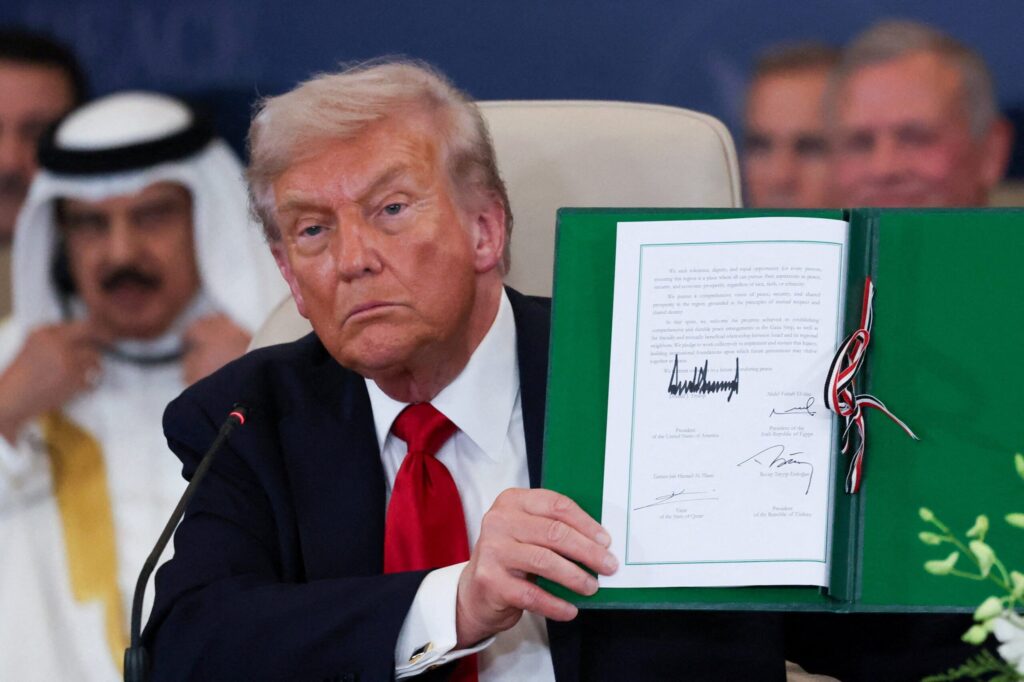
Answer: Brussels and Berlin must link the second phase of Trump’s peace plan with the ambition to take on a political role. Of course, the civilian population in Gaza must be helped unconditionally. But the pressure on the leaderships in Ramallah and Tel Aviv must be increased. This is the only way for the Europeans to regain lost trust. The main way to do this is to add chapters to the plan that are completely missing.
Question: What are they?
Answer: The 20 points are not about the situation in the West Bank, they are not about the Palestinian leadership in Ramallah – and above all, not a single line is about how the Israeli-Palestinian conflict itself will be resolved. If a more ambitious Middle East policy does not succeed, it would be advisable for all European planning staff to draw up scenarios for alternatives to the two-state solution. By then at the latest, everyone should realise that the political, humanitarian and economic costs of preventing Palestinian statehood would provoke much higher costs and even more suffering.