Exodus 17:8-13; Psalm 121 (120); 2 Timothy 3:14-4:2; Luke 18:1-8
Jesus told a parable about their need to pray always and not to lose heart
Luke 18:1 Then Jesus told them a parable about their need to pray always and not to lose heart.
Luke 18:2 He said, “In a certain city there was a judge who neither feared God nor had respect for people.
Luke 18:3 In that city there was a widow who kept coming to him and saying, ‘Grant me justice against my opponent.’
Luke 18:4 For a while he refused; but later he said to himself, ‘Though I have no fear of God and no respect for anyone,
Luke 18:5 yet because this widow keeps bothering me, I will grant her justice, so that she may not wear me out by continually coming.’”
Luke 18:6 And the Lord said, “Listen to what the unjust judge says.
Luke 18:7 And will not God grant justice to his chosen ones who cry to him day and night? Will he delay long in helping them?
Luke 18:8 I tell you, he will quickly grant justice to them. And yet, when the Son of Man comes, will he find faith on earth?”
Initial observations
This parable is found only in Luke’s Gospel where it has a parallel in another parable, The Friend at Midnight (see below). Generally, scholars would say that the parable predates Luke. The evangelists has provided a heading in v. 1 and a conclusion in v. 8b. Vv. 6-7ab sound like the comment of an early Christian prophet. The comment is slightly inept because God is equated to the unjust judge. Vv. 7cd-8a sound like a reassurance as people adjust to the delay in the second coming. V. 8b comes from Luke when the expectation of the parousia had relaxed significantly.
Kind of writing
This is a parable, which means that the details cannot be pressed too hard. Usually a parable has a main point to make. In this passage, Luke gives the parable a heading which points us clearly to the message: Then Jesus told them a parable about their need to pray always and not to lose heart. The “surprise” in the parable is in the strength of character shown by the widow. She is not defenceless, meek and passive—anything but! There is even a possibility (see below) that the judge feels physically threatened by her.
Some “reception history” is embedded in the text. V. 1 comes from Luke. Vv. 6-7 may come from an early Christian prophet, commenting on the parable. God, inappropriately, becomes the unjust judge. V. 8a may represent a stage when the end of time was expected. V. 8b is a more generalised comment by Luke himself, framing the parable.
Old Testament background
(i) Judges were supposed to treat everyone equally, on behalf of the Lord himself:
He appointed judges in the land in all the fortified cities of Judah, city by city, and said to the judges, “Consider what you are doing, for you judge not on behalf of human beings but on the Lord’s behalf; he is with you in giving judgment. Now, let the fear of the Lord be upon you; take care what you do, for there is no perversion of justice with the Lord our God, or partiality, or taking of bribes. (2 Chronicles 19:5–7)
(ii) Widows and orphans were regarded as especially vulnerable.
You shall not abuse any widow or orphan. (Exodus 22:22)
For the Lord your God is God of gods and Lord of lords, the great God, mighty and awesome, who is not partial and takes no bribe, who executes justice for the orphan and the widow, and who loves the strangers, providing them food and clothing. You shall also love the stranger, for you were strangers in the land of Egypt. You shall fear the Lord your God; him alone you shall worship; to him you shall hold fast, and by his name you shall swear. (Deuteronomy 10:17–20)
As a whole, the parable teaches that continual prayer is not simply passive waiting but entails an active, vigorous quest for justice.
New Testament foreground
(i) There is a considerable background to the parable in Luke’s teaching on prayer. Jesus praying: 3:21; 5:16; 6:12; 9:18; 9:29; 11:1; 22:41, 44-45; 23:46. In particular, he prays before his Baptism, the choosing of the Twelve, asking who do people say he is, the Transfiguration, the Lord’s Supper, Gethsemane and several times on cross. Likewise, Luke shows many people at prayer in this Gospel: Zechariah, Elizabeth, Mary, the angels and the shepherds, Simeon and Anna, the disciples and frequently Jesus himself.
(ii) Luke also gives women a high profile in this Gospel: Elizabeth, Mary and Anna (chs. 1-2); a widow whose son had died (ch. 7); a woman in the house of the Pharisee (ch. 7); Mary Magdalene, Johanna, Suzanna and “others” (ch. 8); the woman with the haemorrhage (ch. 8); Jairus’ daughter (ch. 8); a woman in the crowd (11 ch.); the woman bent over for 18 years (ch. 13); the widow at the Temple (ch. 21); the “daughters of Jerusalem” (ch. 23); Women at the cross and burial (ch. 23); Mary Magdalene, Joanna, Mary the mother of James, and the other women on Easter Sunday (ch. 24)
(iii) A good parallel is found in this parable and the comments which follow:
And he said to them, “Suppose one of you has a friend, and you go to him at midnight and say to him, ‘Friend, lend me three loaves of bread; for a friend of mine has arrived, and I have nothing to set before him.’ And he answers from within, ‘Do not bother me; the door has already been locked, and my children are with me in bed; I cannot get up and give you anything.’ I tell you, even though he will not get up and give him anything because he is his friend, at least because of his persistence he will get up and give him whatever he needs.
“So I say to you, Ask, and it will be given you; search, and you will find; knock, and the door will be opened for you. For everyone who asks receives, and everyone who searches finds, and for everyone who knocks, the door will be opened. Is there anyone among you who, if your child asks for a fish, will give a snake instead of a fish? Or if the child asks for an egg, will give a scorpion? If you then, who are evil, know how to give good gifts to your children, how much more will the heavenly Father give the Holy Spirit to those who ask him!” (Luke 11:5–13)
St Paul
See that none of you repays evil for evil, but always seek to do good to one another and to all. Rejoice always, pray without ceasing, give thanks in all circumstances; for this is the will of God in Christ Jesus for you. Do not quench the Spirit. (1 Thessalonians 5:15–19)
Finally, brothers and sisters, whatever is true, whatever is worthy of respect, whatever is just, whatever is pure, whatever is lovely, whatever is commendable, if something is excellent or praiseworthy, think about these things. And what you learned and received and heard and saw in me, do these things. And the God of peace will be with you. (Philippians 4:8–9)
Love must be without hypocrisy. Abhor what is evil, cling to what is good. Be devoted to one another with mutual love, showing eagerness in honouring one another. Do not lag in zeal, be enthusiastic in spirit, serve the Lord. Rejoice in hope, endure in suffering, persist in prayer. (Romans 12:9–12)
I always thank my God as I remember you in my prayers, because I hear of your faith in the Lord Jesus and your love for all the saints. I pray that the faith you share with us may deepen your understanding of every blessing that belongs to you in Christ. I have had great joy and encouragement because of your love, for the hearts of the saints have been refreshed through you, brother. (Philemon 1:4–7)
Brief commentary
Verse 1 Luke often puts a heading over a parable, so that his meaning would be super clear. The risk of losing heart has a strong resonance today.
Verse 2 Judges were supposed to be even-handed and fair. This judge is three times described as unjust, once by the narrator, once by himself (!) and finally by the Lord. He really was unjust.
Verse 3 The widow is very, very persistent, rather like the friend in Luke 11:5-13.
Verse 4 The change is attitude is marked by a shift to internal monologue, as in the case of the prodigal son (“he said to himself”).
Verse 5 Her persistence bears fruit and he’s afraid of being worn down and exhausted. The word for “wear out” has potentially a shocking force. The basic meaning is to blacken the eye, by striking in the face. It could also have a more simply metaphorical meaning of to bring into submission in constant annoyance. Either way, the woman shows considerable spirit.
Verse 6 The comment by the Lord in 6-7b is really an a fortiori argument, along the lines, “all the more so will God…”. The shock of comparing God’s role to that of judge who requires badgering is defused by this comment. If bad people eventually give in, how much more will God give to his beloved. A comment of St Augustine may help:
Why he should ask us to pray, when he knows what we need before we ask him, may perplex us if we do not realise that our Lord and God does not want to know what we want (for he cannot fail to know it), but wants us rather to exercise our desire through our prayers, so that we may be able to receive what he is preparing to give us. His gift is very great indeed, but our capacity is too small and limited to receive it. That is why we are told: Enlarge your desires!
Letter of St Augustine to Proba
Verse 7 It is often thought that lines 7cd were not original but were added in the course of transmission to give an end-time urgency to the parable. This urgency is in some tension with Luke’s theology of time because he foresees a (longish?) period of the church before the end.
Verse 8 To bring the teaching into his own worldview, Luke added this last verse. Now is the time to have your faith grow and flourish. It is, of course, a verse that resonates with us today.
Pointers for prayer
- The purpose of prayer is not to change God’s mind, but to change ourselves and we can be slow to move. When have you found that persistence in prayer strengthened your faith in the presence of God with you in that struggle?
- The context of the story may be a concern about the delay in the final coming of the Lord. Have there been times when your persistence in prayer, or action, was eventually rewarded after a period when you had doubts about the outcome? What were the fruits of your persistent prayer?
- Behind the story lies the final question of Jesus: Who does have faith? Who have been models of faith and trust in God for you? How has that trust been shown in their lives? How is it shown in yours?
Prayer
Lord, tireless guardian of your people, always ready to hear the cries of your chosen ones, teach us to rely, day and night, on your care.
Support our prayer lest we grow weary. Impel us to seek your enduring justice and your ever-present help. Through Christ our Lord. Amen.
2 Tim 3:10 You, however, have followed my teaching, my way of life, my purpose, my faith, my patience, my love, my endurance, 11 as well as the persecutions and sufferings that happened to me in Antioch, in Iconium, and in Lystra. I endured these persecutions and the Lord delivered me from them all. 12 Now in fact all who want to live godly lives in Christ Jesus will be persecuted. 13 But evil people and charlatans will go from bad to worse, deceiving others and being deceived themselves.
2 Tim 3:14 You, however, must continue in the things you have learned and are confident about. You know who taught you 15 and how from infancy you have known the holy writings, which are able to give you wisdom for salvation through faith in Christ Jesus. 16 Every scripture is inspired by God and useful for teaching, for reproof, for correction, and for training in righteousness, 17 that the person dedicated to God may be capable and equipped for every good work.
2 Tim 4:1 I solemnly charge you before God and Christ Jesus, who is going to judge the living and the dead, and by his appearing and his kingdom: 2 Preach the message, be ready whether it is convenient or not, reprove, rebuke, exhort with complete patience and instruction.
Initial observations
The basis for Christian proclamation is outlines in this letter: 2 Tim 3:8-9 and 16-17. Paul himself would have been happy to see his tradition placed within the biblical parameters as shown here.
Kind of writing
Our reading is part of series of comments, constituting the charge to Timothy: 2 Tim 3:1-17, 4:1-22 The stages are as follows:
3:1-9
People to keep away from
3:10-17
Precedents to follow
4:1-5
Final charge
4:6-8
Paul’s last testimony
4:9-18
Final requests
4:19-22
Closing greetings
Thus 3:14-4:2
bridges two sections from the document.
Origin of the reading
The best way to appreciate the context is to read 2 Tim 3:1-9, given below. Clearly there was major conflict and disruption. Consistently, Paul is put forward as the response: 1 Tim 1:12–16; 2:7; 2 Tim 1:11–12; 2:9–10; 3:10–12; 4:6–8.
Related passages
But understand this, that in the last days difficult times will come. For people will be lovers of themselves, lovers of money, boastful, arrogant, blasphemers, disobedient to parents, ungrateful, unholy, unloving, irreconcilable, slanderers, without self-control, savage, opposed to what is good, treacherous, reckless, conceited, loving pleasure rather than loving God. They will maintain the outward appearance of religion but will have repudiated its power. So avoid people like these. For some of these insinuate themselves into households and captivate weak women who are overwhelmed with sins and led along by various passions. Such women are always seeking instruction, yet never able to arrive at a knowledge of the truth. And just as Jannes and Jambres opposed Moses, so these people—who have warped minds and are disqualified in the faith–also oppose the truth. But they will not go much further, for their foolishness will be obvious to everyone, just like it was with Jannes and Jambres. (2 Timothy 3:1–9)
Brief commentary
Verse 14a On the personal example of Paul, Timothy is to be faithful to all that he has received.
Verses 14b-15 The elements of a good Jewish upbringing are outlined. Evidently, Timothy was well brought up as regards the faith: I recall your sincere faith that was alive first in your grandmother Lois and in your mother Eunice, and I am sure is in you. (2Timothy 1:5) The Law, the Prophets and the Writings all functioned as instruction and prayer-book. Following Pauline regards for the Scriptures of Israel, these are said to promote “wisdom for salvation through faith.”
Verses 16-17 This is a famous verse. “Writing” (= scripture or graphe) in the New Testament points always to holy scripture, viewed as a whole. “Inspired” (theopneustos) means literally God-breathed. “Is” has to be supplied in English but the NET version is accurate. Does the writing include at least some New Testament tradition if not texts? In light of 2 Tim 4:2, the indications are yes. By the time of the Pastorals, the emerging New Testament documents were already regarded as authoritative. Cf. 2 Pet 3:16–17. Teaching: the NT tradition. Reproof: cf. 2 Tim 4:2 below. Correction: in relation to behaviour. Training in righteousness: a pastoral formula, using a key Paul expression. The writing also uses the term training (paideia) which had very wide cultural resonance at the time.
Verse 1 This is a formulaic introduction to an exhortation. The qualifications given to Jesus are the key. Firstly, there is going to be a judgment and the work of the evangelist will be assessed. Secondly, this judgement is grounded in the certainty of the Second Coming (literally “epiphany”). The greatest possible significance is given thereby to the role of the preacher (no pressure, of course!).
Verse 2 The first two words are technical terms in in early Christianity. “Proclaim” (kerygma comes from it) means effective proclamation. “Word” (logon) is shorthand for the Gospel about Jesus. The Greek has effective word play: convenient (eukairos) or not (akairos), caught better in the NRSV: “whether the time is favourable or unfavourable.”
Pointers for prayer
- When did I discover for myself the power of Scripture as the Word of God, a place of encounter?
- Being faithful to what we learned as children does not mean childish faith, of course!
Prayer
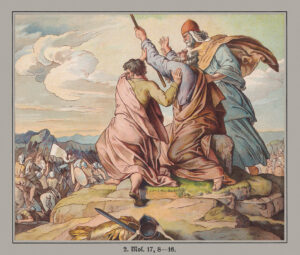
I thank you, O God, for your word, a lamp for my steps and a light for my path. As I open your word, may your Spirit open my heart so that your living word may truly be for me a word of life and joy. Amen. Exod 17:8 Then Amalek came and fought with Israel at Rephidim. 9 Moses said to Joshua, “Choose some men for us and go out, fight with Amalek. Tomorrow I will stand on the top of the hill with the staff of God in my hand.” 10 So Joshua did as Moses told him, and fought with Amalek, while Moses, Aaron, and Hur went up to the top of the hill. 11 Whenever Moses held up his hand, Israel prevailed; and whenever he lowered his hand, Amalek prevailed. 12 But Moses’ hands grew weary; so they took a stone and put it under him, and he sat on it. Aaron and Hur held up his hands, one on one side, and the other on the other side; so his hands were steady until the sun set. 13 And Joshua defeated Amalek and his people with the sword.
Initial observations
One can see the link with the first reading, of course; nevertheless, the reading must strike the careful listener as somewhat ‘unusual.’ The people in church are due some kind of understanding.
Kind of writing
This is the story of Israel’s first battle. It is placed here in the narrative for two reasons. Firstly, it underscores the continued enmity between Israel and the descendants of Esau (the Amalekites). Secondly, it underscores the continued benefit of of the presence of God and the “staff of God.” All sorts of questions are not answered: why did Amalek attack? Who is Joshua—his first appearance? Who is Hur? Why the ancient enmity? All these details fade into the background or are presumed in order to let the presence and action of YHWH shine out.
Scholars are divided was to which strand of the Pentateuch this text belongs, but many think the story is ancient in origin.
Origin of the reading
The book of Exodus purports to tell the story of the Israelites and their escape from Egyptian oppression. The feeling of history as we would define it is, however, misleading. It is quite probable that the story of the escape was written up after the exile in Babylon, in order to root the recent liberation in ancient stories of a God who sets us free. This would explain the absence of a specific references to Pharaohs, for instance, as well as the absence of any archaeological evidence (a) that the Israelites were in Egypt and (b) that they subsequently entered the land of Canaan. What we have in our hands is a kind of retrojected national myth, designed to bolster the image of the liberator God and in order to inculcate the nouvelle théologie of covenant.
As we now have it, the book of Exodus falls into a number of sections:
- The Exodus:
1:1-15:21 - Journey to Sinai: 15:22-18:27
III. Sinai covenant:
19:1-24:11
- The Decalogue: 24:12-31:18
- The Golden Calf:
32:1-34:35 - The Tabernacle:
35:1-40:38
Our reading comes from section II, the Journey to Sinai. It is again likely that the final editor of Exodus reused and transposed material found elsewhere in Deuteronomy. The journey is marked by stories associated with these place names: Marah, Elim, Sin, Rephidim (not found in Deuteronomy).
So I have looked upon you in the sanctuary, beholding your power and glory. Because your steadfast love is better than life, my lips will praise you. So I will bless you as long as I live; I will lift up my hands and call on your name. (Psalms 63:2–4)
Brief commentary
Verse 8 Amalekites (= descendants of Esau; mentioned fairly widely, see Gen 36:12 and Num 13:29). The location, Rephidim, is difficult because the Amalekites are usually linked to the Negev. No motive is given for the attack. The impression given is that marauders attack the easy target of a raggedy group.
Verse 9 This is the very first mention of Joshua, but he is presented as someone already known. The proposed “gesture” implies some kind of prayer, which however is never made explicit. As for the selection of the fighting élite, see Joshua 7.
Verse 10 Joshua obeys the instructions of Moses. Who was Hur? This is a figure mentioned twice in Exodus (Exod 17:12; 24:14) and later as the grandfather of Bezalel (Exod 31:2; 35:30; 38:22; 1 Chr 2:19–20; 1 Chr 4:4; 2 Chr 1:5). Anything more is speculation.
Verse 11 Some kind of magical symbolism is involved here—perhaps not unlike that in Numbers 22-24, when Balaam blesses Israel.
Verse 12 The word for steady (’emuna) in very interesting. Here are the notes form the NET Bible on this word: The word usually means “faithfulness.” Here is a good illustration of the basic idea of the word — firm, steady, reliable, dependable. There may be a double entendre here; on the one hand it simply says that his hands were stayed so that Israel might win, but on the other hand it is portraying Moses as steady, firm, reliable, faithful. The point is that whatever God commissioned as the means or agency of power — to Moses a staff, to the Christians the Spirit — the people of God had to know that the victory came from God alone.
Verse 13 The brevity of this verse puts all the weight on the previous engagement of Moses and behind that God’s action in favour is Israel.
Pointers for prayer
- Persistence in prayer can be hard. Rumi has a penetrating reflection on this: When you neglect your meditation, you contract with pain. This is God’s way of telling you that your inner pain can become visible. Don’t ignore it.
- The sense that we are being carried, that it is not our doing, the awareness of gift and grace are all part of our living relationship with God. We are called to acknowledge the presence and action in our lives of the one in who we live and have our being.
Prayer
God, our sustainer, we are grateful to you for your presence and action in our lives. May we always acknowledge you the source of every gift, the one who shapes our destinies to your gracious purposes. Through Christ our Lord. Amen.
Thought for the day
The cry of the disciples to the Lord, “increase our faith,” resonates very much with us today. Is being a person of faith harder today than it has ever been? In one sense no: previous generations too had to struggle. But today has its particular challenges. For the most part, public discourse is against faith in general and against Church in particular. It would be easy to lose heart. Just holding on to faith would be enough, not to mention growing!! We grow in faith by desire and by practice—desire for God and the practice of prayer. The times call us to focus on the heart of the Christian project—Jesus and the Gospel—and on the heart of discipleship—love and service.
Prayer
“Lord, increase our faith!” Open our hearts to your presence in our lives. Amen!
Hearers of the Word: The Liturgy
Exodus 17:8-13; Psalm 121 (120); 2 Timothy 3:14-4:2; Luke 18:1-8
Readings 1 and 3
In the light of the Gospel, the first reading is taken to be an illustration of intercession—it is not so clear that this is case originally. In any case, the persistence of Moses—even with the necessary help—is certainly clear.
The responsorial Psalm
Psalm 121 (120) is perfect, both in the response and in the opening lines: I lift up my eyes to the mountains; from where shall come my help?
Sunday introductions
First reading
Exodus 17:8-13
The story of Moses and his arms raised will sound a bit strange to us today. Taken at a simple level, it illustrates stamina and steadfastness—just like the persistent woman in the Gospel story.
Second reading
2 Timothy 3:14-4:2
We may sometimes wonder why such ancient writings as the Hebrew Bible and the New Testament are read. There’s part of a response in today’s passage from 2 Timothy.
Gospel
Luke 18:1-8
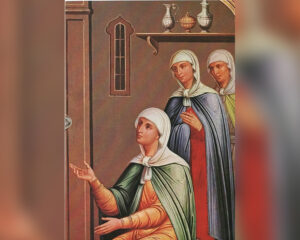
This story will surely ring a bell. In the original, the expression “she’ll worry me to death” could read either “she’ll give me a slap” or “she’ll give me a black eye”!!
Weekday introductions
Monday 20 October
Romans 4:20-25
What do we mean by the word faith? Often we mean believing ‘things.’ Paul has a different way of looking at it.
Luke 12:13-21
A simple and practical question elicits an unexpected response from Jesus. As usual, he goes to the heart of the matter and challenges us all to think again about our real priorities.
Tuesday 21 October
Romans 5:12, 15, 17-21
In trying to reconcile Gentiles and Jews in the Roman churches, Paul wants to show that every human being, no matter what background etc., stands in need of God’s grace in Christ. Symbolically, Adam’s story is our story.
Luke 12:36-38
Parables of watchfulness are not uncommon but this one contains a major role reversal: the master will put on an apron, sit them down at table and wait on his own slaves. The story of the washing of the feet in John’s Gospel comes to mind as does another sentence from Jesus: “For the Son of Man came not to be served but to serve, and to give his life a ransom for many.” (Mark 10:45).
Wednesday 22 October
St John Paul II, bishop of Rome
Romans 6:12-18
As always, Paul’s message is one of freedom. Being set free in Christ, he insists that we continue to be free from whatever keeps us from God.
Luke 12:39-48
The gentle Luke is not always as gentle as we fondly imagine. Today’s reading moves smoothly from night-time burglary to keeping watch. The violent and brutal imagery (cut off, strokes of the lash) is indeed arresting: Luke wants to wake up us to action.
Thursday 23 October
St John of Capistrano, priest
Romans 6:19-23
Paul often bring up the contrast between how we used to be and how we are now in Christ. What is the point of persistence? God’s gift of eternal life in Christ.
Luke 12:49-53
Fire is a cultural image for judgement. By contrast, baptism can be a metaphor for destiny only in light of Christian tradition. With these contrasting images of judgement and death, Jesus links his own fate with his mission from God.
The second paragraph reflects what happened to people who made (and make) a radical choice for Jesus. The social and familial cost was and still can be considerable.
Friday 24 October
St Anthony Mary Claret, bishop
Romans 7:18-25
We know a lot about Paul because he himself tells us a great deal. In today’s reading, we get really under his skin in some very honest reflections. Our experience is in there somewhere too!
Luke 12:54-59
What has the weather to do with going to court? The two sets of parabolic sayings may seem disparate but in reality are related. The link is time and the good use of time in the now. Interpreting the times is the duty of us all; acting on that interpretation is the call of us all.
Saturday 25 October
St Thaddeus MacCarthy, bishop
Romans 8:1-11
How can we ever come to true inner peace? How can we become our true selves as God intended? Paul describes the path, using a language which is his, but based on an experience which is ours.
Luke 13:1-9
Bad things happen to good people, then and now. Coping with the unpredictable invites repentance, but not in the sense of sorrow for sin. Rather, metanoia is better rendered “conversion”, i.e., a fundamental change of attitude to life, to God and to others, a real turn around.
The fig tree is rich in metaphorical resonance from the book of Genesis onwards. In the Gospels, it often bears the message of judgement, as in the cursing of the fig tree. That prophetic action is not recounted in Luke and instead we have a very different story of yet another chance. Luke is telling us to dig around, get manure, create the conditions for bearing fruit…otherwise!