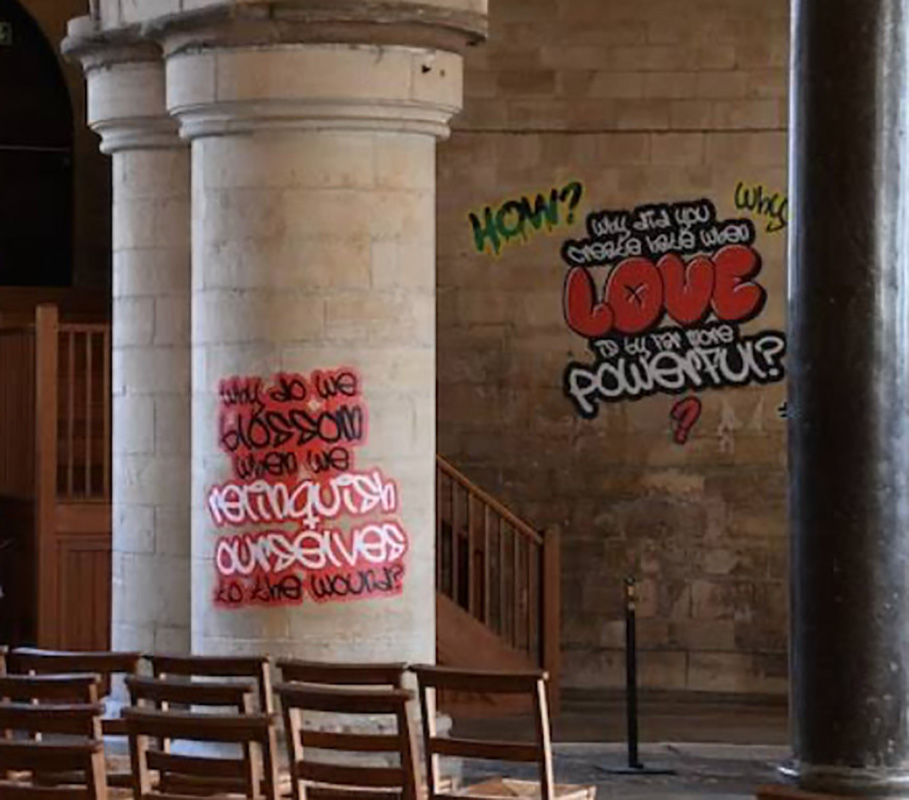
It is not the worst thing to have happened in the Cathedral. After all, St Thomas Becket, the Archbishop of Canterbury, was murdered there in 1170, following a conflict with the King over the rights of the church.
But Canterbury Cathedral, one of the oldest Christian heritage sites, has been made to look like ‘an underground car park in Peckham.’
The graffiti looks like it was put there by vandals, but it is part of a new art project called, ‘Hear Us’”
So said one critic about the new art display which has covered Canterbury Cathedral in graffiti.
The graffiti arrived around the same time as the new Archbishop of Canterbury, Sarah Mullaly, the first woman to hold the leadership.
At first glance, the graffiti looks like it was put there by vandals, but it is part of a new art project called, ‘Hear Us.’
Much like the new Archbishop, the artwork has been met with a mixed response.
The Cathedral’s ancient stone pillars, walls and floors are covered in garish colours, posing questions which are as relevant today as they were when the foundations stones were laid in 597AD: “God what happens when we die?” and “Are you there?”
But aren’t Christian Churches supposed to point to Christ’s very presence and the promise of the resurrection? Christ Himself has already given us the answers to these fundamental questions and, two thousand years ago, poured His wisdom into sound Christian teaching.
Defending
The Dean of Canterbury, David Monteith, has been busy defending the display, as raw and authentic, the voice of the unheard and the marginalised. “This graffiti makes me wonder why I am not always able to be as candid, not least in my prayers.”
I’m with the critics. This is totally misplaced compassion, an ugly display in a beautiful place which, as well as being a world heritage site, is named for Christ.
While some regard the graffiti as artistic and “packing an emotional punch”, many find it disrespectful. “Sacrilege!” is a common complaint.
But should we be surprised in an age where so many have lost sight of the sacred?
You should have told her Rod Stewart wasn’t on till later,” declared a Catholic gent who was equally horrified”
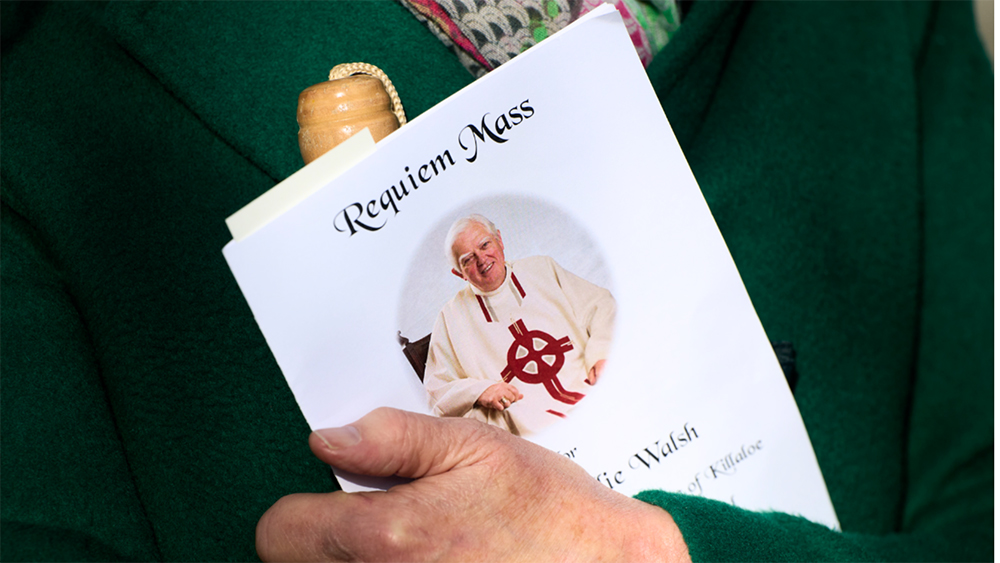
Recently I attended a requiem mass where one of the mourners, a young woman in her twenties, arrived in the church with a cup of coffee. She was directly in front of me and I assumed the poor thing had no time to dump the cup before the mass.
But during the homily, she took the lid off and began to drink her coffee.
“You should have told her Rod Stewart wasn’t on till later,” declared a Catholic gent who was equally horrified.
It appears she simply had no idea of the sacred place she had entered and the solemnity of the occasion, and no one stepped in to help her.
As for Canterbury Cathedral, the leadership should know better (though the Anglican communion has just elected a pro-choice woman to lead them so in the grand scheme of things, the ‘writing on the wall’ is the least of their worries.)
Thank God the ‘artwork’ is temporary. In the words of St Teresa of Avila, whose feast we just celebrated on October 15: “Let nothing disturb you, nothing frighten you, all things are passing, God alone suffices.”
***
A group of primary school children from St Clare’s, Ballyjamesduff, have been busy painting stones with uplifting messages. “Be the rainbow in someone else’s cloud.”
The stones have been placed in their “Positively Pebbles Garden” as part of a project supported by St Patrick’s Mental Health Service.
Teacher Verena Cunningham said the garden celebrates the uniqueness of each child – and is a reminder that we must tend our mental health as we care for the flowers and plants in our garden.
Amen to that.
The children were happily pictured with a collection of stones which spelled out, “Be You.”
And as Catholics, we have St Clare and St Patrick and many others to remind us that our true selves are found in Christ.
“If I find Him,” said the American Trappist monk, Thomas Merton, “I will find myself, and if I find my true self, I will find Him.”
***
I visited a wake house in Co. Fermanagh last week. It was a two-hour trek over hill and dale to Ederney, which translates from Irish (Eadarnaidh) as ‘a place between’. How appropriate, I thought.
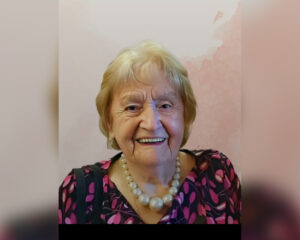
The wake was for Peggy McManus, the mother of my friend Ann, who spent years as a press photographer for the Irish News, winning many awards along the way.
Peggy (nee McKey) was born in Hilltown, Co. Down and had passed at the age of 93. She was a widow, and mother of eight, who had, tragically, buried two of her children. Her faith shone through her family, which now includes great grandchildren.
Peggy died on the way to morning Mass.
As her heart failed, her daughter, Ann, on her instructions, whispered an act of contrition in her ear.
Her requiem mass was held, rather appropriately, in Ederney’s church named after St Joseph, patron of a happy death.
***
How wonderful that Pope Leo has made the poor the subject of his first encyclical, in Dilexi Te (I have loved you).
We ignore the poor at our peril. “On the wounded faces of the poor,” writes Pope Leo, “we see the suffering of the innocent and, therefore, the suffering of Christ himself.”
Service of the poor (those impoverished in economic as well as spiritual terms) is one of the great pillars of our faith, after prayer and evangelisation.
As Christians, we are called to imitate God to lift up the weak and the lowly. Some of the language focused on political and economic structures.
Of course, all humanity should share the desire for political and economic structures that uphold justice and equality. But perfect political and economic structures would still give way to corruption in the hands of flawed human beings.
Christ did not choose to unseat Caesar, or corrupt officials who had no heart for the poor. What would be the point without repentance and spiritual transformation?
Christ was very clear about his mission when his political and religious enemies, who had no heart for the poor, tried to trap him about paying taxes to the Roman emperor.
Jesus sought a revolution of the heart. Because it is only a change in our hearts that will ultimately lead to a change in structures and burst the bubble of the wealthy elite.
That is not to say bishops, priests, religious and lay people ignore the poor, remain silent in the face of corruption or indeed offer no practical help. How many of us have heard the words “No room at the Inn,” echoed in a new way by those who are supposed to pastor the poor?
St Francis of Assisi is one of the first saints referenced in the papal document. Next year we celebrate the 800th anniversary of his death. What kind of man do we celebrate? A rebel. Yes.
But he did not lead a political movement to overturn structures. Francis preached love and repentance, by throwing off his wealth and privilege, and giving everything to the poor. That is truly radical. That is what confounds the world.
And, as one admirer put it, Francis arrived at the gates of Heaven, in rags, and entered a rich man.