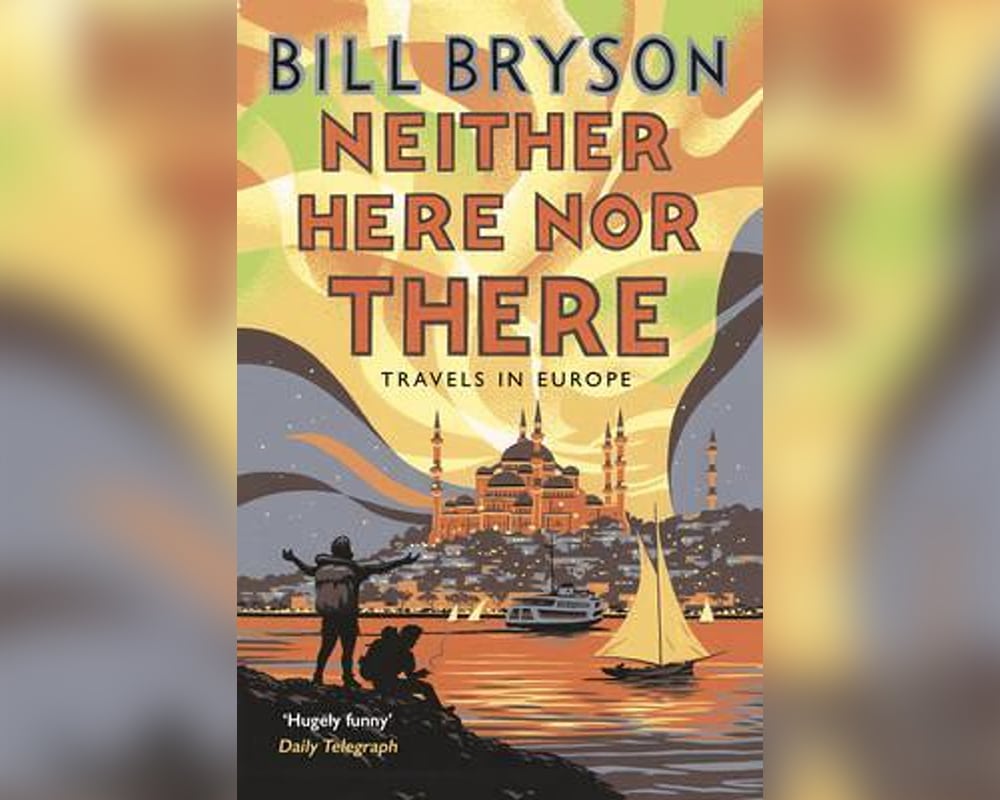
Neither Here Nor There: Travels in Europe,
by Bill Bryson
(Penguin Random House, €15.40 / £9.99)
Anthony Gaughan
Bill Bryson is an American humourist. Like other comedians he portrays himself as woebegone, put upon and the butt of those who work in bars, restaurants and hotels. His style is breezy and entertaining.
Bill writes travel books which record his meanderings across continents. One is reminded of another US writer who also published books on the continents: John Gunther. He provided a socio-political account of the various continents in books of more than a thousand pages famous in the post-war years.
He did so through interviews with and biographical sketches of dictators, prime ministers and business and industrial leaders. But then Gunther was a foreign correspondent for the Chicago Daily News; a serious man, not a humourist.
In contrast, those who feature in Bill’s account of Europe are those he meets in bars, coffee shops, restaurants, hotels and on the streets. And, although his main aim is to entertain, his comments sometimes also provide an insight into the socio-political ethos of a country or a region. For an American Europe is a new world of a different kind.
Bill begins his trek across Europe at its most northerly point. Hammerfest in Norway is a thirty-hour journey by bus from Oslo. He goes there to see the Northern Lights and goes there in winter time. The cold, the darkness and the physical conditions are such that he wonders how people would decide to continue to reside there.
Then he is told a story from 1944. The Germans, on retreating before the advancing Russians, burned down every house in the town except the church. The people were evacuated, but after the war returned and rebuilt their town one house at a time.
Stereotypes
As he travels south to central Europe Bill provides the reader with profiles of well-known stereotypes. He comments on the “good looks” of Scandinavian men and women.
In Copenhagen he visits a number of museums and walks out to view the ‘Little Mermaid’ perched on a rock at the harbour’s edge. He witnesses a drunken Irishman disgracing himself and his country in the centre of the city.
While acknowledging that the Danes are industrious, he finds them to be boring. Having noted that the Swedes reside in one of the most affluent and orderly countries in the world, he wonders why so many of them have a penchant for committing suicide.
In continuing towards the centre of Europe Bill meets two kinds of French people. There were those who seemed unable to return a smile and reacted haughtily when addressed in a language other than French. But he also meets others who were friendly and helpful.
However, he wryly remarks that neither of them would ever thank an American visitor for the US’s role in rescuing them from Nazi tyranny during World War II. He enjoys the wonderful sights of the glittering city of Paris: Notre Dame Cathedral, the Eiffel Tower and the Louvre Museum with its collection of world-famous paintings.
Bill’s experience of Italy prompts him to conclude that the Italians are congenitally incapable of queuing and have a natural penchant for creating chaos”
Bill’s travelogue of Europe is comprehensive. He even visits Liechtenstein! In Belgium he is particularly impressed by the town of Bruges. In Holland’s Amsterdam he is fascinated by the canal system. He visits the city’s notorious sex street and even claims that one of the shop-window ladies winked at him. Next, he found the Germans he met in Hamburg relaxed and genial with not a hint of arrogance, just a quiet confidence justified by the wealth around them.
Progressing on into Switzerland, he admires the Swiss for their industriousness, noting that this small country which has to cope with three languages and virtually no natural resources is one of the richest countries in the world.
Bill’s experience of Italy prompts him to conclude that the Italians are congenitally incapable of queuing and have a natural penchant for creating chaos.
In the final stages of his journey Bill goes from Sofia in Bulgaria to Istanbul in Turkey on the legendary Orient Express. However, it was not the enjoyable experience he anticipated. The train was but a shadow of its former glory.
As he explored the historic sites in Istanbul and enjoyed the scenic views on the Bosporus, the calls to Bill to return home were becoming more and more insistent. His wife was telling him that the grass around their house was knee-high, that the children were calling the male adults they met ‘Daddy’ and she claimed that she was pregnant once more!