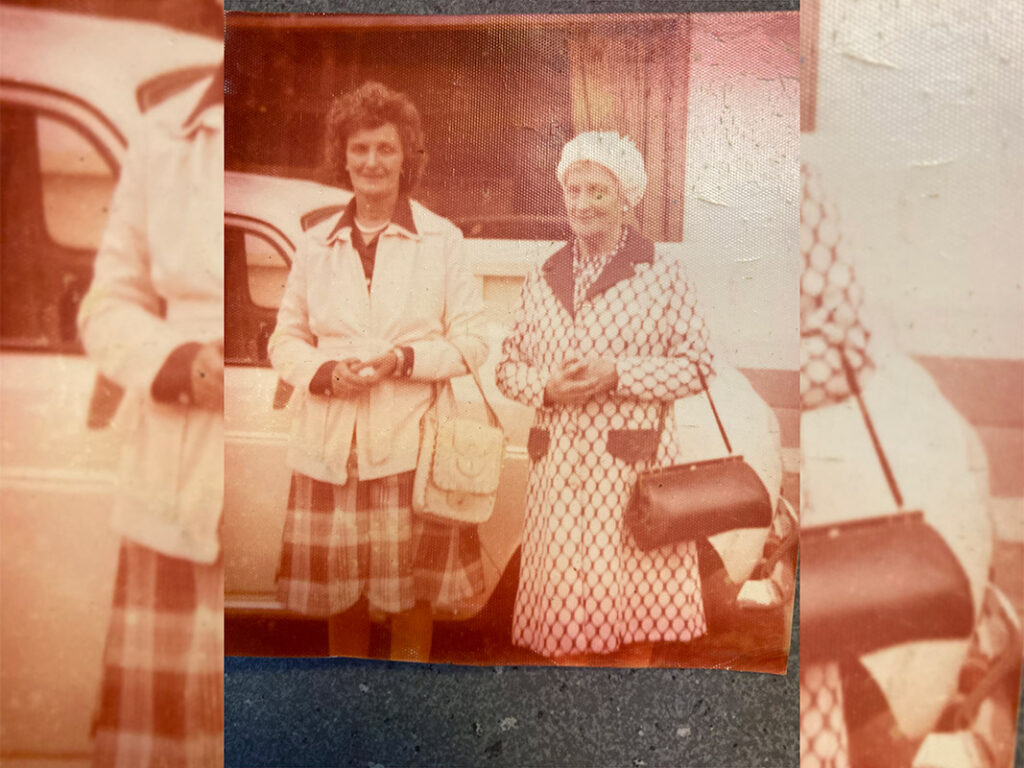
Decades ago, when British soldiers patrolled staunchly republican areas of Belfast, some received a rather unexpected blessing from a local woman who lived in Ardoyne. Whenever this devout Catholic spotted a soldier lying in an alleyway on patrol, she would open her handbag, and take out a bottle of holy water, along with her most prized possession which was wrapped in green felt: a penal cross, dated from 1724, which had been handed down through generations of her family.
“During the height of the troubles, she carried that cross everywhere,” recalled her grandson, Paul McGrady. “Everything was kept in her handbag. She would have pulled the cross out, blessed the soldiers on foot patrol and then sprinkled them with holy water.”
Would she not have been in danger, I asked? “A woman of her advanced years? They would not have seen her as a threat.”
Anne Magee, her sister, recalled a much-loved character who was affectionately known as “Granny Mac.”: “Everybody knew her and loved her.”
Granny Mac was deeply conscious that this cross was made at a time when the Mass was banned in Ireland. A daily Mass-goer, usually at her parish of Holy Cross in Ardoyne, she would take the bus across town to visit her children and grandchildren who would also receive a special at birth or when ill.
The penal cross had been passed to Granny Mac through a rather unique family tradition: the first daughter in the family always received the cross.
She coveted the cross. Indeed, she broke the line of succession, snatching the relic when Granny Mac died”
Granny Mac, who was born Mary Josephine McAteer (née Stuart) was given the cross on the death of her own mother. “It was an eldest daughter who pulled it out of the fire during penal times,” said Anne who was expected to inherit the cross from her own mother Anna (McAteer) McGrady, also a first-born daughter.
No one is quite sure how it ended up in the fire – perhaps it was to hide evidence of mass – or discarded by a soldier who had come to disrupt illegal worship.
Before the troubles erupted, the cross was kept in a bedside drawer, belonging to Granny Mac’s own mother, Granny Stuart. But after 1969, the cross was taken out and went wherever Granny Mac went.
One day, Anne and her brother Paul remember their granny arriving at their house in St James’ Drive, upset that the cross was broken in two pieces. “Granny dropped that cross and brought it to mammy and they were trying to patch it up. I remember mammy saying to my granny to start keeping it a drawer all the time. Mammy and granny wrapped it up. It couldn’t be fixed.”
An elastic band held it together.
‘Auntie Maureen,’ was Granny Mac’s third daughter and she coveted the cross. Indeed, she broke the line of succession, snatching the relic when Granny Mac died on February 13, 1984.
This added another poignant layer of grace and suffering to the story of this penal cross. “That cross should have gone to my mammy,” said Anne, with an understandable sense of injustice. “She had great faith in that cross. It has healing powers, but you have to have faith.”
Return
There was a gentle attempt to have the cross returned, but Auntie Maureen claimed she had been given the relic to the Bon Secours nuns – a story that turned out to be painfully untrue. “I’m annoyed my mammy never got blessed with it before she died,” said Anne.
In fact, Auntie Maureen was still clinging tightly to the cross when she died, aged 96, on September 17, 2023. She left the relic to her niece, Christine Gordon, who has childhood memories of Granny Mac swaddling the cross like a child and blessing her, along with her eleven siblings.
The penal cross was recently presented to the parish of St Matthias’ Church in Belfast”
Christine said Maureen took the cross with her to hospital, sharing stories of the cross with other patients. Christine said one patient later told her: “I had fallen away from my faith. But meeting your aunt has resurrected it.”
The feast of the Exaltation of the Cross is celebrated every September 14.
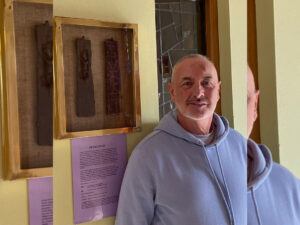
The penal cross was recently presented to the parish of St Matthias’ Church in Belfast, where the parish priest, Fr Gabriel Lyons, has put it on prominent display to the right of the altar.
***
Paul’s story of miraculous healing
Paul McGrady was on his school lunch break on February 9, 1981, when he collapsed at the corner of his street. He was rushed from St James’ Drive to the Royal Victoria Hospital in Belfast.
At the age of fifteen, he had suffered a massive brain haemorrhage and was in a coma. “The consultant said I had a massive bleed and if I didn’t make progress in the next 24 hours I would probably die,” Paul recalls. “And if I was to survive beyond that, I would be in a vegetative state.”
Paul’s family were grief-stricken, having already suffered the devastating loss of his older brother, Anthony, who was shot dead in a sectarian attack on August 25, 1973, aged just 16.
Paul had a particularly close bond to his maternal grandmother, Granny Mac, who came to his bedside with the penal cross. “She blessed me with the cross, and then she and my sister Anne went to the little chapel in the Royal and prayed.”
In fact, Granny Mac eventually headed to Holy Cross Church, in Ardoyne, to pray while his sister also continued her prayers for hours, pleading with God: “Please don’t take my brother!”
“I felt,” said Anne, “that God was standing in front of me listening and I just got this feeling that it was ok. And we got a call that morning at 3 o’clock to say my brother had come around and they couldn’t explain it.”
Doctors decided to operate, and on February 20, Paul lay face down on the table while “a horseshoe cut” was made in the back of his head. By the end of the month, he was released from hospital.
Almost 45 years later, Paul is pondering what happened to him. “There is something in that cross,” he said. “It just entered my head recently within the last lot of weeks. That one of my ancestors had pulled that cross out of the fire. That cross has a burn mark on the back of it, where it was scorch damaged.”
“And during my surgery there wasn’t adequate padding put on the operating table, and I have a pressure-burn on my forehead. If you met me, you would still see it though obviously it is faded.”
Does Paul believe he was given a miracle?
“Well,” he said, “what is the definition of a miracle? I was extremely ill, and I pulled through and made a full recovery. At the time the doctors put the recovery down to my youth. Granny Mac blessed me with that cross and the doctors didn’t give much hope for me at the time.”
“I don’t know. It is something I couldn’t answer.”
But Anne is convinced that Paul’s healing was miraculous. “It was a miracle. Make no mistake about it,” she insisted. “He had been out for three days, in a coma, and they gave us no chance and said he would be very badly brain damaged. And my Granny Mac brought the cross. It meant so much to her.”
We agree to meet in St Matthias Church and as he stands by the cross, he is amazed at the craftsmanship – and he is emotional thinking of his own mother and grandmother. So how does he feel about it being in the church now? “My granny would always call me ‘Paul of the Cross.’ My sister and I would have preferred it to go to Holy Cross, where she worshipped. But at least it is somewhere that people can come and look and benefit from its healing powers. It did belong to God. So, it belongs to the people and to God now.”