Editor’s note
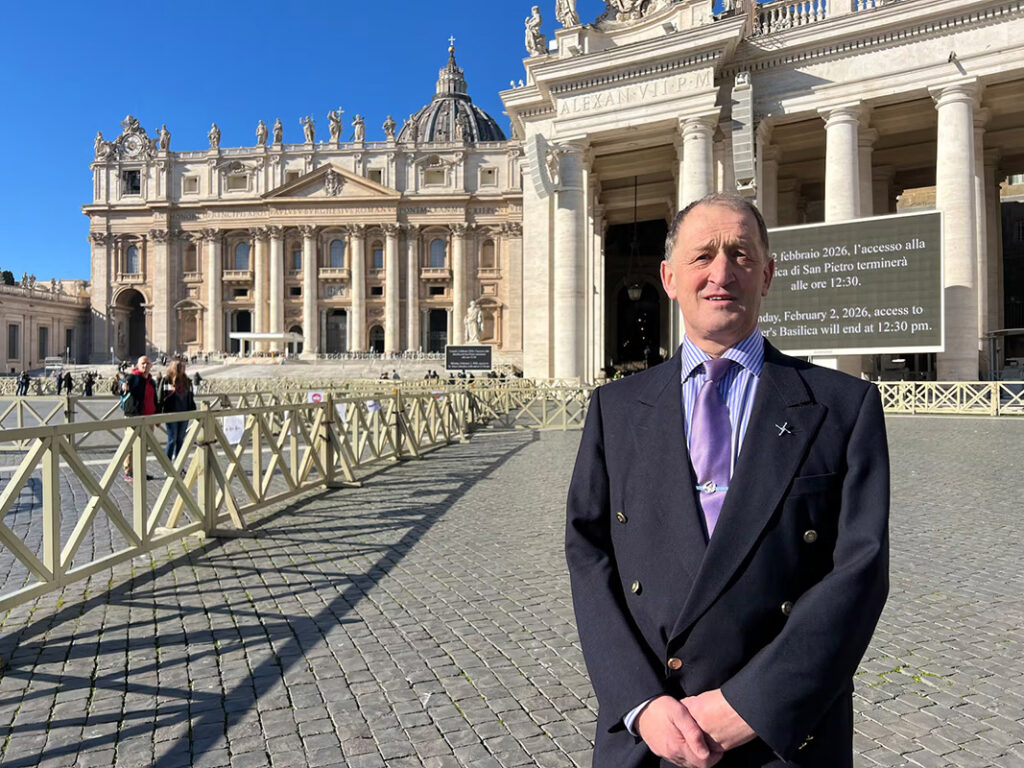
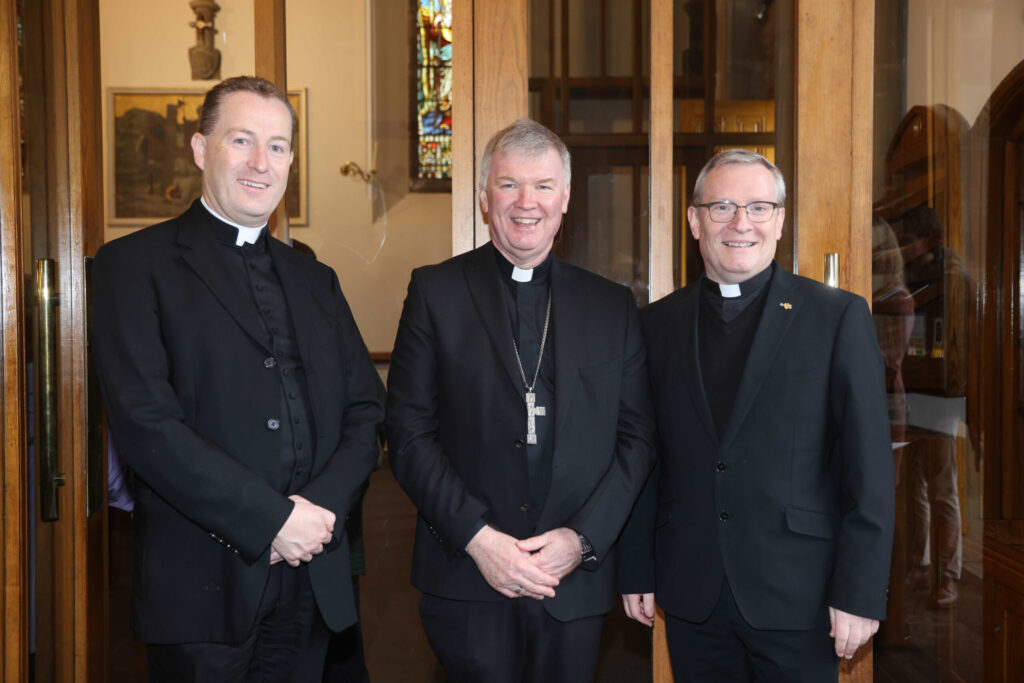
Three weeks ago we featured this interview with Fr John Murray by columnist Martina Purdy and want to share it again. Fr Murray is recovering after a brutal attack as he heard confession in Downpatrick. Fr Murray had just retired from his role as PP, was recovering from illness and was preparing to move home when the attack happened. We wish him a speedy recovery and our prayers.”
Folklore promises that those who perish on the hill at Saul, Co. Down, will skip purgatory and go straight to Heaven. After all, it was here that St Patrick himself ended his days on March 17, 461AD. But the legend was not what drew the parish priest there as he marked his 75th birthday.
Rather, Saul offered a welcome refuge for Canon John Murray after the parochial house in Downpatrick had to be repaired.
His plan was to remain as parish priest for another year but was taken ill after the Chrism Mass during Holy Week. “I was still in hospital,” he recalls, “when I gave the bishop my resignation.”
Although recovering well, he will officially hand over Downpatrick parish on August 16 to Fr Eugene O’Neill, one of the first seminarians he nurtured as the diocesan vocations director for Down and Connor, a post he held for almost 30 years, from 1985 to 2014.
How does he feel about staying as Pastor Emeritus in Saul where St Patrick began and ended his Christian mission on earth. “I haven’t thought as deeply about that,” he smiles. “But I am conscious and honoured that I am literally at the bottom of the hill dedicated to him and obviously not far from the site at Saul, where his first church, a barn, was given.”
Successor
He is aware that the next parish priest may not have a ready successor; Pathways, the diocesan pastoral project, has estimated the number of priests in Down and Connor could be down to 24 by 2042.
For now, he has to grapple with the prospect of ‘letting go’. “That has brought with it a mental and spiritual challenge for me,” he admits, “trying to identify my new role in the Church and coming to terms with that. I know I will miss the ebb and flow and the nitty-gritty of parish life because it is always full – sometimes very full. There are sometimes four or five funerals over a few days and you are going from pillar to post.”
Meeting people and being with them in key moments of their life is one of the blessings of his priesthood – though he has found some virtues in becoming Pastor Emeritus. “I will no longer be responsible for that broken cistern in the chapel or missing slate on the roof!”
“In my own life, it is a greater chance to pray, and in a solid way. It is not that I didn’t pray before but sometimes it was tough to fit in. As I’m recovering from illness. I have had more time to give decent time to prayer and reflection.”
Your frustrations. Bring everything and let God process it. And he does”
As a young priest he made a commitment to a daily holy hour, which he says is vital. “That has been a great foundation for me.”
In one of his final homilies as parish priest, he preached on the Gospel story of Mary and Martha – and encouraged everyone to spend at least ten minutes at the end of the day focussed only on Jesus. “Bring our anger to God,” he told the congregation. “Your frustrations. Bring everything and let God process it. And he does.”
As he approaches the 50th anniversary of his ordination next July, he is grateful that his spiritual fatherhood does not come to an end. “Father is the most gracious title I have as a priest. In a sense we give spiritual life to many, many people.
“It came into my head the other day that if someone said to me, ‘Father, my mother is dying, can you come, it would be abominable for me to say, ‘No, I can’t. I’m retired…’ A priest will always be a priest.”
When his health improves, Canon Murray is hoping to spend more time offering the sacrament of confession. “I think the absence of confession has been a big loss for the Irish Church.”
Rewarding
Once a frequent visitor to Medjugorje, he recalls how rewarding it was to spend three hours a night, hearing confessions. “I was exhausted at the end. But it was worthwhile. I enjoyed it – that was the illustration of the sacrament in its best form”.
Consequently, he has offered an Evening of Mercy on Mondays for the past twenty years, with Mass, preaching, rosary, confession, and adoration and it is a ministry he hopes to continue.
This bout of illness has provided more time to reflect on his own life: mistakes made, situations or conversations he wished had handled better.
One decision he does not regret was pursuing his vocation, which came to the fore at aged fourteen as a student at St Malachy’s College in Belfast. He laughs at how often on school visits he fielded questions and comments from boys. “They would say, ‘It must be very boring being a priest’. I have never been bored or lonely. I was very happy, very fulfilled,” he said.
The ‘champagne joy’ he experienced as a young seminarian carried him through many dark times, and tragic circumstances, having served as a parish priest in the heart of West Belfast during the worst of the Troubles. He also ministered to prisoners, and recalls a light-hearted moment when an inmate told him that she was in for shoplifting. “But you are in the H-block!” he said. “Yes,” she answered, “but the shop was lifted 50 feet in the air.”
We each got to meet the Pope face to face. I thanked him for his words and told him it was my 40th anniversary. He just smiled. He had a lovely smile”
For years he contributed a weekly column on saints to The Messenger from which flowed two books: Saints of Our Time and Saints for the Family.
As a young seminarian he had the honour of presenting a candle at Candlemas to Pope Paul VI, and once concelebrated mass with Pope Francis in Rome, a surprise encounter arranged by his three brothers. “We each got to meet the Pope face to face. I thanked him for his words and told him it was my 40th anniversary. He just smiled. He had a lovely smile.”
Canon Murray delights in the new pontiff Pope Leo – but it is John Paul II, whose image is displayed in his oratory. “There was something very courageous about him.”
In 1979, Canon Murray led a group of young people to Galway for his historic papal visit. “In the west of Ireland, it was a day of heavy clouds and suddenly out of the mist came the helicopter and I remember suddenly breaking down inside, and thinking ‘This is the first time the successor of Peter had come to these shores’ and the tears just flowed down.”
Still he does not look back with too much nostalgia. “There was a lot of superficial Catholicism. I thought about the kids I brought to see the pope in Galway. I don’t know that they all had a deep faith. It certainly did not stop some of them getting drunk on their weekend away. I’m not saying that is the acid test but I think we are being challenged to look at our faith. It is so disappointing that the Irish can throw off the gift of life. You look at the Irish who were lovers of life, yet year – and this is a government figure – 10,852 babies were aborted. That is a terrible indictment of our society and Catholics voted for it.”
Difficult
He also finds it difficult when so few respond after so much effort. “You see hundreds of thousands cheering on a football team and yet the real treasure is God and yet there are so few, but then we need only to look at the Lord’s own words in John’s Gospel where there is disappointment when he says, ‘Will you also walk away?’”
But he sees reasons to hope in this new era of co-responsibility between priests and the laity. “The baptised only saw their role as ‘pray, pay and obey’ as that old joke goes. This is the age of ‘ordinary baptism ’ so to speak. We are all called to do something in the Church and we are called to be missionary disciples.”
Having studied and taught church history, with its great persecutions and schisms, he is philosophical about declining numbers and quotes Mother Teresa. “It is not about success, it is about faithfulness. We are just called to be faithful.”
With a home on Saul, just steps from the national monument of St Patrick, who brought the faith almost 1600 years ago, it’s a phrase he repeats. “Fidelity,” said Canon Murray, “in and out of season.”