Cecil B. De Mille was the most prolific director of religious films in history. He even made one of them twice – The Ten Commandments in both 1923 and 1956.
De Mille held fervent beliefs but always had one eye on the box office. He said once, “Why turn down 2000 years of free publicity?” Such an attitude led to the clerihew, “Cecil B. De Mille/Much against his will/ Was persuaded to leave Moses/Out of The War of the Roses.”
His films featured decadent behaviour at a time when this was taboo. He escaped censure by having his sinners punished. Censors weren’t overly subtle. As long as retribution was handed down in the final reel, they tended to forget what went before.
To offset these kinds of scenes, he featured what one writer called “lush inspirational music, heroic pos-tures, mysterious back lighting and unearthly halos.” People said of him, “He wanted to have the twelve pieces of silver and the crown of thorns.”
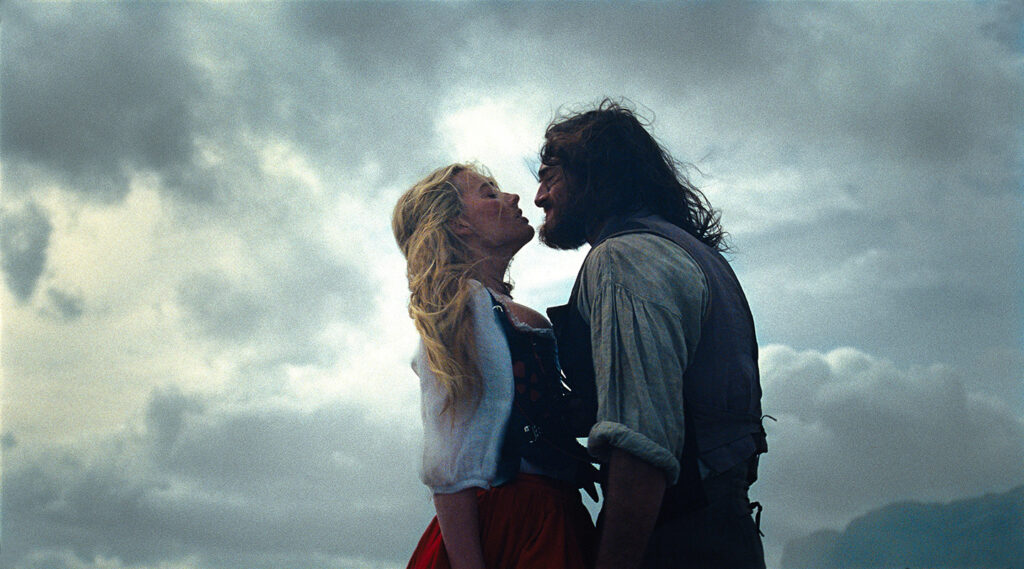
De Mille’s first exemplification of Catholic hagiography was in Joan the Woman (1916), a biopic of Joan of Arc. Catholics objected to it for its highlighting of the Inquisition’s violence. The depiction of the clergy in the film made, as one critic wrote, “the cassock and the cowl the very image of cruelty.”
Such a tunnel vision was deployed in many of his other works, like King of Kings in 1927. Here he gave us a standardised depiction of Jesus. Subsequent directors used this as their template for future Christs before more three-dimensional characterisations took root.
De Mille’s 1932 film The Sign of the Cross told the story of a Roman soldier (Frederic March) torn between his love for a Christian woman and his loyalty to the emperor Nero. Again, there was erotic content mixed with spiritual overtones. De Mille parlayed it under the rubric of pietistic zeal.
He directed The Crusades in 1935, treading once again on the inflammatory terrain embedded in Joan the Woman but not central to it. He admitted telescoping history rather than giving a realistic appraisal of it. The reason he gave for this was that audiences went to films to be entertained rather than educated.
His self-righteous crusaders, and the heathens they fought, provided him with a neat dichotomy within which to embrace his expedient narrative. In his review of the film, Graham Greene – a Catholic convert – denounced him for what he saw as a ‘Protestant’ chronicling of the material. (De Mille was a Freemason whose mother was born Jewish but converted to Episcopalianism).
Samson and Delilah (1949) had similar excesses running in tandem with didacticism. The bottom line with De Mille’s ‘sword and sandal’ epics is that they chant Catholic glories while delighting in pagan rhapsodies.
The doublethink was possible in an era which didn’t have too much touble with such nuances, allowing him to flourish as an apologist for Catholic orthodoxy while simultaneously pulling the carpet from under the feet of that zeitgeist.