Michaelangelo and the Pope’s Ceiling,
Ross King (Pimlico, £9.99)
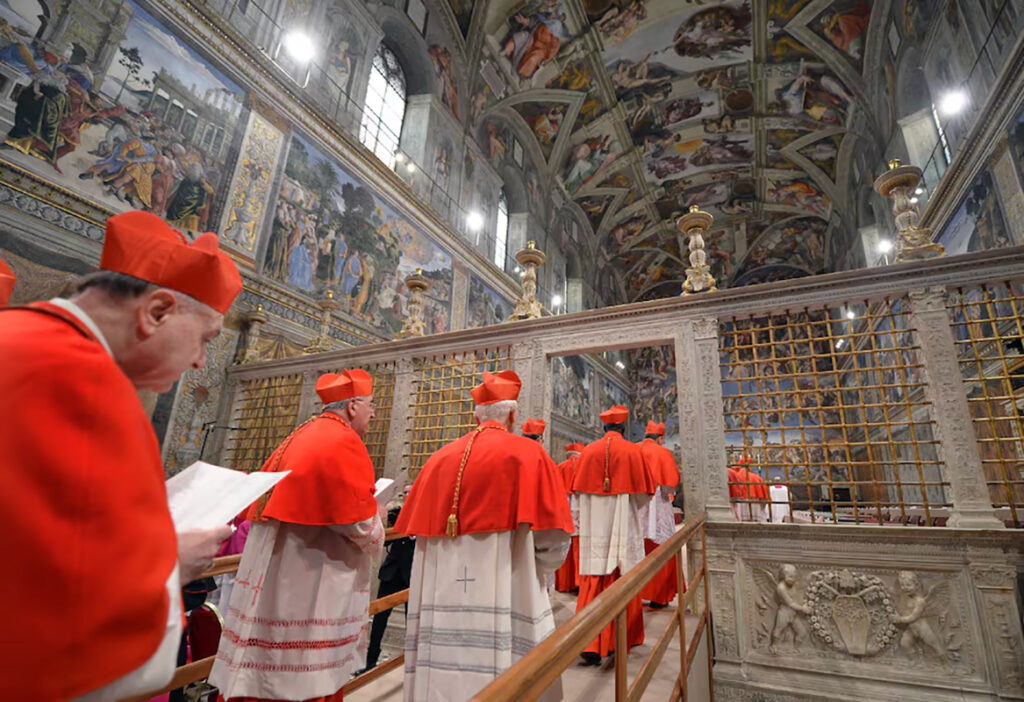
Quite by chance I was reading this book at the time the Conclave began. I thought it would be interesting to make the decorations of the Sistine Chapel the focus of some reflections on the election of the Pope.
But like the rest of the world I was taken by surprise by the speed with which the decision was made.
In this case a rapid decision augurs well. The assembled cardinals had settled in their own minds on a sense of continuity with the era of Pope Francis as the appropriate course for the future of the Church, a continuity which would also encompass all men of good will.
Photographs appeared of the world’s press of the cardinals assembled in session below the ceilings decorated over a period of four years by Michelangelo and his assistants. The walls of the chapel were already covered by a series of paintings representing the life of Moses and the life of Jesus Christ, a resume of sacred history, to which the new decorations on the ceiling were to provide a magnificent counterpoint.
But the ceiling was to encompass the creation of the word, the creation of Adam and Eve, the fall and expulsion from the garden – with behind it the realisation that for Christians Jesus Christ was in effect a second Adam.
Scholarship
In this book Ross King combined his skills of narrative as a novelist with an effective deployment of the latest scholarship on the ceiling. It is over all in itself a revelation of just what many people mean by the cultural glories of Rome. Smoothly readable and well informed it can be warmly recommended to all readers, for there is something for everyone in these pages.
This epic drama of the creation is a very suitable environment in which to deliberate the future of the Church.
But once the decision was made the spirit of the Church would have to turn from the glories of the past to the problems of the present day, not the problems of the Church so much as the problems of the word.
Here perhaps we can see that the missionary in the character of the new Pope will come into its own, a man who can trace a Creole ancestry back to a free Black woman in Louisiana. He greeted his former diocese in Peru rather than his native Chicago – that was significant: his first thought was not for wealthy Chicago but impoverish Peru.
They carry away, of course, an abiding memory of the past glories. but have themselves to turn as the new Pope has also to do, to turn to the workaday world where the real vocation of the Church has to be carried out”
Carrying in their minds the memory of the glories of creation as conceived by Michelangelo, the hand of God reaching out to enliven Adam configures a promise as the Church understands it to mean that God will also reach out and revivify his people today.
In enlarging upon the meaning of the panels under which some 6 million visitors a year pass, for this room is one of the most visited locations of the faith in the Christian world today.
They carry away, of course, an abiding memory of the past glories. but have themselves to turn as the new Pope has also to do, to turn to the workaday world where the real vocation of the Church has to be carried out.
For many this book may be an illuminating substitute for visiting the Sistine Chapel itself. It is an important aspect of the Church’s cultural heritage, and important part, but not the whole part.
The fact that the new Pontiff was born in the United States, means in the minds of many he was still an “American Pope”, only this concept of American extends throughout the two continents, for those many millions south of the Rio Grande consider themselves also Americans, real Americans, something more than North Americans.
Long years as a missionary in Peru will have transformed Robert Prevost into a South American and all that can mean, for North Americans have long had trouble understanding and respecting their Southern neighbours.
“Let us build bridges,” Leo XIV exclaimed. One of those bridges, the first of many, will have to be thrown across the Rio Grande.