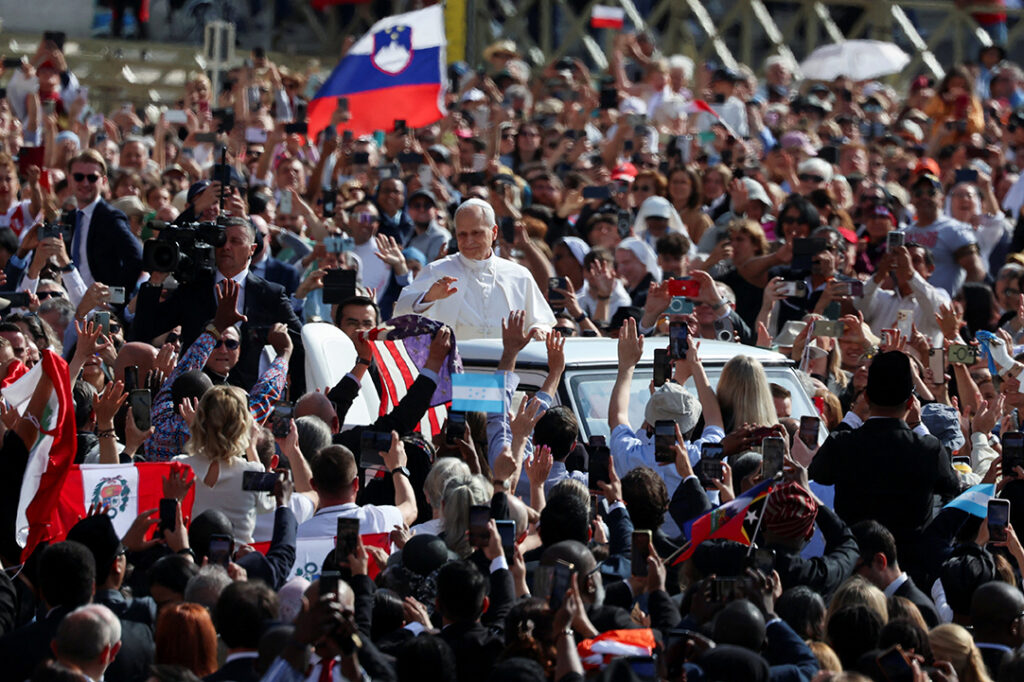
“I would like that our first great desire be for a united Church, a sign of unity and communion, which becomes a leaven for a reconciled world,” said Pope Leo XIV formally beginning his tenure as the successor to St Peter.
“In this our time, we still see too much discord, too many wounds caused by hatred, violence, prejudice, the fear of difference and an economic paradigm that exploits the Earth’s resources and marginalises the poorest,” the new pope said in his homily during his inauguration Mass.
“For our part, we want to be a small leaven of unity, communion and fraternity within the world,” he told the estimated 150,000 people gathered in and around St Peter’s Square. “We want to say to the world, with humility and joy: Look to Christ! Come closer to him! Welcome his word that enlightens and consoles! Listen to his offer of love and become his one family: ‘In the one Christ, we are one.’”
A version of the quote from St Augustine is the pope’s episcopal motto and is featured on his coat of arms.
Before the Mass began, Pope Leo rode through the square in the popemobile for the first time since his election May 8, greeting the faithful as cheers of “Viva il papa!” (“Long live the pope!’) poured out from the crowd. He then entered the basilica to pray at the tomb of St Peter, accompanied by patriarchs of the Eastern Catholic churches.
Delegations
Ecumenical and interreligious guests and more than 100 government delegations joined the new pope for Mass in St Peter’s Square. The United States was represented by Vice President JD Vance and Secretary of State Marco Rubio, accompanied by their spouses and senior White House aides.
Vance and the second lady, Usha Vance, visited Pope Francis’ tomb in the Basilica of St Mary Major the evening before the Mass. “He was beloved by many Catholics around the world, and I hope you will join me in praying for the repose of his soul,” he wrote in a post on X.
Cardinal Mario Zenari placed the woollen pallium on the pope’s shoulders, symbolising his role as shepherd of the universal church”
Among the Christian leaders present was Orthodox Ecumenical Patriarch Bartholomew of Constantinople, along with other delegations from the Orthodox churches, the Anglican Communion, the Lutheran World Federation, the World Methodist Council, the World Communion of Reformed Churches and various evangelical and Pentecostal communities. Representatives of the Jewish community as well as Muslim, Hindu, Buddhist, Sikh, Zoroastrian and Jain traditions also were in attendance.
Following the Gospel reading, three cardinals from the different orders within the College of Cardinals took part in the formal beginning of the Petrine ministry: Italian Cardinal Mario Zenari placed the woollen pallium on the pope’s shoulders, symbolising his role as shepherd of the universal church; Filipino Cardinal Luis Antonio Tagle presented him with the fisherman’s ring, evoking St Peter’s mission to draw people into Christ’s net; and Congolese Cardinal Fridolin Ambongo offered a prayer invoking the strength of the Holy Spirit for the new pontificate.
Representing the universal church, 12 people — clergy, religious and laity from around the world — then came forward to offer their obedience to the new pope.
Reflecting
Reflecting on the Gospel reading from St John — in which Jesus asks St Peter three times to tend to his sheep — Pope Leo said in his homily that the ministry of Peter is rooted not in authority for its own sake, but in love that serves and unites.
“Peter is thus entrusted with the task of ‘loving more’ and giving his life for the flock,” he said. “The ministry of Peter is distinguished precisely by this self-sacrificing love, because the church of Rome presides in charity and its true authority is the charity of Christ”
The successor of St Peter, he said, “must shepherd the flock without ever yielding to the temptation to be an autocrat, lording it over those entrusted to him.” Instead, “he is called to serve the faith of his brothers and sisters, and to walk alongside them.”
I was chosen, without any merit of my own, and now, with fear and trembling, I come to you as a brother, who desires to be the servant of your faith and your joy”
Pope Leo also recalled the period of mourning following the death of Pope Francis, and he said that the conclave that followed the late pope’s death was “a moment of grace.”
“I was chosen, without any merit of my own, and now, with fear and trembling, I come to you as a brother, who desires to be the servant of your faith and your joy, walking with you on the path of God’s love, for he wants us all to be united in one family,” he said.
“With the light and the strength of the Holy Spirit, let us build a church founded on God’s love, a sign of unity, a missionary church that opens its arms to the world,” he said, calling for a church that “proclaims the word, allows itself to be made ‘restless’ by history and becomes a leaven of harmony for humanity.”
War
At the end of Mass, the pope called for prayers for regions afflicted by war: Gaza, Myanmar and Ukraine, which “finally awaits negotiations for a just and lasting peace.”
Immediately after the Mass, Pope Leo met with several government representatives including Vance and Rubio, as well as Peruvian President Dina Boluarte. The pope had spent more than 20 years in Peru as a missionary priest and bishop and has Peruvian citizenship.
Ukrainian President Volodymyr Zelenskyy was present for the Mass and had a meeting with the Pope, their second encounter of the day. The pope welcomed Zelenskyy to his office with a warm greeting, thanking him for his patience.
Although the Vatican did not release a formal statement about the meeting, Zelenskyy expressed his gratitude on social media, saying the pope’s voice and authority are a symbol of hope for peace. Zelenskyy also acknowledged the Vatican’s offer to mediate direct negotiations between Ukraine and Russia. This meeting follows the pope’s previous prayers for Ukraine and ongoing efforts for peace, including facilitating the exchange of prisoners and the return of Ukrainian children taken to Russia.