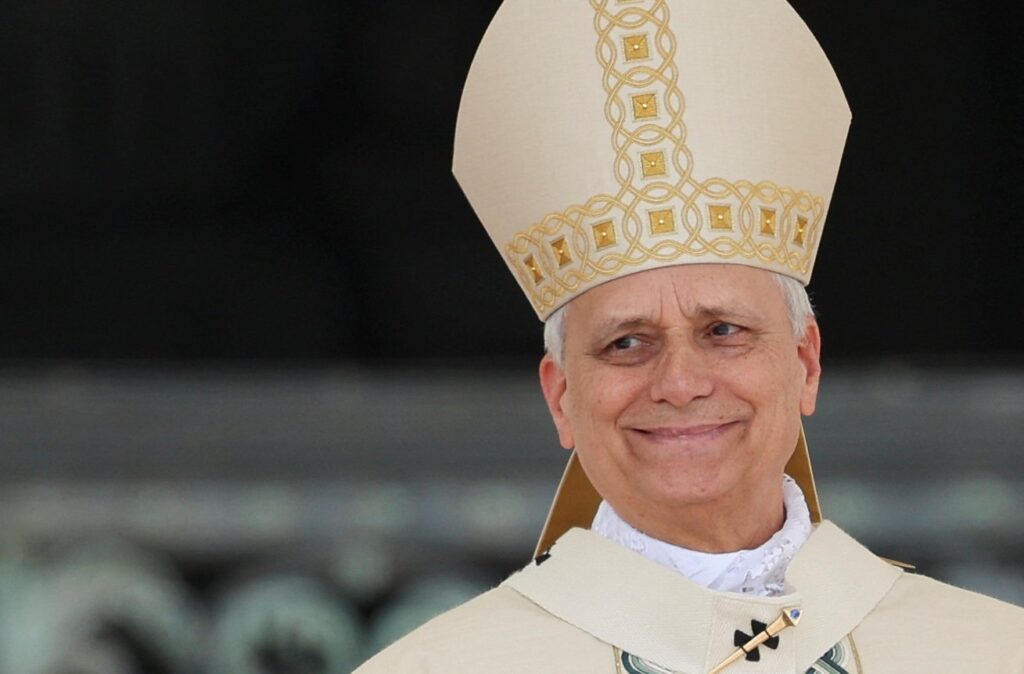
How did Pope Leo XIV become a social media star in just a few days? Media experts explain why his pictures are no coincidence and what we can expect from him in the future.
“It was perfect,” says historian René Schlott. He reviews the conclave and the first appearances of Pope Leo XIV. Schlott has researched the media staging of the papacy. The new pope’s first public appearance seemed unreal to him. “It was almost like a film,” Schlott told the Catholic News Agency (KNA). The Vatican knows how to generate immense attention worldwide with the staging of the papal election – even though the church and religion are losing importance in the West.
Schlott was particularly impressed by the way the first US-American to sit on the throne of Peter presented himself: “self-assured, telegenic and confident”. Leo is obviously very aware of the media attention. “He manages to fulfil the office of Pope from a standing start and deliver the obligatory pictures.”
The power of images and symbols
For Schlott, this is also evident in his choice of vestments and accessories. At his first appearance after the election – a particularly symbolic moment – Leo wore a golden cross, and later, on the way to his flat, a silver one. “Something like that doesn’t happen by chance.” By choosing traditional and simple clothing, Leo indicated continuity with his predecessors and at the same time made it clear: “I am not a copy of Francis, but neither am I a copy of Benedict.” He is thus sending visual signals in different directions in terms of church policy. Schlott is convinced: “Leo knows how to make full use of the papacy’s image programme from the very first days.”
Schlott sees a further indication of Leo’s flair for media impact in his choice of name. “Leo was the best possible name.” If Robert Francis Prevost had chosen the name of a direct predecessor, it would have been either presumptuous or problematic. His decision is reminiscent of Leo XIII, who opened up the Church to social issues – Leo XIV could now be the one to dedicate himself to digitalisation and the media.
The Vatican between media criticism and media use
Leo XIII was the first pope of whom film and sound recordings exist. Although there is traditionally a certain degree of media and press scepticism in the Vatican, the pontiff has also been active on Twitter since 2012 under Benedict XVI. Under Francis, Instagram was added in 2016. Leo XIV now also uses these channels.
The Vatican media apparatus uses these platforms to disseminate extracts from speeches, sermons and doctrinal writings. Sociologist and moral theologian Christina Behler has examined Pope Francis’ Twitter behaviour. She tells KNA: “Digital communication enables the Church to proclaim messages regardless of time and place.” This allows the Vatican to reach a significantly larger audience than with conventional forms of proclamation. “Social media solves the church’s problem of dwindling reach quite well.”
Leo can’t complain about a lack of reach. More than 52 million users already follow him on his nine Twitter accounts. After just a few days, he has surpassed his predecessor on Instagram – the new Pope already has over twelve million followers there. Francis had reached around 10.5 million after nine years.
Sociologist: Pope does not enter the discourse
The Pope’s communication behaviour follows the logic of the Church’s proclamation. “The Pope sends messages. He teaches, but does not justify himself and does not enter into open discourse,” says Behler. “This is part of the systemic logic of the Catholic Church.”
The Pope operates in a democratic communication space, which – unlike a sermon – enables and provokes direct reactions. Behler has analysed these reactions. The result: many responses and comments also come from people far removed from the church and religion. This is a gain in reach for the church. The media-appropriate staging of content plays an important role here. “The Pope can be understood as a brand that functions independently of the current incumbent,” said Behler. This is why the official social media name is always “Pontifex” – not “Leo XIV”.
How will Leo present himself?
What can we expect from Leo in the future? Since the beginning of the Pope’s Twitter activities, no special social media content has been produced by the Pope; instead, existing written content from speeches and other texts has been utilised. Behler is sceptical as to whether the new pope will deviate from this. So far, she does not see any major differences between Pope Leo XIV and his predecessors on social media – neither in terms of form nor content. Although Leo has more practical knowledge of social media – after all, he had his own Facebook and Twitter account – as Pope he is no longer a private person. Nevertheless, she believes he has his own style.
Historian Schlott, on the other hand, believes a change is possible. “Perhaps a home story on Instagram or selfies would be too much of a good thing, but producing more social media-appropriate content – I think Leo is capable of that.”