“Welcome to the desert of the real,” Morpheus tells Neo as he awakens from the computer-generated dreamworld into grim reality. The line, borrowed from Simulacra and Simulation by Jean Baudrillard, captures a central modern anxiety: what if the world we experience is not real, but an illusion?
In his work, Baudrillard – a French philosopher and sociologist – argues that we no longer interact with reality directly. In a world saturated by advertisements, social media, and AI-generated content, reality is not only mediated but has been replaced. Instead, we consume simulacra – copies without an original. Instagram aesthetics, political deepfakes, and endless content loops create a state of ‘hyperreality’, where the imitation becomes more compelling than the real – or at least more convenient. Why go outside when you can check the weather from your device? Why experience something new when you can read reviews? Why live life if you can’t post about it?
Hyperreality
Social media, like TikTok or Instagram, are prime examples of hyperreality in action. It is not just a tool for sharing life – it creates an alternate version of it. AI-generated filters ‘beautify’ faces, influencers curate lifestyles that do not exist, and reality is selectively edited until it conforms to the idealised image. It is not deception in the traditional sense, but something more insidious: a world where the image of a thing is more real than the thing itself. Leaving people scrambling to make themselves more like what they see.
For Baudrillard, this is not simply deception but a transformation of meaning itself. In Simulacra and Simulation, he traces four stages of the image: first, it reflects reality (as in a photograph). Second, it distorts reality (as in propaganda). Third, it hides the absence of reality (like reality TV). And fourth, it becomes pure simulation, existing only in reference to itself, detached from any original. In this final stage, the real dissolves entirely, leaving only a self-perpetuating cycle of images. The image no longer represents reality – it dictates it and truth becomes just another aesthetic.
But what if images are not always a veil over reality? What if they reveal rather than deceive?
Barriers
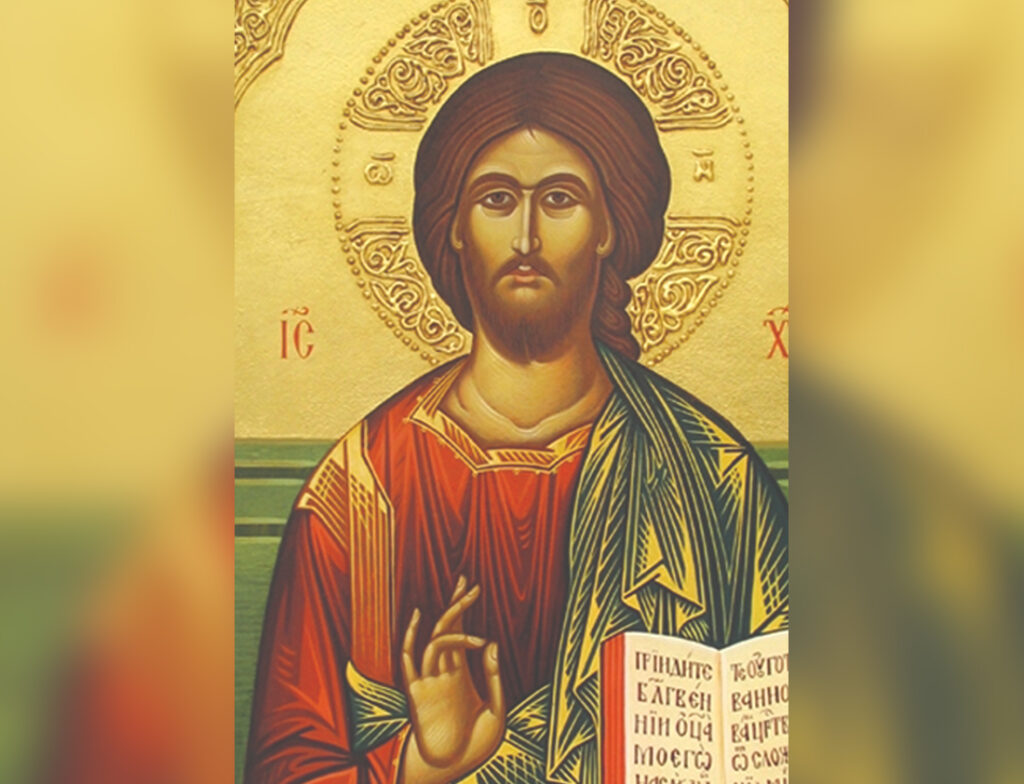
Where Baudrillard sees images as barriers to truth, Catholic thought has long understood them as a means of revelation. The world itself is an image of higher realities, a reflection of divine meaning. “The heavens declare the glory of God” (Ps. 19:1). Man, made in God’s image, is meant to see through creation into its source. Sacred art and icons are not distractions from truth but participations in it. Sacred art and icons do not obscure reality but participate in it.
St John Damascene, defending the veneration of sacred images, writes: “Every image is a revelation and representation of something hidden. The image was devised to transcend space and time, for greater knowledge, and for the showing of things hidden—to desire what is good and hate what is evil.”
Likewise, the Catechism echoes this by saying: “The sacred image, the liturgical icon, principally represents Christ. It cannot represent the invisible and incomprehensible God, but the incarnation of the Son of God has ushered in a new ‘economy’ of images.” (CCC 1159)
This “new economy” of images is key. The incarnation transforms the role of representation. Before Christ, depicting the divine risked idolatry – an image could only be a shadow of the unseen God. But in Christ, the invisible becomes visible – “He is the image of the invisible God” (Col. 1:15). God does not merely authorise images; He enters into them. Jesus is the true icon, and all sacred art participates in this mystery. This participation in the divine image is not limited to sacred art—as we, too, bear the Imago Dei, the image of God.
Baudrillard’s scepticism of images echoes an ancient anxiety, the fear that they do not reveal but deceive. This is the nature of the iconoclastic controversy as he describes: “Iconoclasts feared not that images obscured God but that they revealed the terrifying truth—that there was nothing behind them.”
Sacred images differ from simulacra in that they do not point to themselves but beyond, drawing the viewer into participation with the greater spiritual reality”
This is the heart of Baudrillard’s critique. If images do not point beyond themselves but only refer to other images, they collapse into an endless self-referential loop. Deepfakes, Instagram filters, and AI-generated influencers are not just distortions—they create a world with no reality behind it.
Yet the Catholic tradition offers a way out – not by rejecting images, but by learning to see rightly. Sacred images differ from simulacra in that they do not point to themselves but beyond, drawing the viewer into participation with the greater spiritual reality. Icons demand contemplation, not consumption, and come with their own languages which can be learned.
Unlike the hyperreal aesthetics of Instagram or the echo chambers of X (formerly Twitter) which replace reality, sacred images invite us deeper into it. Liturgy, the Sacraments, and sacred art require an engagement of the will. As St John Damascene puts it: “The beauty of the images moves me to contemplation, as a meadow delights the eyes and subtly infuses the soul with the glory of God.”
This is the challenge of out time: to distinguish between illusions and true icons, between hyperreality and sacramental reality. The modern world is flooded with images, but not all are the same. Some deceive. Others reveal. Some close us in on an endless loops of simulation. Others open us to the real.
Baudrillard saw only the desert. Yet perhaps there are still oases out there – if only we knew where to look. The challenge of our time is learning to seek.