Nicolas Cage has been flying under the radar for so many years now we could be forgiven for forgetting just how great an actor he is. With two Oscar nominations in his quiver (one converted) and a plethora of other awards, his career should be the envy of many more hyped talents.
Fighting off charges of nepotism at the beginning of it, he changed his name from Coppola (Francis Ford Coppola is his uncle) to Cage to deflect attention from it. Since then, he’s brought huge energy to a raft of roles characterised by their chameleon nature.
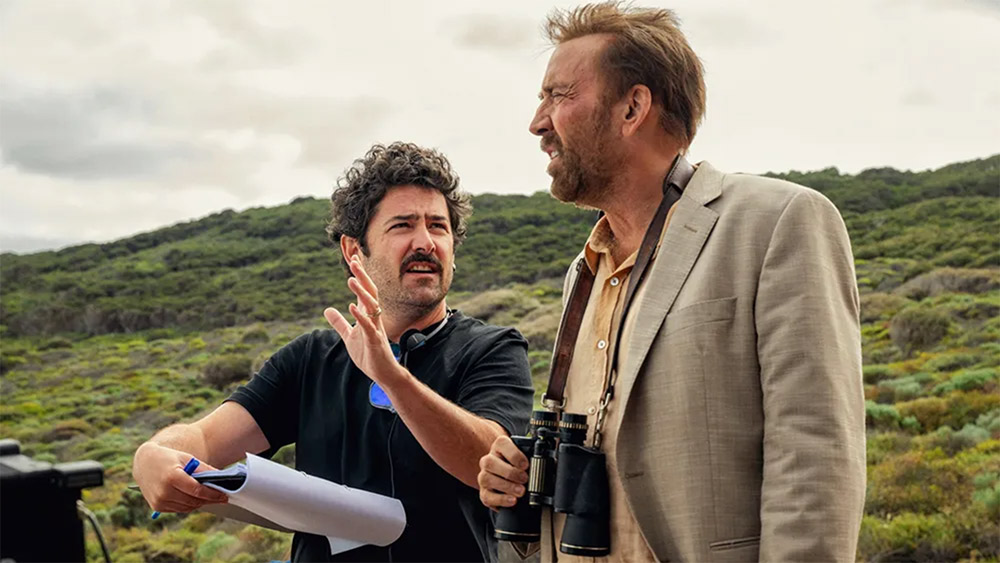
I expected both mystery and terror from his latest outing, The Surfer (15) seeing as it’s directed by Lorcan Finnegan. In Finnegan’s Vivarium we were presented us with a couple trapped in a miasma of identikit houses in a Kafkaesque suburb with, as Jean-Paul Sartre might have put it, “No exit.”
Here the trap is a sun-kissed Australian beach where the unnamed Cage, a monied businessman, had an idyllic youth before his father died He seeks to recapture that lost paradise by trying to buy back his childhood home from its new owners.
His dream is scuppered by a series of bizarre incidents featuring an abusive cadre of beach-hut ne-er-do-wells drinking and drug-taking on the beach. They summarily divest him of the blandishments of ‘yuppieism’. Dehydration gives him a meltdown.
In his descent to the level of ‘unaccommodated man’, to quote Shakespeare from King Lear, we see a Biblical metaphor for expiation. It’s compromised by the Satanic figure of Scally (Julian McMahon). Scally rules his flock like a demented despot.
A homeless old man (Nic Cassin) has a grudge against him. He offers Cage some solace, but also the threat of retribution against Scally.
The Surfer recalls David Fincher’s The Game and Danny Boyle’s The Beach, in its elaborate structure and diverging parameters. Finnegan plays with the antinomies of poverty and wealth, memory and desire, technology and primitivism in Cage’s quasi-cathartic rite of passage into a world that at times appears illusory.
The film goes from the sublime to the ridiculous with its baptismal motif, and the portrayal of surfing as a quasi-spiritual activity. Cage also looks too grounded to repeatedly part with his expensive possessions for messes of pottage – or, if I may use a terrible pun, pots of message.
Finnegan has some interesting things to say to us about the pains and duties of paternity over three generations, though the constraints of a 100-minute film means this ambition, like his other ones, verge on the aspirational.
Even if we accept Cage’s masochism, and his capitulation to Scally’s demonic mantra “You’ve got to destroy to create,” Finnegan’s reach often exceeds his grasp in a challenging film which seeks to emulate the horror and sophistication of the works of M Night Shyamalan, whose career he seems to be trying to emulate for some time now.
Does he succeed in this instance? Answers on a postcard please.