As a former student of canon law at the Catholic University of Leuven (KU Leuven), I find myself reflecting on the remarkable legal and pastoral legacy of Pope Francis following his death, especially as the university prepares to celebrate its 600th anniversary in 2025. Founded in 1425, KU Leuven has long stood as a centre of ecclesiastical learning and canonical scholarship. It was within this rich academic tradition that I first encountered the legislative mind—mens legislatoris—of Pope Francis. His pontificate ushered in some of the most significant canonical reforms since the 1983 promulgation of the Codex Iuris Canonici (CIC), shaping the life of the Church in profound and enduring ways.
While previous popes made adjustments to the Code, Pope Francis introduced sweeping changes that reflect his deeply pastoral vision. Pope John Paul II, who promulgated the Codex Iuris Canonici in 1983—the final legislative fruit of the Second Vatican Council—made relatively few changes during his long pontificate. His 1998 motu proprio, Ad tuendam fidem, added doctrinal clarity to certain canons, and Pope Benedict XVI’s 2009 Omnium in mentem offered targeted clarifications in areas like matrimonial law and the role of deacons. Yet it is under Francis that the Code has experienced its most substantial overhaul, with a clear emphasis on mercy, justice, and ecclesial decentralisation.
A prime example of this is the reform of the marriage nullity process. In 2015, with the motu proprio Mitis Iudex Dominus Iesus, Pope Francis revised canons 1671 to 1691 to make the annulment process faster, more accessible, and more pastorally sensitive. He eliminated the need for an automatic appeal in uncontested cases, introduced a briefer process for clear-cut cases of nullity, and reaffirmed the bishop’s role as a judge within his own diocese. These changes emphasised subsidiarity and the pastoral care of those in difficult marital situations.
In 2021, Pope Francis enacted one of his most far-reaching reforms with the apostolic constitution Pascite Gregem Dei”
Following the 2016 apostolic exhortation Amoris Laetitia, Pope Francis did not formally amend canons 915 or 916 (which concern admission to the Eucharist), but he encouraged a deeper pastoral discernment for divorced and civilly remarried Catholics. Rather than relying solely on juridical solutions, he emphasised the role of the internal forum and episcopal conferences in providing context-sensitive pastoral guidance. This approach reflected his wider vision of synodality and local discernment, favouring accompaniment over blanket norms.
Reforms
In 2021, Pope Francis enacted one of his most far-reaching reforms with the apostolic constitution Pascite Gregem Dei, which revised Book VI of the Code of Canon Law (canons 1311–1399), the section dealing with penal law. This reform strengthened the Church’s legal response to sexual abuse, financial misconduct, and sacramental violations. Notably, the revised canon 1395 now provides for the mandatory dismissal from the clerical state in cases of clerical abuse, a move that reduces discretion and aims to ensure justice for victims. The reform also underscored the obligation of Church authorities to enforce canonical penalties, shifting away from a previously more permissive and discretionary culture.
His 2021 motu, proprio, Spiritus Domini, amended canon 230 §1 to allow women to be formally instituted as lectors and acolytes”
The 2019 motu proprio Vos Estis Lux Mundi, later updated in 2023, complemented these penal reforms by addressing the accountability of bishops and religious superiors in cases of abuse and negligence. It required every diocese to implement confidential reporting systems, and expanded definitions of abuse to include the abuse of authority and power. This built upon earlier legislation such as Come una madre amorevole (2016), which clarified the procedures for removing bishops who failed in their responsibilities.
Another area of transformation under Pope Francis has been the role of the laity in Church governance. His 2021 motu proprio, Spiritus Domini, amended canon 230 §1 to allow women to be formally instituted as lectors and acolytes. The 2022 apostolic constitution Praedicate Evangelium, which restructured the Roman Curia, made it possible for laypersons to lead Vatican departments (dicasteries), emphasising that authority in the Church comes from canonical mission, not ordination alone. Canon 129, which traditionally limited the power of governance to clerics, has also seen developments that reflect a more inclusive approach, while amendments to canons 588 and 596 have expanded possibilities for lay leadership within religious communities.
In a particularly striking move in 2022, Pope Francis granted authority to the Congregation for Institutes of Consecrated Life and Societies of Apostolic Life to permit non-clerical members to serve as major superiors in clerical religious institutes of pontifical right. This derogation from canon 588 §2 signalled a further willingness to entrust laypeople with substantial leadership responsibilities, marking a significant evolution in the understanding of ecclesial governance.
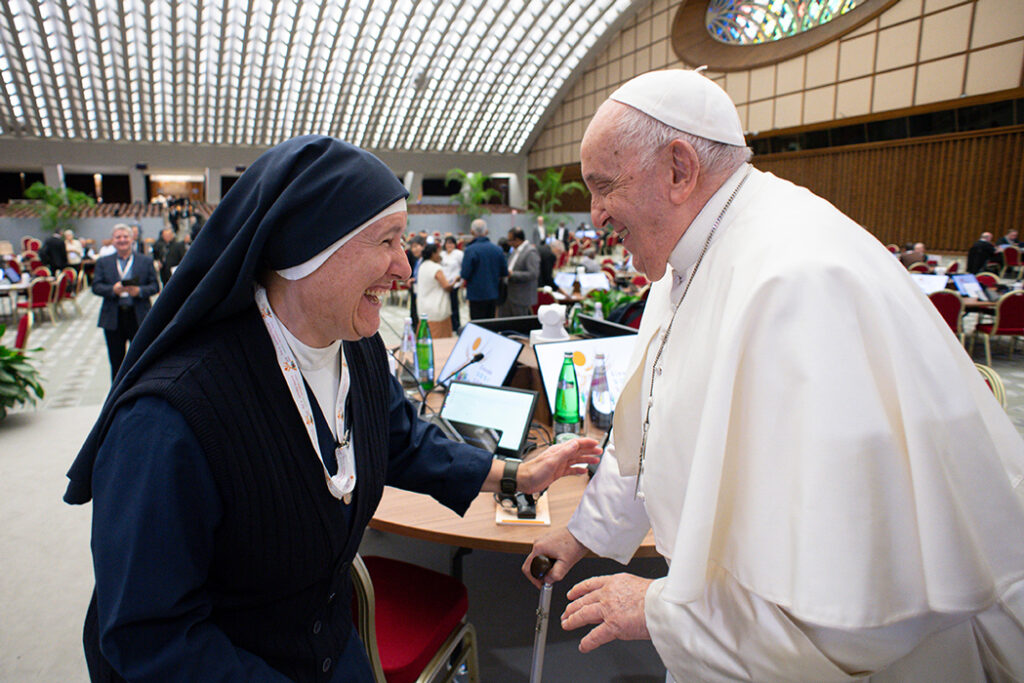
In light of synodality, Pope Francis’ apostolic constitution Episcopalis Communio (2018) brought new canonical weight to synodal processes, revising canons 342–346 to give greater authority and voice to episcopal conferences and synods, embedding synodality more deeply into the Church’s legal and pastoral structures.
Expression
In all of this, Pope Francis demonstrated that canon law is not a static set of rules but a living expression of the Church’s mission. His reforms embody a Church that is more accountable, participatory, and mission-oriented—where law serves not merely as a means of discipline, but as an instrument of evangelisation and pastoral care.
Now, in the wake of his passing, Pope Francis’ reforms will continue to be the subject of study, implementation, and reflection. For students of canon law and canon lawyers alike, his legislative contributions will remain a lasting part of both the curriculum and the lived reality of the Church. It is clear that his vision—marked by synodality, mercy, and reform—will continue to shape the Church’s future. The question that now faces the People of God is not only how these reforms will be implemented, but how they will be deepened and built upon in a spirit of communion, discernment and mission.