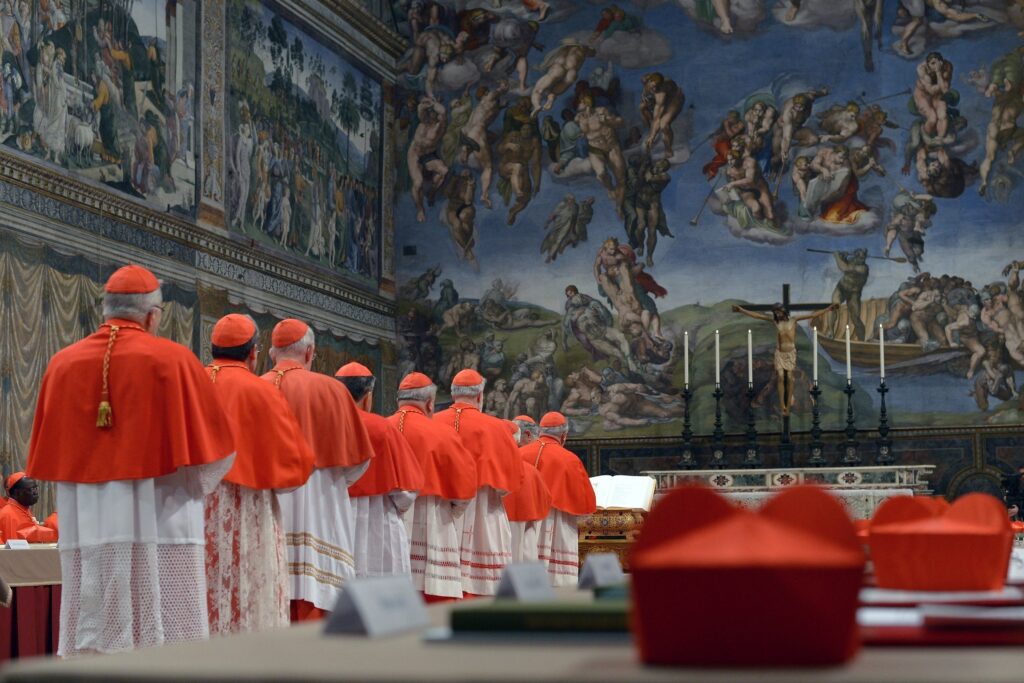
Growing public pressure alone has ensured that the conclave today is usually a matter of a few days. One papal election in history once lasted over 1,000 days. The inhabitants of Viterbo found this too colourful.
People love the conclave – and the media love it even more. The highest level of secrecy, at the same time the highest news value, gossip, Catholic and socially acceptable. A ritual that is as archaic as it is colourful, and more suited to giving free rein to the imagination than anything else. For many cardinals, the papal election is also a highlight of their career.
Of course, this has not always been the case in past centuries. For some, the ritual cramming became a trauma. The longest of all papal elections took place in 1268. It lasted 1,005 days – and pushed everyone involved to their limits.
The custom of locking up (“conclave”, Latin for “room locked with a key”) originated in the 13th century out of simple annoyance at too long exploratory talks and too many unsuccessful election rounds. First – as so often in the earlier history of the papacy – rival noble families from the city of Rome, then the factions of the Ghibellines and the Guelphs (i.e. partisans of the emperor and the papacy respectively) blocked the election. They were eventually replaced by the Roman-French opposition, which led to the Schism of Avignon in the 14th century.
On 29 November 1268, Pope Clement IV died – a Frenchman and opponent of the Hohenstaufen dynasty who had fled from Rome to the small town of Viterbo, around 70 kilometres to the north. Just one month after the execution of the last Hohenstaufen, Conradin, the Pope also met his death.
Settlement hopeless
The 20 cardinals, or 19 electors, who gathered at the place of death, Viterbo, fell into two blocs. An agreement seemed hopeless from the outset. But as the cardinals owned property in Viterbo anyway, it wasn’t too bad to have to turn up pro forma every day for the election in the bishop’s palace and leave again without a result, each to their own residence. Another pro for the delay was probably the fact that the cardinals had access to the not inconsiderable income of the papacy during the vacancy of the see – and could therefore live very well with the stalemate.
However, the city fathers of Viterbo, who had to accommodate the quarrelling boarders, were the ones who were annoyed. In order to promote the will to unite, they gradually decided to take ever harsher measures. Firstly, the city gates were closed to at least prevent the departure of cardinals – three had died in the meantime – and also to prevent further political influence from outside by mounted messengers. Cardinal Enrico di Susa, who was seriously ill, was only allowed to leave with special permission.
In 1270, the prefect of the city had the quarrellers locked up and guarded. However, food and drink apparently remained so good that the suffering had to be further increased. In the spring of 1271, the rations were cut, without result. In the summer, the cardinals were put on bread and water, to no avail. Finally, in August, in the middle of Italy’s worst summer heat, angry residents covered the roof of the bishop’s palace – to give the Holy Spirit more access.
New pope without ordination
And so it was that on 1 September 1271, 1,005 days after the beginning, an agreement was finally reached. The choice fell on the 61-year-old Italian Tebaldo Visconti, Archdeacon of Liège. However, this still meant that there was still no pope – because the person chosen was currently travelling as a pilgrim to the Holy Land. It therefore took until March 1272 for Visconti to arrive in Rome, be ordained a priest and installed as Pope Gregory X (1271-1276). (1271-1276) was enthroned.
In 1274, Gregory X stipulated that the cardinals were no longer allowed to leave the polling station in future; a procedure that was also practised by various Italian city republics. During the election, they were also not allowed to take any income from the papal chamber or any other income from the papacy. The Catholic Church thus owes one of its most exciting ceremonies to this day to the end of that all-too-annoying election a good 750 years ago.