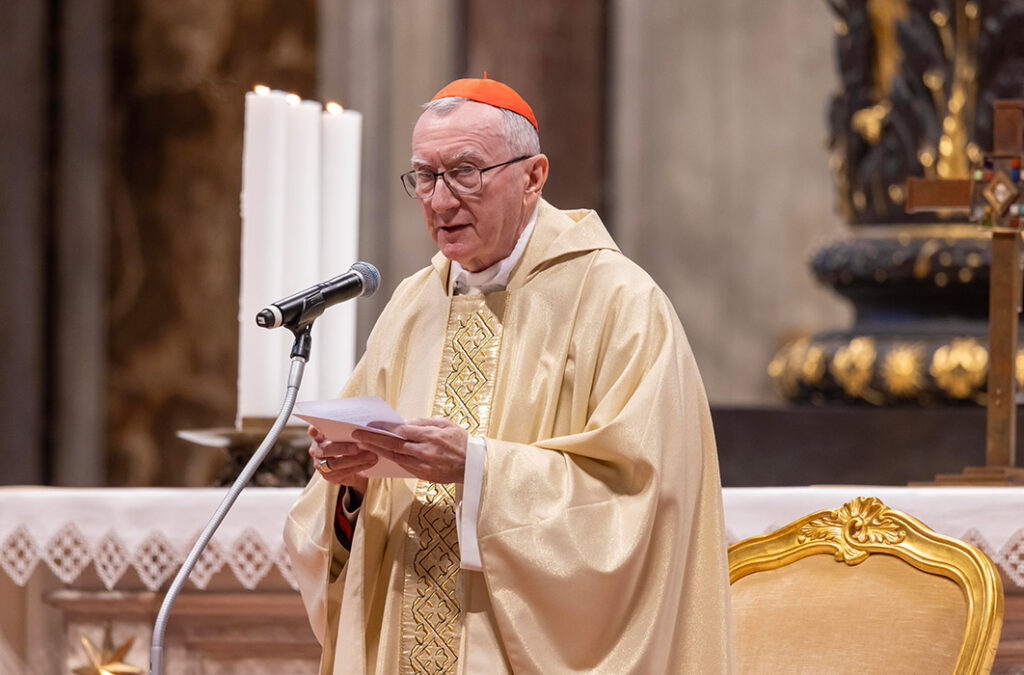
Pietro Parolin is a diplomat of great caliber. His star in the diplomatic service of the church and in the development of realpolitik and pragmatic strategies has been shining for many years. Just to give an example, in 2006, Inside the Vatican magazine named Parolin one of the ‘Top Ten’ of the year, citing his work on nuclear disarmament, dialogue with Iran and North Korea, and the fight against human trafficking. His diplomatic ‘vocation’ blossoms from the very start. After being ordained a priest in 1980 at the age of twenty-five, he was sent to study canon law at the Gregorian University in Rome and simultaneously began his training in the Vatican’s diplomatic service, a field in which he started to play an active role as early as the mid-1980s. He was soon sent to Nigeria, then Mexico, and later recalled to Rome where he worked in the Secretariat of State under Cardinal Angelo Sodano.
Diplomacy
From 2002 to 2009, Parolin was Undersecretary of State for Relations with States. In this capacity, he was able to make himself known for the Vatican’s efforts to mediate and improve relations between the Holy See and Israel, which, since the signing of the Agreement governing relations between its states in December 1993, has had a tortuous path. His direct relationship with Israel and, initially, good wishes, have since suffered major repercussions. A first friction was glimpsed in June 2019 when, on the occasion of a meeting in Rome with Chief Rabbi Riccardo Di Segni, he raised an appeal for all faiths and cultures to be granted “equal rights and equal opportunities for the construction of a future of peace and harmony”, transpiring a fear of discrimination. But the lowest point in relations between Parolin and consequently the Holy See and Israel was reached in the aftermath of the Hamas attack on October 7, 2023.
In particular at the beginning of 2024 when Cardinal Parolin at the end of the bilateral meeting between Italy and the Vatican State declared: “We are all outraged by what is happening. It is carnage….. Israel’s right to defence, which has been invoked to justify this operation, must be proportionate; But certainly with 30 thousand deaths it is not”. Immediately, the Israeli ambassador to the Holy See, Raphael Schutz, issued a statement in which he called the statement “deplorable” and “erroneous”. From then on, diplomatic relations sank, with clear and evident accusations from Parolin but also from Cardinal Pizzaballla, Patriarch of Jerusalem of the Latins, the Pope himself and other Catholic figures that led, among other rudness, to Israel’s cancellation of all posts of condolences for the death of Pope Francis
Roles of the highest importance come for Parolin, who seems to share goals and strategies with the new pope”
The ‘hot potatoes’ that Parolin had to deal with, however, are various. He had to deal with very delicate issues of relations with Vietnam, North Korea, Iran. As undersecretary, he was also entrusted with thorny roles, such as when he was sent in 2009, after being appointed titular archbishop of Acquapendente by Benedict XVI, a pope whom Parolin seems never to have particularly loved, to be nuncio to Venezuela.
But, certainly after relations with Israel, the most complex operation he had to deal with is the Vatican-China agreements. Already a member of the commission for relations with Beijing with Benedict XVI, Parolin had an original approach to Sino-Vatican relations and was the protagonist of the agreement in 2018 on the appointment of bishops, renewed every two years until 2024. While it was celebrated as the beginning of a new era, the treaty has also sparked widespread criticism of yielding to Chinese demands. Among the harshest critics of the agreement is Cardinal Joseph Zen Ze-kiun, bishop emeritus of Hong Kong.
With the arrival of Jorge Bergoglio to the papal throne, roles of the highest importance come for Parolin, who seems to share goals and strategies with the new pope. On August 31, 2013, at the age of only 55, Francis appointed him his Secretary of State while he was created and proclaimed Cardinal in the Consistory of February 22, 2014. Since its inception, it has been a stable part of the C9, the magic circle of nine cardinals closely close to the pope and his advisors in reform projects.
Francis appointed him his Secretary of State while he was created and proclaimed Cardinal in the Consistory of 22 February 2014. Since its inception, it has been a stable part of the C9, the magic circle of nine cardinals closely close to the pope and his advisors in reform projects”
Beliefs
Born in Schiavon, in the province of Vicenza, Italy, on January 17, 1955, Cardinal Parolin, if he became pope, would be a relatively young pontiff. In his potential path to the papal throne, the main obstacle, according to some observers, would be a poor pastoral attitude given the services carried out in the church, all of which are in some way far from the people and from pastoral daily life. His positions of openness – he is considered a possibilist on the celibacy of priests and on communion for the divorced and remarried, he believes in a more democratic reform of the curia and the church, he insists on an environmentalist approach on the furrow created by Laduato si’ and he has always spent himself in perfect continuity with Francis on the migration issue, taking positions of clear criticism of Europe for a ‘merciless’ management – but also those of greater conservatism – no concessions on the gay issue and other sexual orientations, no openness on the female diaconate – make him a credible candidate in continuity with Pope Francis but, at the same time, probably less progressive.
On the occasion of a meeting in Rome with Chief Rabbi Riccardo Di Segni, he raised an appeal for all faiths and cultures to be granted ‘equal rights and equal opportunities for the construction of a future of peace and harmony’, transpiring a fear of discrimination”