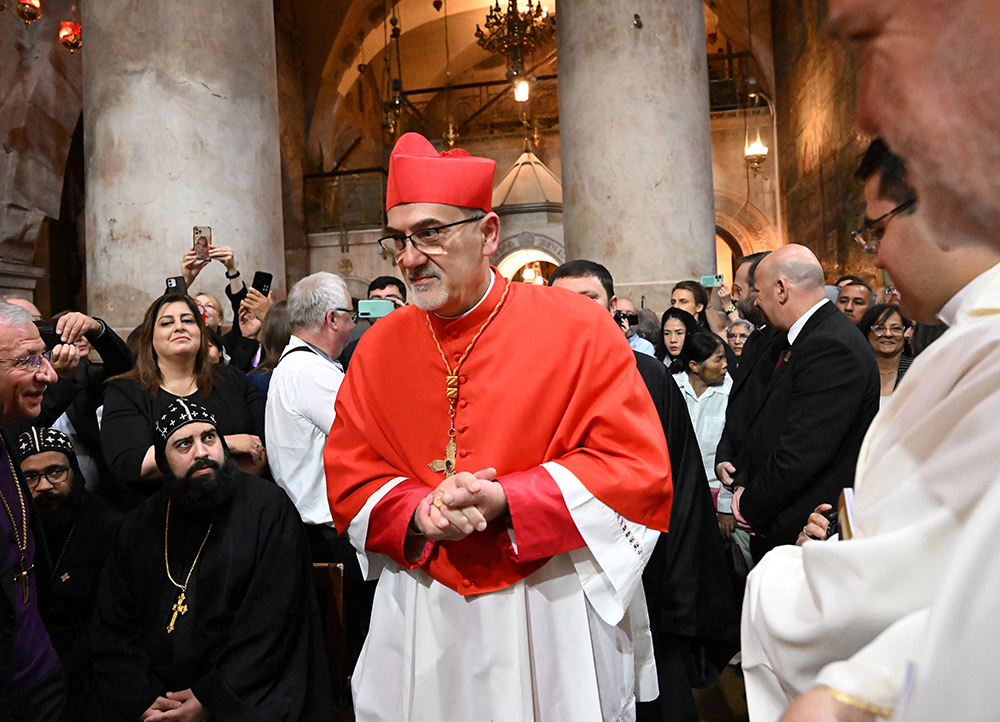
In Gaza ‘the situation is shameful, catastrophic, we have to say it… the dignity of those 2.3 million people, is not taken into the slightest consideration. We cannot think that they are all colluding with terrorism and crime’. This sentence, is just the latest in a long series of sharp accusations that the Latin Patriarch of Jerusalem, Card. Pierbattista Pizzaballa, has uttered since the Israeli army operations on Gaza and the West Bank began in the aftermath of October 7, 2023. The Patriarch said it during an interview with Tv2000, the television station of the Italian Bishops’ Conference (CEI) last April 11.
A few weeks after the dramatic attack by Hamas, on the other hand, Cardinal Pizzaballa, in a letter sent to the faithful of his diocese, condemned the massacres carried out by Hamas and the continuous bombing of Gaza, but also spoke explicitly of ‘occupation’ as the root of all tension: ‘Only by putting an end to decades of occupation, and its tragic consequences, and by giving a clear and secure national perspective to the Palestinian people, will it be possible to start a serious peace process’. In another passage, from Jenin, West Bank in July 2024, in the aftermath of yet another raid against refugee camps, the cardinal speaks explicitly of ‘unjustified attacks’: “(We) hope for pursuit of peace and dialogue to prevent other future unjustified attacks on the population.”
As can be seen from these explicit statements, Cardinal Pizzaballa fully represents the political and geopolitical, as well as pastoral, position of the Holy See regarding the Palestinian population that has become increasingly clear since the post-October 7, 2023 crisis erupted. After having, of course, harshly and repeatedly condemned the attacks carried out by Hamas and the massacres and kidnappings of Israeli citizens, the Vatican has maintained a clear line of denouncing the atrocities committed by Israel and reiterated the political position of two states and two peoples.
If we look at the international scene, we can safely say that the Holy See, through the mouths of its main exponents – the Pope, Secretary of State Parolin, Cardinal Pizzaballa – has been, if not the only one, among the very few state and geopolitical realities to have raised voices against the military operations perpetrated by Israel for more than a year and a half without either Europe, the United States or the West in general ever taking a clear position and going beyond bland declarations.
Journey
One of the youngest members of the College of Cardinals, Pierluigi Pizzaballa O.F.M., was born in Cologno al Serio (Bergamo, Lombardy) on April 21, 1965. He entered the Order of Friars Minor in September 1984 at the age of 19 and spent his novitiate year in one of the most important sanctuaries in the Franciscan context, that of La Verna (Arezzo-Italy). On September 15, 1990, he was ordained a priest.
In close contact with the Jewish reality and deeply attached to the spirituality of those holy places, Pizzaballa edited the Roman Missal in Hebrew”
His story as a priest and as a Christian is linked from the beginning to the Holy Land. Not even a month after his ordination, in fact, the young priest moved to Jerusalem, where he completed his studies at the Studium Biblicum Franciscanum. In close contact with the Jewish reality and deeply attached to the spirituality of those holy places, Pizzaballa edited the Roman Missal in Hebrew. He translated various liturgical texts into Hebrew for the Catholic communities in Israel and joined, later becoming its assistant general, the so-called Catholic Kehilla, the Hebrew-speaking Catholic community that owes its origins to Brother Yohanan Elihai of the Little Brothers of Jesus who, upon arriving in the Holy Land on March 21, 1956, celebrated the first Mass in Hebrew, in the Syrian rite, in Haifa.
Significance
Since the end of the last century, Pizzaballa has been at the service of the Custody of the Holy Land and has held fundamental roles in relations with the Jewish world. Since 2008 he has been a Consultor in the Commission for Relations with Judaism of the Pontifical Council for the Promotion of Christian Unity. In 2004 he was appointed Custos of the Holy Land for the first time to be reconfirmed in 2010 and hold the position until 2016, when Pope Francis appointed him Apostolic Administrator of the Latin Patriarchate of Jerusalem with the dignity of archbishop. On October 24, 2020, however, came Pope Francis’ appointment as the new Latin Patriarch of Jerusalem.
His impressive curriculum and authoritative figure made Pierluigi Pizzaballa the ideal candidate for the cardinalate in the eyes of Pope Francis. The prestigious nomination arrives in fact on September 30, 2023 and Pizzaballa becomes the first Patriarch of Jerusalem to receive it. For many observers, the choice takes on special significance both in the sense of a more solid relationship between Rome and Jerusalem but also in giving more importance to the voice of the Church of Jerusalem in both Rome and the global Church. It also signalled the Vatican’s desire to play a more active role in the Middle East.
It was resounding, in this sense, that he offered his own body in place of hostages taken
by Hamas”
The appointment as cardinal, however, as mentioned, came on September 30, 2023. Plans for better relations with the Jewish world and Israel, as well as the project for a more authoritative voice to be assigned to the Church of the Holy Land, were disrupted just days later. The very serious Hamas attack on October 7 and Israel’s ruthless response still in place forced the Cardinal to devote a great deal of energy to the conflict. Certainly, the Cardinal immediately wanted to provide the Church’s contribution to the search for a peaceful solution and offer every means available to avoid catastrophe. It was resounding, in this sense, that he offered his own body in place of hostages taken by Hamas. “A journalist,” he said on that occasion, “asked me at a press conference if I would be willing – if it were possible – to offer myself in exchange for the hostages. And I replied: certainly yes, a Christian – a bishop moreover – is always called upon to offer his life for others. Nothing extraordinary: it is the following of Jesus… Needless to say, I would have said the same for the Palestinians. But, I repeat, there is nothing extraordinary”.
Gravity
So many years in contact with one of the world’s most troubled lands, a marked sensitivity for the people who live there, as well as the perception on his own skin of the suffering and injustice he has witnessed daily for decades, have made Pizzaballa a man who continually questions himself about evil, about the meaning of being a Christian, and about the abyss of futility and despair, which is always possible even for those who have faith. “And you who have dedicated your whole life to being the hinge, the facilitator,” he confessed in a long interview that appeared in L’Osservatore Romano in November 2023, “you can no longer put the pieces together. And you feel useless, because you are unfit for opposition,” he once confided. “When logic fails, emotions take over. And you ask yourself: how can you live as a Christian inside such a crisis? Then your people who seek you out, who expect a word from you…bring you back to a plane of reality…. because a Christian lives his life in the fight against evil”.
So many years in contact with one of the world’s most troubled lands, a marked sensitivity for the people who live there, as well as the perception on his own skin of the suffering and injustice he has witnessed daily for decades, have made Pizzaballa a man who continually questions himself about evil”
With his culture, his deep-rootedness in the Middle East that is nourished by the study of the scriptures and the original contexts of the Christian faith as well as his presence in the field, thanks to his ability to have relations with different and often conflicting communities, but also with an authoritative voice condemning inhumanity and seeking peace in a context of war that is among the most serious and long-standing in the world, Cardinal Pizzaballa represents a key and original figure in the Church to come.
‘When logic fails, emotions take over. And you ask yourself: how can you live as a Christian inside such a crisis? Then your people who seek you out, who expect a word from you…bring you back to a plane of reality…. because a Christian lives his life in the fight against evil’”