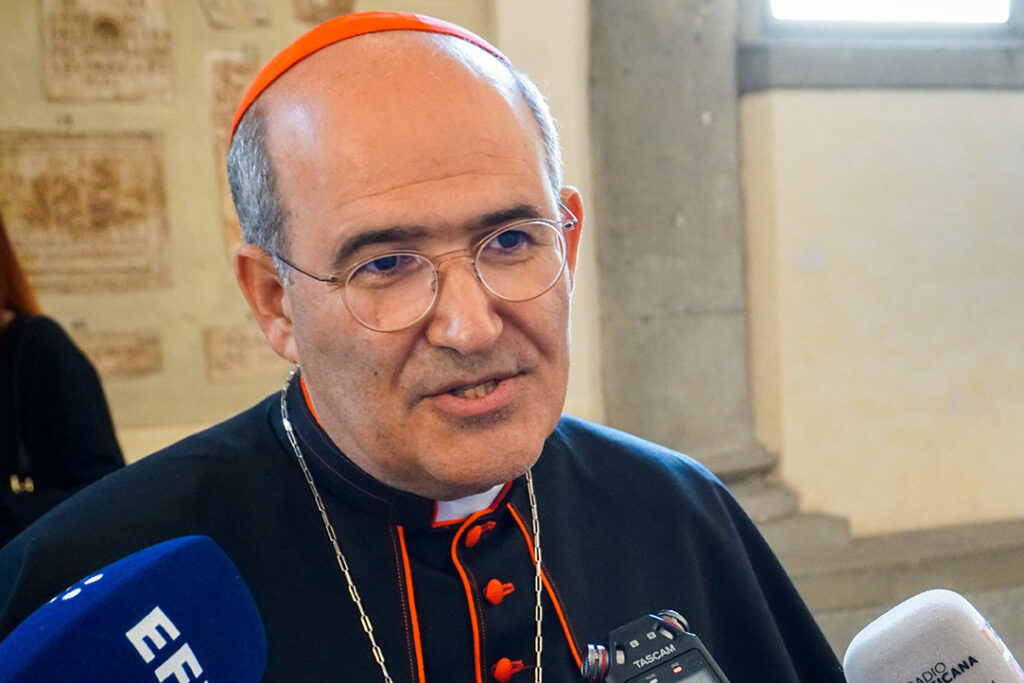
Beauty will save the world, and the Church too: Portuguese Cardinal José Tolentino de Mendonça, until now (in Bergoglio’s pontificate) Prefect of the Vatican’s Dicastery for culture and education, truly believes this. Beauty, says and expresses the 60-year-old cardinal in his vision and pastoral praxis, will save the Church in its relationship with the world, a theme at the heart of the Second Vatican Council document ‘Gaudium et spes’. ‘Beauty’ is not an abstract or purely philosophical term for him: it is instead the full epiphany of God, it is the very face of Christ. He is a cardinal, Tolentino de Mendonça, who feeds on art, be it poetry, literature, sculpture, painting or music. He feeds on art in its broadest and most complete sense, finding in art a profound spiritual value and meaning that becomes an opportunity and drive for the transcendent. This is what he tells readers every week in the Portuguese magazine Expresso, a non-Catholic publication, in a column that, not for nothing, is entitled ‘What are clouds?’
Art, the supreme expression of the human soul, is for the Cardinal a master way of evangelisation, that is, a tightrope for the encounter with today’s humanity. Art is the path to an intimate dialogue and fruitful interpersonal relationship that can be woven with every man and woman of our time. This approach, which Tolentino already lived in his experience as a bishop, poet and pastor in Portugal, brought him to the Vatican when he was first called to lead the Apostolic Library (in 2018) and then appointed Prefect of the Dicastery for Culture, in 2022. A role in which he took up the legacy of Italian Cardinal Gianfranco Ravasi, an erudite philologist and man of letters, a cardinal who, through the ‘Courtyard of the Gentiles’ initiative, had initiated an experience of dialogue with the world of non-believers.
This approach, for Tolentino, becomes pastoral, that is, it is not a mere intellectual exercise, but a way to bring people closer to the divine, to what God is, and to travel mysterious paths to touch the human heart”
Tolentino de Mendonça, a man of mild and cordial disposition, with an innate ability to empathise with his interlocutors, was already a rising star in the College of Cardinals and, in just three years, he quickly made his mark on the Vatican department entrusted to him: that of elaborating a cultural proposal of high level and international depth, such as to lead the Holy See to engage in dialogue with the leaders of contemporary art and culture. It is not so much a matter, the cardinal emphasises, of ‘begging’ for small spaces in the great assemblies of world culture, to ensure that the voice of the Church is at least considered or that Christian values can have ‘a place at the table’. Rather, it is a matter of making oneself present, of coming forward in the agorà and in the places of contemporary culture, in the academy and in the public sphere, elaborating ideas and initiatives that, thanks to their intrinsic moral, spiritual, ideal, civil, intellectual and educational value, are able to speak to today’s humanity: they are able to meet its existential questions, to intercept the anxiety of the infinite that dwells within the heart of every man and woman of the third millennium. It is precisely the inexpressible, which artists know how to express not in words but with their art. This approach, for Tolentino, becomes pastoral, that is, it is not a mere intellectual exercise, but a way to bring people closer to the divine, to what God is, and to travel mysterious paths to touch the human heart.
He became dean of the Faculty of Theology in 2018, distinguishing himself for his research and especially his poetic production”
In his history as a presbyter and pastor Tolentino de Mendonça has always followed this inspiration, which has distant and plural roots. Born on the island of Madeira in 1965, as a boy he spent his early years in Angola, a former Portuguese colony. The experience of a childhood spent in Africa marked him deeply. Returning to Madeira and entering the seminary, he was ordained a priest and pursued his academic and pastoral career as a seminary professor, parish priest and rector of the Pontifical Portuguese College in Rome, then lecturer at the Portuguese Catholic University. As a professor at the Athenaeum, he became dean of the Faculty of Theology in 2018, distinguishing himself for his research and especially his poetic production. In the same year Pope Francis chose him to preach spiritual exercises at the Roman Curia, four months later he appointed him archbishop and archivist and librarian, a year later he created him cardinal.
In just three years, he quickly made his mark on the Vatican department entrusted to him: that of elaborating a cultural proposal of high level and international depth, such as to lead the Holy See to engage in dialogue with the leaders of contemporary art and culture”
Ministry
Two events represent the synthesis of his ministry and vision, considered in full harmony with Pope Francis: the highly original opening to the public of the Holy See Pavilion at the Venice Biennale international cultural exhibition in 2024. Entitled ‘With My Eyes’, the Pavilion was set inside the Giudecca women’s prison. It was unique and unprecedented: the works were the result of the encounter between the artists and the eighty female inmates, and the visit itself was, in fact, a concrete experience of encounter between the public and the guests of the prison.
The second event was the recent meeting for the Jubilee of Artists, held in Rome last February, which involved 700 eminent personalities from the world of culture, art, cinema, at an international level, with the idea of ‘befriending’ contemporary artists, to share the same ‘restlessness’. The figure of the meeting is witnessed by one of the guests, Maurizio Cattelan, a sculptor who loves to raise and bring to the public provocative works (in 1999, he represented John Paul II being felled by a meteorite), exposing and recounting radical themes, desecrating and offensive to some. ‘Even provocation is useful for religion,’ said Tolentino de Mendonça.