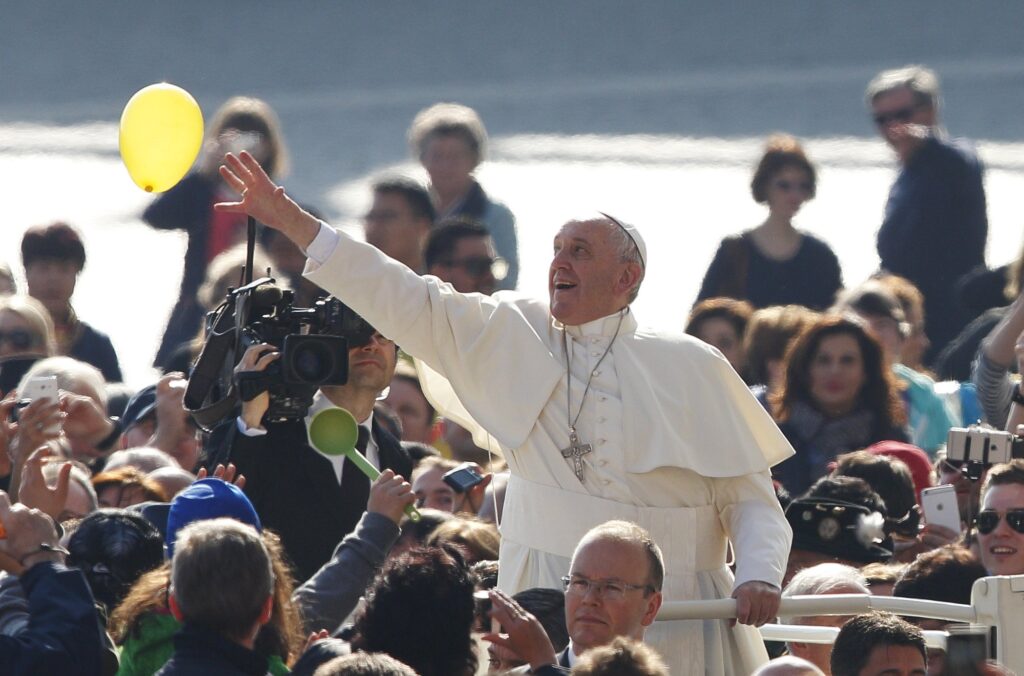
Pope funerals are more than just religious ceremonies. They create rare encounters – even between leaders of conflicting states. What potential does the funeral of Pope Francis have?
“The funeral of a pope is no ordinary event,” says historian René Schlott. It is a religious and at the same time highly political moment, staged on one of the world’s biggest stages.
Schlott has researched papal funerals and analysed their media and political significance. When asked by the Catholic News Agency (KNA), he explains: “Only since the funeral of Pius XII in 1958 have official state delegations been an integral part of the ceremonies – before that, only individual state guests appeared.” Pope funerals reached their political peak with the funeral service for John Paul II in 2005. At that time, more than 157 state delegations travelled to the funeral, according to the expert.
Pope Francis’ farewell on Saturday could also become such a world event. Even before the date was set, US President Donald Trump announced his attendance. It will be the first foreign trip of his second presidency, at a time of noticeable transatlantic tensions.
One point of contention is Trump’s stance on the war in Ukraine – fittingly, Ukrainian President Volodymyr Zelenskyi has also announced his attendance. Their last meeting in Washington ended in a scandal. Now Trump and Selensky could come closer – at least symbolically – in St Peter’s Square. Meetings outside of official protocol are also possible – and have contributed to easing diplomatic conflicts in the past, according to Schlott.
Politics in a seemingly politics-free space
According to the historian, papal funerals offer “a space seemingly free of politics and conflict”. At first glance, the religious ritual overshadows the political. And yet the political can be experienced: “Who shakes hands with whom, who speaks to whom?” Heads of state sit in alphabetical order in St Peter’s Square – which leads to surprising seating neighbourhoods. For example, Prince Charles, representing Great Britain, shook hands with the internationally ostracised President of Zimbabwe, Robert Mugabe, during the peace greeting at the 2005 service – a gesture that made headlines around the world. The meeting of Israeli, Syrian and Iranian heads of state was also only conceivable in this context at the time – and also caused a stir.
Grand gestures at the tomb of Francis?
And this year? While Francis has often been criticised for his reticence on global political issues, his funeral offers a variety of diplomatic options. Russian Culture Minister Olga Lyubimova is expected to attend as an envoy from the Kremlin. Vladimir Putin is staying away – not least due to international sanctions. The Russian president did not attend the Polish Pope’s funeral back in 2005. “The Vatican stage can also be used for demonstrative distancing,” comments Schlott on Russia’s behaviour.
Russia is not alone in this. According to the academic, China did not send anyone to Rome in 2005 either. This could now happen again. The relationship between the Vatican and China is tense – particularly because of the Holy See’s diplomatic recognition of Taiwan. “If Taiwan takes part, China will stay away,” says Schlott. He adds: “I’m curious to see whether Catholic church representatives would also refuse to attend if China participates.” After all, not everyone within the Church agrees with the late Pope’s course of rapprochement with Communist China.
Israel and Palestine
Then there is the Middle East: throughout his life, Francis sought dialogue with Muslim states, criticised the Gaza war and maintained contact with the Christian minority in Gaza. There is now irritation in Israel: after the Pope’s death, the government there initially published messages of condolence on the internet, but then deleted them again. In view of the delicate situation in the Middle East, a possible Israeli absence on Saturday would be a strong, negative signal not only for the Vatican. However, an Israeli presence could create space for diplomatic dialogue in a war-torn region.
The next few days will show what Francis’ funeral will bring. Schlott makes it clear: “Pope funerals are not classic summit meetings, but their symbolic and political weight is considerable.” The potential of such meetings should not be underestimated. They demonstrate a paradoxical power that unites in grief – and opens doors that might otherwise remain closed.
Credit: Benedikt Heider (KNA)