The unlikely appeal of the convent to young women in our day and age
In an age that tells us to always want more, these women choose less – and find more in that choice. Fewer distractions from the outside world. But more silence, more clarity, more peace, writes Renata Milán Morales
A significant number of young women have recently chosen to step away from their careers, personal relationships and digital commitments to embrace a life dedicated to God through a consecrated life or by entering a cloister.
“In the last fifteen years, a culture of discernment has developed,” said Sr Jacinta, speaking to The Plough. Sr Jacinta, who grew up in Princeton, New Jersey, dropped out of New York University in 2010 to join the Nashville Dominicans. “If you’re a young faithful Catholic today, the question of vocation and discernment comes up naturally.”
Trend
For many, the image of a cloistered nun conjures up images of the Middle Ages – ancient abbeys, Gregorian chants and a life removed from the world in deep contemplation. It’s hard to imagine such a path appealing to young women today. Some might even see it as a form of self-imposed isolation. But contrary to these perceptions, a quiet but steady movement is growing.
What is driving this unexpected trend? Why would people raised during social media and career aspirations choose a life of seclusion, silence and prayer? The reasons are many, connecting a deep spiritual longing, a sense of disillusionment with contemporary life, and the interest of renunciation in our culture.
It is not we who choose God, but God who has chosen us”
Sr Mary Mother of Merciful Love, SSVM, based in Ireland, sheds light on this vocation: “It is a response to God’s call. John Paul II says that this is what it means to be called to a life of consecrated life. It is a total decision. It comes directly from God. He also mentions a verse from the Bible, John 15:16, which says that it is not we who choose God, but God who has chosen us and appointed us to go and bear fruit. This is essential to understanding vocation, because a person’s vocation depends on when they respond to God’s call. God first loved us and called us to be his own. Vocation is therefore a response to God’s life.”
In an age of limitless choice, young women are often told they can be anything they want to be. But as psychologist Barry Schwartz argues in The Paradox of Choice, an abundance of options can lead to anxiety rather than liberation. Many Millennials and Gen Z women express feelings of being overwhelmed, unfulfilled and exhausted.
For some, this exhaustion turns into a rejection of modernity itself. The monastery and convent offer an alternative – a space where the constant noise stops, where endless scrolling and striving is replaced by silence, reflection and purpose.
Choice
At first glance, the convent might seem at odds with modern feminism. What could be less empowering than a life of obedience, celibacy and self-denial? Yet for some young women, these very commitments offer a profound sense of freedom.
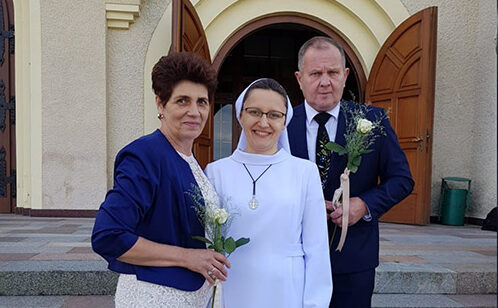
Sr Marta Hewelt, a Franciscan Missionary of Mary, shares her experience: “I am a Franciscan Missionary of Mary. It is a missionary congregation, so the first thing that attracted me was the desire to help people and to give to them. When I joined the FMMs, I fell in love with the prayer of the Word of God. It is an amazing form of prayer and encounter with Jesus. Every day before I go out on a mission, I pray with the Word of God and Jesus guides me through life. It is also a challenge to trust God completely, but just praying the Word of God helps me to do that. I am very happy, and my vocation is a great gift for me.”
Felt torn and had no peace until I decided and said ‘yes’ to God who was calling me to the celibate life”
This apparent contradiction isn’t new. In medieval Europe, convents often served as unexpected centres of female freedom, allowing women to engage in scholarship, leadership and creativity in ways that were inaccessible in secular society. Today’s young women, disillusioned with the hyper-individualism of modern feminism, are rediscovering a different form of agency.
Ironically, in a society that values personal freedom, the choice to become a cloistered nun is a radical act of rebelliousness. In a time when professional achievement and social media presence often define identity, the decision to renounce these markers is profoundly countercultural.
For many, the journey isn’t about rejecting the world out of fear or dissatisfaction, but about seeking something greater, something that transcends the temporary. Sr Marta reflects on her own journey: “I had a boyfriend who was very good to me, and we went to church together, but I felt that someone else was calling me. I felt torn and had no peace until I decided and said ‘yes’ to God who was calling me to the celibate life. Then the decision was made, and I felt at peace”.
The interest in monastic life doesn’t mean that a mass revival of monasteries is imminent. The numbers are still modest and the lifestyle demanding. But the trend points to a wider hunger – a desire for depth in a superficial world, for silence in the midst of constant noise, for meaning in an age of distraction.
Fulfilment
Sr Mary Mother of Merciful Love SSVM explains: “People often wonder how they can be so happy all the time. The secret is to be a spouse of Christ. I’m sure people are familiar with the image of Jesus as the Bride. We can live a spiritual marriage. The consecrated person testifies that what many have thought impossible becomes possible and truly liberating with the grace of the Lord. Yes, in Christ it is possible to love God with all one’s heart. To place him above every other level. This witness is more necessary than ever, precisely because it is so little understood in our world. Love is the goal of the consecrated life”.
Even for those who don’t choose the cloister, its growing interest suggests a cultural shift worth noting. Perhaps young women aren’t so much rejecting modernity as redefining what it means to be fulfilled. In a society that equates success with visibility, the convent offers an alternative vision – one in which purpose is found not in being seen, but in being silent.
They are drawn not only by the beauty of silence and prayer, but by the sense of belonging to something the world cannot offer”
For a generation tired of chasing a disappearing horizon of achievement, this vision is more attractive than ever. “I feel free, I feel happy and I feel I can be more myself. And that gives me real life,” says Sr Marta.
This sense of being truly yourself – not defined by what you own, how you look or how many followers you have – is at the heart of consecrated life. It’s about discovering your identity in a deeper relationship with God. Not as an escape from reality, but as a journey into what is most real.
St Teresa of Avila once wrote: “He who has God lacks nothing: God alone is enough”. These words, written centuries ago, are still true today for many young women who are entering a very old tradition with fresh hearts. They are drawn not only by the beauty of silence and prayer, but by the sense of belonging to something the world cannot offer – a love that asks for everything and gives everything in return.
In an age that tells us to always want more, these women choose less – and find more in that choice. Fewer distractions, fewer possessions, fewer expectations from the outside world. But in their place: more silence, more clarity, more peace.
Truth
The consecrated life is not easy. It involves sacrifice. The decision to give up romantic love, the dream of a family and many worldly ambitions is not taken lightly. And yet, for those who are called, these sacrifices are not seen as losses. They are gifts – given freely for love.
As St Clare of Assisi wrote, “What you hold, may you always hold. What you do, may you always do and never give up. But with a swift pace, with a light step, and with unshakable feet, so that even your steps do not stir up dust, go forward safely, joyfully and swiftly on the path of prudent happiness”.
Many of the young women entering religious life today didn’t grow up thinking this was their future. They dreamed of being teachers, doctors, artists, engineers. Some were in long-term relationships. Some were successful in their studies or careers. But something deeper was calling in their hearts – something they couldn’t ignore.
Often the call to religious life begins as a restlessness, a feeling that something is missing, even when everything seems ‘right’ on the outside. It can come during a time of prayer, while reading Scripture, or simply in the quiet moments of daily life. That gentle invitation: come and follow me.
And it is always personal. God speaks to each soul in a unique way.
The world doesn’t need what women have, it needs what women are. In the consecrated life this truth is fully lived”
St Edith Stein (St Teresa Benedicta of the Cross) once said: “The world doesn’t need what women have, it needs what women are”. In the consecrated life this truth is fully lived. A woman is not valuable for what she can produce or do. She is valuable because of who she is – loved by God, created for communion with him and free to live that love in radical ways.
Calling
For some, this means a hidden life in the cloister, interceding for the world through silence and prayer. For others, it means serving the poor, teaching children, or caring for the sick — all with the same heart of consecration.
Whether in a monastery or a mission field, these women are saying ‘yes’ to something greater than themselves. Not because they think the world is bad or evil, but because they believe in something better. They want to be signs of hope. Reminders that love is real. That joy is possible. That God is nearby. And in a world that is often cynical, that witness matters.
While the number of new vocations may still be small, their impact is not. Every young woman who chooses this path becomes a light – sometimes hidden, sometimes visible – pointing to the truth that we are made for more than what this world offers.