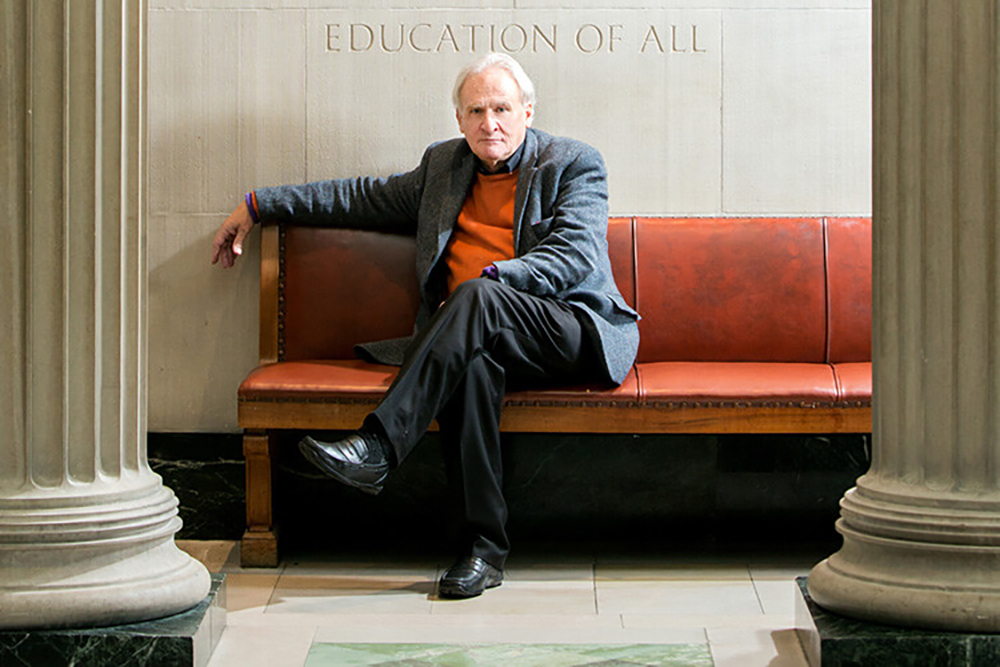
Paul Durcan at 80
edited by Niall McMonagle, with an introduction by Colm Tóibín
(Harvill Secker, £16.99 / 19.99hb)
Thomas McCarthy
Paul Durcan was born in Dublin in 1944 into a legal family with Co. Mayo connections. Educated at Gonzaga and UCC, he has become the leading poet of his generation, a former Ireland Professor of Poetry and recipient of Doctorates at both UCD and Trinity College, Dublin.
His magnificent collection, The Berlin Wall Café, was a Poetry Book Society Choice in 1985 and Daddy, Daddy won the Whitbread Award in 1990. His Crazy About Women (1991) and Greetings to Our Friends in Brazil (1999) enjoyed huge popular success, bringing him a devoted readership and huge national fame.
His distinct sensibility and style, combined with a riveting dramatic flair, created a kind of following that was rivalled only by that of Seamus Heaney. His more than twenty collections of poetry have created a body of work in Irish literature that is unparalleled and magnificent.
Recently, to celebrate the poet’s eightieth birthday, the editor and scholar Niall McMonagle created this shrewd and important selection of eighty Durcan poems.
Power
Colm Tóibín, himself a fine poet as well as a famous novelist, has written a perceptive and affectionate Introduction to this McMonagle selection: ‘Durcan’s public poems are risk-taking explorations of the intersection where tragedy and comedy meet in contemporary Ireland. He can put an antic disposition on, for example,’ writes Tóibín, ‘to explode the power of the Catholic Church in a poem such as ‘Cardinal Dies of Heart Attack in Dublin Brothel.’
In ‘The Divorce Referendum, 1986,’ on the other hand, his indignation at a sermon in a church is more unequivocal.’ But Tóibín also signposts that other equally important aspect of Durcan’s work, his humanity, a pitiful, humorous but empathetic humanity that is found in one of his earliest famous poems ‘Tullynoe: Tête-à-Tête in the Parish Priest’s Parlour’ –
‘He had: he had a sister a hairdresser in Kilmallock.’
‘He had: he had another sister a hairdresser in Ballybunion.’
‘He had: he was put in a coffin which was put in his father’s cart.’
‘He was: his lady wife sat on top of the coffin driving the donkey.’
‘She did: Ah, but he was a grand man’
‘He was: he was a grand man…’
‘Good night, Father.’
‘Good night, Mary.’
Giving us a picture of the rise and fall of the dead man with his son the doctor, the ebb and flow of fortunes”
With our post-modern sophistication it would be easy to underestimate the power of the above words, but they are powerful at many levels, telling us of the settled ease of old priest and housekeeper, of the certainties of a rural background, of class and faith.
The earlier part of the poem is the housekeeper’s litany of car brand-names, from Audi to Avenger to Volvo, giving us a picture of the rise and fall of the dead man with his son the doctor, the ebb and flow of fortunes.
Being able to write like this is Durcan’s signature gift. His style would have many imitators, but no real rivals, the poet exploring celibacy and bemoaning solitude, as Tóibín says. In Durcan the bourgeois ordinariness of Irish daily life seemed to speak fully for the first time in poetry: his effect was revolutionary.
Impact
A real signal of his permanent impact over time has been the memory of those great Durcan titles, poetry titles that are almost poems in themselves: ‘Wife Who Smashed Television Gets Jail,’ ‘Making Love outside Áras an Uachtarán,’ ‘The Drimoleague Blues,’ or ‘The Pièta’s Over.’ The latter poem is one of the most astonishing, heart-breaking texts ever written on the break-up of a marriage:
‘The Pièta’s over – and now, my dear, droll husband,
As middle age tolls its bell along the via dolorosa of life,
It is time for you to get down off my knees
And learn to walk on your own two feet….’
All of the poems in that collection, The Berlin Wall Café, have a Pasternak-like quality that lifts Durcan’s voice into a humanist sublime. And this is the level at which he continues to write across a career that spans more than sixty years of publishing.
This apt and generous selection by John McMonagle will introduce a new generation of poetry lovers to the work of an Irish poet who is both verbally unique and politically important.