Relentless Ministry
For many priests, some of the most draining moments of their ministry are encounters with Catholics who approach faith and parish as a resource to be used, Fr Chris Hayden writes.
The concept of ‘relentless ministry’ is not without limitations. It’s an entirely valid notion, of course, and if I were to suggest that ‘relentless ministry’ was a fiction, I expect that some of my colleagues might well want to take out a contract on me! There’s absolutely no denying that ministry can be, and often is, truly relentless.
That said, the notion of relentlessness may need some thought and refinement. Is it just the ‘work load’? Just the constant rushing from pillar to post? Just that there are only twenty-four hours in the day? It can be all of the above, for sure, yet it’s something more. The relentlessness of ‘relentless ministry’ is more than a function of our limited resources of time and energy. It is also – I would argue more so – a cultural, mental and spiritual relentlessness.
A while back, a priest-friend told me that he was “tired of being on a war footing.” He was experiencing something more than physical fatigue: he was experiencing battle fatigue. He was experiencing his ministry as relentless because it was routinely an uphill struggle, a swimming against the tide, a wrestling match, not with those he would have expected to be opponents, but with some of the very people he had been assigned to serve.
He was experiencing his ministry as relentless because it was routinely an uphill struggle, a swimming against the tide, a wrestling match, not with those he would have expected to be opponents, but with some of the very people he had been assigned to serve”
We needn’t be surprised at opposition – even relentless opposition – from contemporary culture. We preach what is in many respects a counter-cultural message. In and to a culture of death, we proclaim, or should be proclaiming, a culture of life. In the face of the sexual revolution, we proclaim, or should be proclaiming, the sexual counter-revolution, the life-giving wisdom of a coherent and hopeful vision of sexuality. In and against a culture of individualism, we proclaim, or should be proclaiming, a message of communion and social justice. Relentless opposition should come as no surprise. We were promised it by Christ himself: “In the world you have tribulation, but be of good cheer, I have overcome the world” (John 16:33).
Opposition, resistance and misunderstanding from the prevailing culture is relatively bearable”
I would suggest that opposition, resistance and misunderstanding from the prevailing culture is relatively bearable. The kind of opposition that is more likely to feel relentless and unbearable is opposition from within, opposition from those who adhere to a kind of disgruntled, acculturated Catholicism, opposition from those who are Catholic enough to make demands but not committed enough to have an overall sense of the Church and its mission.
Lest anyone think I’m indulging in a dismissive swipe, let me add that this is precisely the constituency we need to be reaching, in and through that grand and pressing challenge that has been named the New Evangelisation. The details of that may wait for another occasion, but here, it’s worth noting that for many priests, some of the most draining moments of their ministry are encounters with Catholics who approach faith, religion and parish not as a way of life, but as a resource to be used, dipped into as and when desired.
Guidance
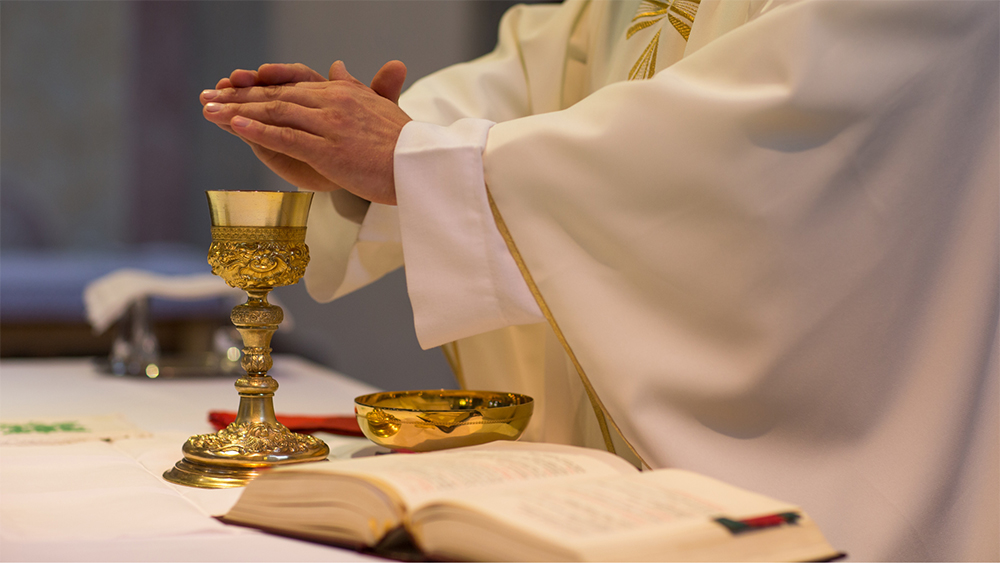
This is seen most clearly, perhaps, in those who desire sacraments but who do not have a sense of what they are asking for. The fact is that for a significant proportion of Catholics, faith, religion and sacraments are something like generic aesthetic resources, perhaps in much the same way that flowers are, or music is. When people buy flowers, they don’t expect the florist to tell them what they can and can’t do with those flowers, or where they may and may not be displayed. Or when people hire a band, they don’t want the musicians to tell them who can and can’t dance and when, or whether there should be a period of silence, or what songs – however popular – are not to be played. The Church, in contrast, has numerous rules, regulations, guidelines, edicts, positions, expectations, requirements. Such contrariness! What sort of generic aesthetic resource provision is that?
Many a priest finds himself wrestling with those whose motivation for sacraments is desperately poor and partial”
It’s important to note that in all of this, there can also be an abundance of pastoral opportunity, and in our preparation for and celebration of the sacraments, we priests need to be intentional about spotting and taking advantage of opportunities for evangelisation and catechesis. I would not for a moment suggest that those whose primary motivation appears to be aesthetic or social have no authentic desire for the things of God. That would be a gross and uncharitable over-interpretation, whereas true pastoral charity urges priests to seek and build upon openness to faith. The fact is, however, that many a priest finds himself wrestling with those whose motivation for sacraments is desperately poor and partial, and this can lead to considerable tension. Even when we’re not wrestling or wrangling, the inner tension, the sense that we are not doing justice to the sacraments, to what is holy, to faith as such, can begin to gnaw – relentlessly.
Friction
Part of what is at issue here is that people looking for Catholic ‘services’ (in the broad, secular sense of that word) don’t know the worldview, the story, the narrative that gives an overall shape to worship and practice. The result is that every requirement, every observance, every limitation (and logically, all requirements and observances entail limitations) is perceived to be random, out-of-the-blue. The Church is then perceived to be fundamentally awkward, if not downright neurotic: miserable herself, she seeks to share that misery with others, largely by ordering them around.
Faith and practice get perceived as a series of prohibitions, and the Church as a great naysayer”
‘Why shouldn’t we have Brown Eyed Girl as one of our wedding hymns, for Heaven’s sake? Just what harm would it do?’ ‘What do you mean, Lady in Red is not a hymn? It’s slow, and it’s set in a church yard!’ ‘Why can’t I remove the crucifix from the altar to make more room for flowers?’ ‘Why can’t we have three or four – or, for that matter, six or seven – godparents for our child’s baptism? I thought you guys were trying to get people involved?’ ‘The photographer can’t what? You should be grateful that he shows an interest in how the ceremony is being conducted!’ ‘What on earth is the problem with bringing up a bag of golf clubs at the offertory? He used to love golf.’ ‘We can’t scatter the ashes along her favourite river walk! Why ever not?’
And so it goes. Faith and practice get perceived as a series of prohibitions, and the Church as a great naysayer. And the priest, who, chances are, is a pretty regular, agreeable sort, finds himself having to choose between the role of dour, iron-fisted liturgical enforcer, and that of nice, unquestioning provider of generic aesthetic resources. And if, as is likely, neither of these roles suits him terribly well, then sooner or later it all starts to feel a bit, well, relentless.
For many priests, that awkward pastoral space between liturgical freefall and liturgical exactness is a difficult space to inhabit. It is difficult because liturgy is not just about ceremonies or running orders; it is about faith. Routinely finding ourselves on the back foot, having to defend, justify, explain, plead or compromise, can be subtly corrosive of morale. This insidious form of relentlessness is one we need to guard against, while avoiding any hint of self-pity, and pursuing every pastoral opportunity that presents itself.
For many priests, that awkward pastoral space between liturgical freefall and liturgical exactness is a difficult space to inhabit”
Fr Chris Hayden is a priest of the Diocese of Ferns.