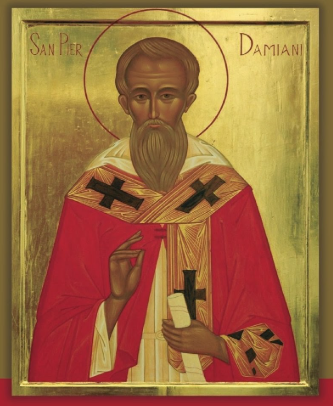
St Peter was born the youngest child into a poor but noble family in Ravenna, Italy. His early years were not easy, as both of his parents died when he was still young. He was raised by an older brother who mistreated him, forcing him to work. However, his life took a positive turn when his other brother, Fr Damian, a priest from Ravenna, took him in. This brother provided Peter with an excellent education, and Peter was so grateful that he added his brother’s name to his own, becoming Peter Damian.
Peter excelled in his studies and taught in a university setting. However, he soon found that the academic life did not suit him, forcing him to withdraw to the monastery of Fonte-Avellana for a forty-day retreat. It was during this time that he discerned a calling to the monastic life and received the habit, marking the beginning of his spiritual journey as a monk. As a monk, Peter Damian lived a secluded life, dedicating himself to prayer and extreme penance. His penances were so severe that they sometimes affected his health. Despite this, his intellectual gifts were not neglected, and he was soon called upon to teach his fellow monks. His time at the monastery also saw the creation of one of his first works, a biography of St Romuald, a recently deceased monk from his monastery who was renowned for his exceptional holiness.
In 1043, at the age of thirty-five, Peter was appointed the prior of his monastery, and he led his brothers with unwavering commitment to their rule. This was a time of significant instability within the Church, particularly due to the actions of Pope Benedict IX, whose papacy is remembered by its scandals. In 1045, Benedict IX resigned to marry his cousin, leaving the papacy vacant. Fr Damian’s godfather, Fr John Gratian, was made Pope Gregory VI. Peter Damian was excited at this change and urged the new pope to tackle the corruption. Peter was repeatedly called upon to help reform the clergy, combat simony (the selling of Church offices), address sexual abuses, challenge bishops, and reform monasteries.
In 1057, Peter Damian was made Cardinal-Bishop of Ostia, despite his resistance to the position. As a cardinal, he quickly became known for his commitment to eradicating corruption, even when it put him at odds with other Church leaders.
Peter Damian’s efforts to reform the Church were not limited to Italy. His work extended to the broader Church, especially in combating simony and clerical marriage. His writings, such as Liber gratissimus and Liber Gomorrhianus, were influential in shaping the Church’s perspective on these issues. He also played a key role in preparing the decree on papal elections in 1059, which declared that only the College of Cardinals had the right to elect the pope.
Peter Damian died in 1072 at the age of sixty-five, after battling ill health and fighting corruption within the Church for many years. His legacy lives on in his writings, his reform work, and his role in shaping the medieval papacy. In 1828, he was declared a Doctor of the Church. His life remains a powerful testament to the strength of prayer, penance, and reform, and he is remembered as a saint who helped to restore the Church’s holiness during a time of great crisis.
Do not accept anything as the truth if it lacks love. And do not accept anything as love which lacks truth
Responsibility is not a romantic word, but it is the essence of love… The greater the sense of responsibility for the other, the more real the love is”