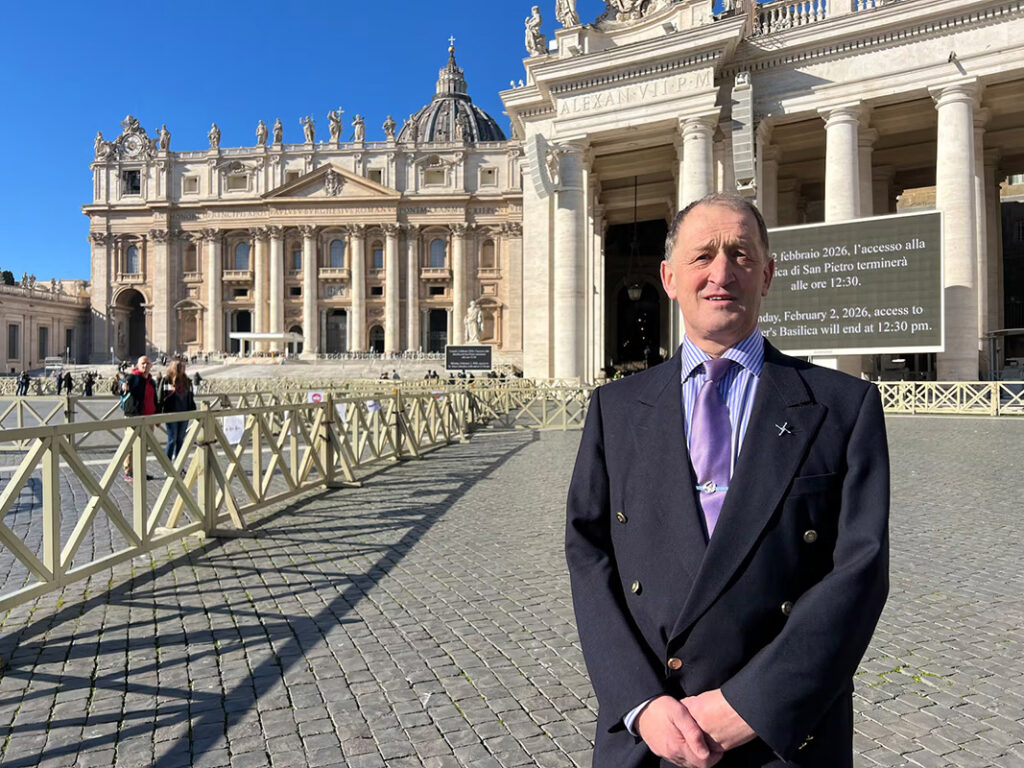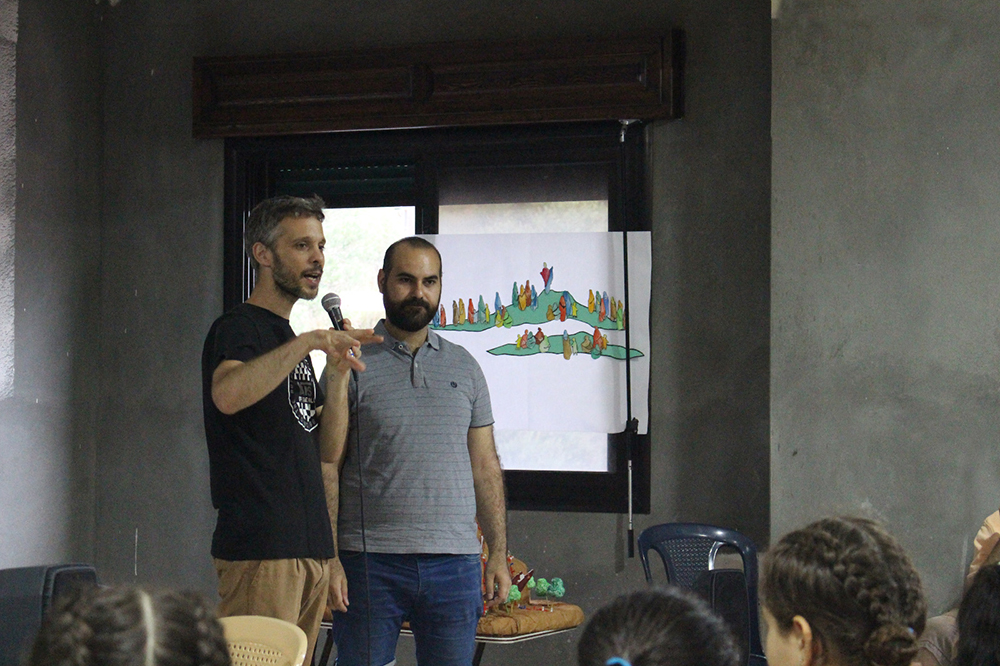
Caritas Italiana worker in Aleppo and member of the Focolare movement Davide Chiarot spoke to The Synodal Times
Syria is experiencing a momentous moment. It is normal for the whole world to wonder about its future, whether it will be truly democratic and pluralist as the new leaders claim, or whether, as in the case of Afghanistan, it will turn into a nightmare or possibly worse. The international community is wondering whether to look with distrust at the markedly Islamic matrix of the new leadership that came to power a little over a month ago, or whether instead to give credence to the statement made by Ahmed al-Sharaa, commonly known as Abu Mohammed al-Jolani to Ibrahim Faltas, vicar of the Custody of the Holy Land “I do not consider Christian Syrians a minority, but an integral and important part of the history of the Syrian people”. Whether to trust the praise of Jolani himself for the work of the Pope or the reassurances that the new government continually offers about the new social order that the country will experience.
These are more than legitimate questions. The first to ask them, however, are they, the Syrians, oppressed by an atrocious 13-year-long conflict (which hopefully will come to an end) and harassed by a dynastic regime that has lasted over 50 years. In the meantime, the streets of the cities are alive with anticipation, tranquillity and hope seem to prevail. To better understand the new situation from the inside, The Synodal Times turned to someone who, by choice and vocation, lives among the people, the Caritas Italiana worker in Aleppo and member of the Focolare movement Davide Chiarot.
It is well known that young people were forcibly conscripted and forced into action”
Davide: “The situation in the city remains quiet. The effort of the new interim government is to re-establish security as quickly as possible. This means that a series of operations have been put in place throughout Syria, especially in Homs and on the coast where raids and controls are underway that are leading to arrests of senior cadres of the old regime and the seizure of weapons caches. These are areas with a large Alawite presence, the Shiite minority group of the Assad and loyal to the power that had always had a strong majority at the top. The action this month also focused on regularising the police and army: offices were opened in all cities and all citizens in possession of weapons were invited to hand them in and register. The armed labour base of the regime theoretically has nothing to fear because it is well known that young people were forcibly conscripted and forced into action”.
Davide, are the clashes and episodes of violence over?
“Unfortunately, there are still some episodes of revenge, especially against those who were evidently part of the power during the regime. Some of the prisoners who entered prison after the regime change and are accused of having been agents of Assad or in any case close to the regime possibly are being treated in a good manner. But on the whole there is a general interest in avoiding reprisals, acts of revenge, and the aim is to collect testimonies, evidence and then hold regular trials. During this period, several mass graves and prisons where torture was practised were discovered. The white helmets and the UN are trying to preserve these sites both to provide information to the relatives of the victims and because they may contain useful material for future trials”.
What are the main problems facing the country at the moment?
“Well first of all, Israel’s presence in the south is a cause for concern. It is unclear how far it will extend and what it may hold. In this sense there is a lot of anticipation for the truce for Gaza, an event that could favour an easing of tensions. The second problem is the tensions in the north-east between Kurds and pro-Turks. Clashes between armed militias of the two blocs continue. One of the objectives that the new leadership has set itself is precisely the dissolution of all armed groups in order to bring them together in a single army. On this delicate point, an agreement seems to be on the way. And finally there is the problem of the blockade of the banking system and the daily withdrawal limit of 500,000 lira a day (about 40 dollars, ed.). But for everyone, even for us at Caritas, for the churches, the NGOs, the limit on the flow of liquidity is a serious problem, payments cannot be made and there are many difficulties in continuing activities”.
In this transitional period, is daily life resuming normally?
“Schools are regularly open, but I cannot tell you if salaries are arriving regularly. There is a provisional reorganisation of ministries, which slows everything down a bit. Then there is the aspect of water and electricity supplies, which is still a problem. They are negotiating agreements with Turkey to increase the supply. In the meantime, there is a great deal of political and geopolitical ferment, diplomatic relations are being established, there have been many reciprocal visits, especially by representatives of Arab countries, the United States and a few European countries. Everyone, leaderships and populations, are hoping for a suspension or at least reduction of sanctions”.
Everyone knew how harsh the regime was but it was hard to imagine this level of cruelty, the torture, the prisons”
Some 40 days have now passed since the new leadership took power, does hope or fear prevail among the population?
“On the one hand, hope prevails, the situation was so bad that the change was welcomed by all, or at least by many, positively. Even among Christians there is a widespread feeling that a new page has been opened. But on the other hand, there is great concern. Recently there was a meeting with the bishops and patriarchs of all the churches and there was an effort, the feeling is positive, but we still need to understand better. Christians felt somehow protected but lived with an underlying fear that somehow pushed them to justify the regime. But what is emerging now is truly frightening. Everyone knew how harsh the regime was but it was hard to imagine this level of cruelty, the torture, the prisons. In a way, on the one hand there was the feeling of having a power that somehow protects you and on the other hand you lived without the real news reaching you. Now you come to terms with reality and ask yourself: what will be the future and what will be the relationship especially with Islam, which, as is well known, Which, as is well known, is not limited to managing the private sphere of the population.”
Are there fears of retaliation and revenge?
“Basically everyone has suffered a system of oppression. Furthermore, I think people are aware of how all churches have spent themselves to help everyone. In particular, everyone recognises the inclusive, transversal value of the work of Caritas. I don’t think there is resentment towards Christians, the real culprit is the regime, the people in general have good relations and have suffered together in thirteen years of war”.
Are refugees outside the country starting to return?
‘There is an initial return from Turkey, Jordan and Lebanon, but the numbers are still very low, people are waiting to understand. The easing of sanctions to facilitate reconstruction would be very important. In the meantime, we at Caritas are implementing a very ambitious project that focuses on encounter, reconciliation and peaceful coexistence, it is called PeaceMed and involves 26 countries on both sides of the Mediterranean. It is an important sign to recreate trust in Syria and in this whole area that is so tried but also full of wonderful people”.