The traditional discourse associated with the concept of sainthood typically revolves around descriptions of heroism, daring defiance and grandiose gestures of faith. In time, this perception has begun to shift and allow for a more modest, grounded, even unassuming perception of saintly figures and their path to inclusion in the lofty litany.
Ireland’s own Frank Duff, the founder of the Legion of Mary, produced a prophetic reflection on this exact topic in 1916 at the age of 27 with a pamphlet entitled ‘Can we be Saints?’ Duff concluded, after a number of compelling arguments and analyses, that in fact sainthood was achievable for all who desired to go about committing their lives to the corporal works of mercy, whether overtly or covertly.
Duff, who died in 1980, mightn’t be a recognisable figure to those outside of the era he’s primarily associated with but thankfully, it doesn’t require a lot of research to identify a direct continuation of his thinking in the vastly different 21st century.
Unassuming
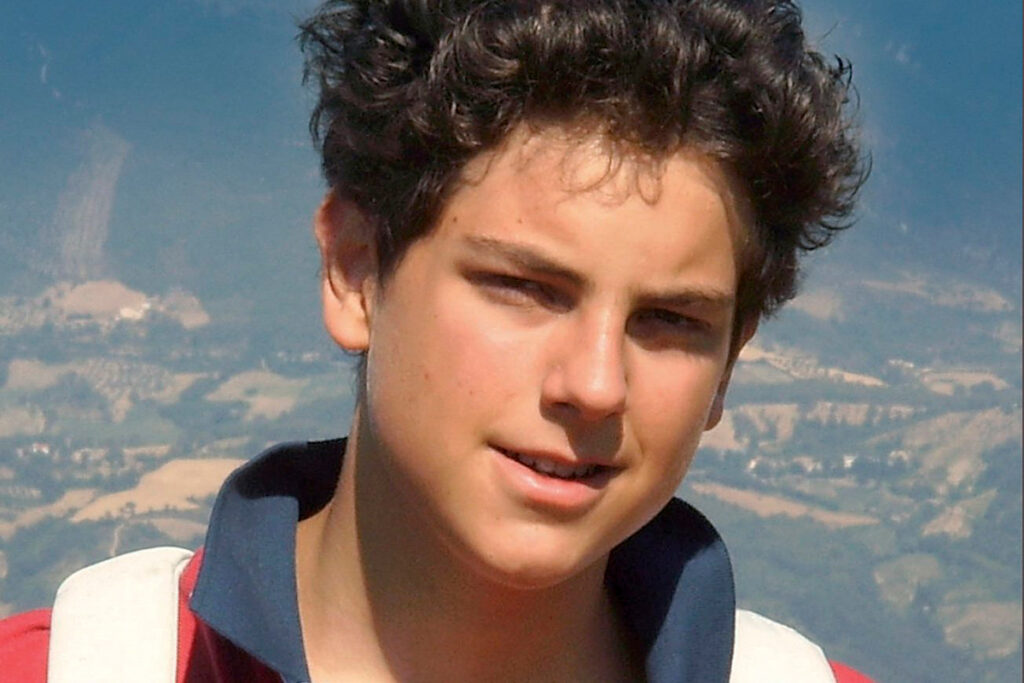
The embodiment of the word ‘unassuming’ fits the nature and profile of Blessed Carlo Acutis seamlessly. Born in 1991 to a father who worked in insurance and a mother who worked in publishing (neither religious), his adolescence was as conventional and ordinary as any other young person’s, even though the family was reasonably wealthy.
Although he was born into a secular family, Blessed Carlo was always inquisitive about faith matters and by 12 he became a catechist in his local parish. Distress entered Blessed Carlo’s life at the age of 15 when he was diagnosed with an aggressive form of leukaemia. Within 12 days of the initial symptoms, Blessed Carlo breathed his last breaths, with the teenager stoically preparing himself to meet eternal life.
His story soon began to spread far and wide and his unwavering faith in the context of pain and suffering resonated with many youth, who could relate to his ordinary image and contemporary appeal. On July 1 of this year Pope Francis approved the canonisation of Carlo Acutis, with two miracles being attributed to him.
One of the countless numbers of young people who gravitated to the story of Blessed Carlo is Mary-Aoife Ong, co-director of Carlo Acutis Youth Ireland, an organisation dedicated to promoting the legacy and message of Blessed Carlo.
Ms Ong, who wasn’t aware of the prospective saint this time last year, told The Irish Catholic that she encountered his story by sheer coincidence but upon doing so, knew that she had to be a part of something that promoted his miraculous works.
There are queues of people outside of pop and rock concerts, but there’s nobody going in to see the creator of these pop singers; of the creator of the whole universe in the Eucharist in the churches”
“Myself and my brother knew nothing about Carlo this time last year,” Ms Ong said. “We had just finished college and we went over to Assisi to visit two Capuchin brothers who we originally met playing Irish music in Ireland. They invited us to come over to Assisi to see St Francis and see the set-up. When we went over we saw Blessed Carlo laying out in the tomb – just totally ordinary with the jeans and runners. We thought, ‘oh my goodness. There’s something about this young guy that really touched our hearts.
We came back and we said that we have to try and do something to try and bring that bit of peace that we experienced in Assisi to other people in Ireland because the churches are empty, as Carlo would say ‘there are queues of people outside of pop and rock concerts, but there’s nobody going in to see the creator of these pop singers; of the creator of the whole universe in the Eucharist in the churches.’
“That’s how we got involved in Carlo Acutis Youth Ireland. We came back and the primary relic had just started making its way over to Ireland and it had one of its first visits in the North and then the next was in Dublin and we went to that visit and just got roped in.”
Ms Ong notices that engagement with the organisation has increased since the major announcement by the Pope to canonise Acutis and that young people are drawn to the qualities consistently attributed to him, such as his unfailing compassion for those considered on the margins of society.
“We’re all kind of offering our trust in Carlo’s hands,” Ms Ong said. “We can really see the increase in the interest in it this time as opposed to a couple of months ago where people didn’t really know much about Blessed Carlo but now that the canonisation has been announced, there’s definitely a lot more interest.
“He very much lived by example and always looked for people on the margins of society. The way he dressed, the way he talked, his language, it was the small, subtle things about Carlo – encouraging his friends to come outside and including the bullies, to say a kind word to the migrant and to help the homeless – the small actions.
“They all saw his joy and knew there was something different. People knew he was religious but I don’t think they ever understood the extent of his faith until after he passed away.”
Sainthood
Sainthood is, of course, an extraordinary thing and the profoundness of being deemed worthy of the Church’s highest accolade should never diminish in a world full of seemingly endless cacophony and noise. But Blessed Carlo believed that being ordinary in deeds and in appearance were not inhibitors to the gifts of a person being divinely recognised, in fact, in his mind, the biggest attribute one needs in the pursuit of sainthood is to simply desire it.
“His big thing was anyone can become a saint if you really, really desire it,” Ms Ong said. “He really just pushes the love side of God. One of my favourite sayings of his is that whatever perspective you look at life from, life is always great. It really brings you back down to earth to find God in the everyday bits and pieces of life.
“I think with Carlo, his view was on the infinite and not the finite and that’s something that just speaks value. He used to say things like ‘money is just pieces of shredded paper’. He really didn’t have any attachment to those things. He loved life but he just knew what was to come was just infinite and that God would be infinite with love and mercy – you can’t even fathom how infinite and amazing the life to come was.”
Suffering is a key theme in the considerably short but meaningful life of Blessed Carlo. In the days before his impending death, he endured tremendous pain but never faltered in serenity or faith. Ms Ong notes that the resilience of Blessed Carlo as he awaited his calling from the Lord can be used as inspiration for young Catholics to encourage them to continue to withstand and profess in a world that becomes less receptive, and in some cases hostile, to their beliefs.
“One of his main points was to always be united with Jesus and I think that also helped a lot because when he was suffering with his illness and going through those difficult times, he knew that Jesus also went through this and he was able to unite himself with Christ on the basis of his experience.
“I know myself as a young person, it’s very difficult to find other Catholics and express your faith. If you go into a church it can be very difficult as a lot of people are much older. But then you look at someone like Carlo and you can just see that he was able to look beyond all of that and you can see that all of these little things don’t really matter ….. yes they’re crosses to carry but they’re such a small cross to the crosses that other people are carrying in the world.”